

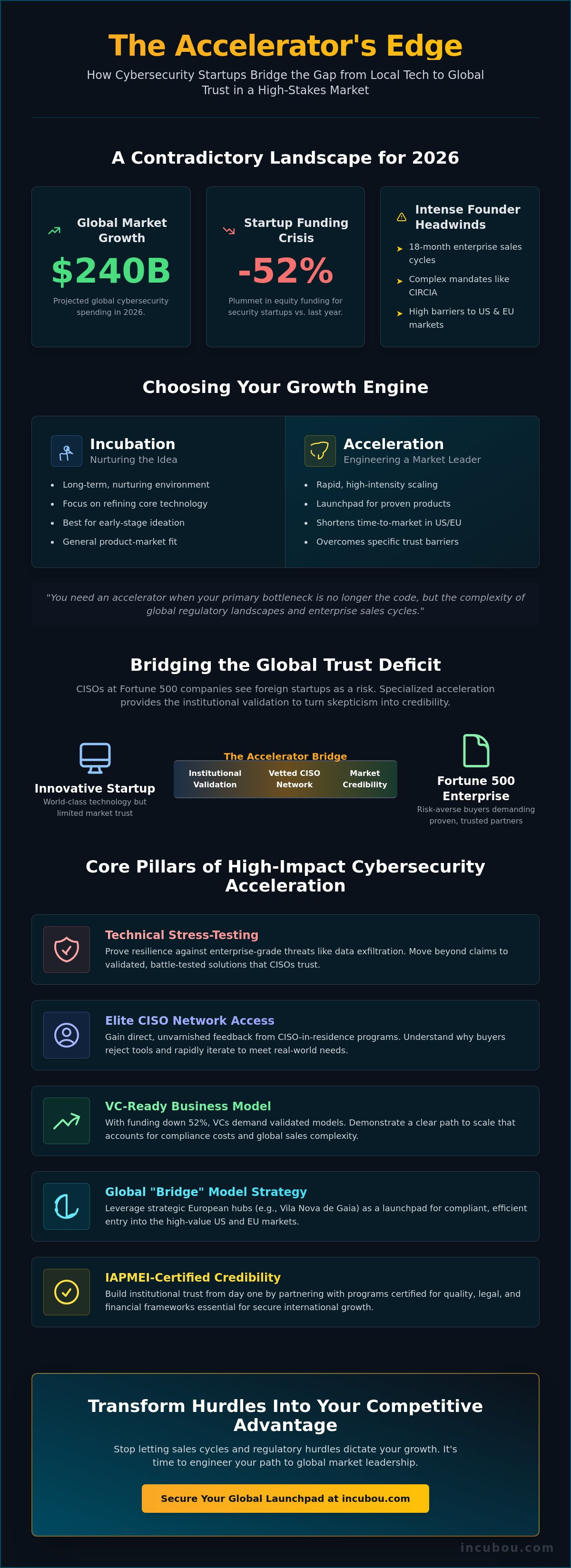
While global cybersecurity spending is projected to reach $240 billion in 2026, equity funding for security startups has plummeted by over 52% compared to last year. This creates a high-stakes environment where technical innovation is no longer enough to guarantee survival. You've likely felt the weight of eighteen-month sales cycles and the daunting complexity of new mandates like the Cyber Incident Reporting for Critical Infrastructure Act (CIRCIA). It's exhausting to build world-class tech only to see it stall at the border of a foreign market.
We understand that scaling globally requires more than just a great product; it demands an ecosystem of trust. This guide demonstrates how specialized cybersecurity acceleration services provide the strategic bridge you need to achieve international market dominance. You'll learn how to navigate the 2026 regulatory landscape, secure warm introductions to elite CISOs, and validate your business model for rapid expansion into the US and EU. We'll show you how to transform bureaucratic hurdles into your greatest competitive advantage.
Key Takeaways
- Distinguish between generic incubation and specialized cybersecurity acceleration services to overcome industry-specific trust barriers.
- Master the "Bridge" model to use strategic European hubs like Vila Nova de Gaia as a launchpad for US market entry.
- Identify high-impact scaling partners by auditing their network depth and documented relationships with Fortune 500 CISOs.
- Leverage IAPMEI-certified acceleration to build institutional credibility and attract the right venture capital for global expansion.
- Shorten enterprise sales cycles by integrating technical stress-testing and validated go-to-market strategies into your growth plan.
Defining Cybersecurity Acceleration: Beyond Generic Business Incubation
Generic business incubators often focus on general product-market fit or basic operational scaling. In the high-stakes world of digital defense, these generalist approaches fall short. Cybersecurity acceleration services are built to address the specific technical and geopolitical hurdles that security founders face when moving from a local pilot to a global enterprise contract. They don't just provide office space; they provide the specialized infrastructure required to navigate a sector defined by extreme risk and rapid obsolescence.
The Trust Deficit in Global Security Sales
Security is not just a software purchase. It's a critical risk management decision. For a CISO at a Fortune 500 company, adopting a tool from a foreign startup isn't just about features. It's about whether that vendor can withstand a sophisticated supply chain attack or if they'll still exist in three years. Specialized acceleration services provide the institutional validation necessary to bypass these skepticism-driven delays. By leveraging a network of vetted advisors and established security leaders, these programs act as a seal of approval for risk-averse buyers. Cybersecurity acceleration is a strategic mechanism for institutional trust-building that converts technical potential into market-ready credibility. This credibility is the only way to overcome the "foreign vendor" bias that often kills deals before they reach the procurement stage.
Acceleration vs. Incubation: Which Do You Need?
While incubators offer a long-term, nurturing environment for early-stage ideation, startup accelerators are designed for rapid, high-intensity scaling. You need an incubator when you're still refining your core technology. You need an accelerator when you have a proven product and are ready for a professional launchpad into the US or EU markets. The scaling trigger occurs when your primary bottleneck is no longer the code, but the complexity of global regulatory landscapes and enterprise sales cycles. In the European ecosystem, looking for IAPMEI-certified programs is vital. This certification ensures the program meets rigorous quality standards, providing the legal and financial frameworks necessary for secure international growth.
Successful acceleration in 2026 is measured by more than just valuation growth. The true metric is time-to-market. With global cybersecurity spending projected to reach $240 billion this year, being three months late to a market shift can mean losing millions in potential revenue. Specialized advisors help refine business models to align with current mandates like the Cyber Incident Reporting for Critical Infrastructure Act (CIRCIA). This ensures your solution is compliant and competitive from day one. You aren't just building a company; you're engineering a market leader.
Core Pillars of High-Impact Cybersecurity Acceleration Services
High-impact cybersecurity acceleration services move the needle by focusing on commercial resilience rather than just technical features. While technical innovation is your engine, these services provide the road and the high-octane fuel. They ensure your solution survives enterprise-grade scrutiny before you ever step into a high-stakes procurement meeting. This involves a rigorous shift from building a product to building a sustainable, global business.
One core pillar is technical validation through stress-testing. It isn't enough to claim your AI detects threats; you must prove it under simulated duress. Modern programs test your resilience against data exfiltration tactics, which have surpassed simple encryption in 2026 threat profiles. Effective programs utilize CISO-in-residence initiatives to provide direct, unvarnished feedback from the executives who actually sign the checks. They help you understand exactly why a CISO might reject your tool even if it works perfectly on paper. This feedback loop is the fastest way to bridge the gap between a technical breakthrough and a commercial win.
Investment readiness has also changed significantly. Since cybersecurity companies raised only $3.22 billion in early 2026, a 52.52% drop from the previous year, VCs demand more than just user growth. They want a validated business model that accounts for the high cost of compliance and the necessity of a cyber-ready workforce. You must demonstrate how your startup will scale without ballooning operational costs.
Refining the Cybersecurity Business Model
Transitioning from one-off deployments to scalable SaaS or MSSP-ready models is essential for 2026. You must address the "integration hurdle" by ensuring your product works seamlessly within existing SOC stacks. Pricing strategies must balance value-based outcomes with the competitive pressure of a crowded market. If your tool doesn't integrate or costs too much to manage, it won't scale.
Sales Velocity and Market Penetration
Bypass the traditional gatekeepers by leveraging established accelerator connections. A warm introduction to a Fortune 500 CISO can shave six months off your sales cycle. Focus on developing a B2B sales strategy that targets specific industry pain points, such as the $10 million average cost of a US data breach. Use channel partners and resellers to achieve rapid market scaling without the overhead of a massive internal sales team.
Navigating Global Expansion: The 'Bridge' Model for International Growth
Scaling a cybersecurity firm across borders is a geopolitical maneuver as much as a commercial one. While the global market is expanding, the United States remains the primary target for any serious security innovator. It commands the largest share of the projected $240 billion global spend in 2026 and sets the technical standard for the rest of the world. However, jumping directly into the US market without a strategic foothold often leads to burned capital and stalled sales cycles. Successful founders use a "Bridge" model to mitigate these risks.
This model utilizes specialized cybersecurity acceleration services to create a dual-market strategy. By establishing a base in a strategic European hub, you can refine your product within the EU's rigorous regulatory framework before launching into the American sector. This approach ensures your technology is battle-tested against GDPR requirements while you simultaneously prepare for NIST and FedRAMP standards. It's about engineering trust across different legal and cultural frameworks before you ever hire your first US-based sales lead.
Cultural adaptation is the final, often overlooked, piece of the expansion puzzle. A pitch that resonates in a local European market won't necessarily land with a CISO in New York or D.C. Global buyers have different risk tolerances and procurement priorities. You must adapt your messaging to address specific regional pains, such as the 72-hour reporting requirements now mandated by the Cyber Incident Reporting for Critical Infrastructure Act (CIRCIA) in the US. Our cybersecurity acceleration services help you translate technical features into the high-stakes language of global risk management.
Vila Nova de Gaia: The Emerging Cyber Innovation Hub
Portugal is rapidly becoming the preferred base for cybersecurity internationalization. Vila Nova de Gaia offers a unique mix of high-tier technical talent and a globally-connected startup ecosystem. It serves as a strategic launchpad that allows you to maintain a presence in the European market while keeping a focused gaze toward the Americas. This localized hub provides the legal, financial, and community support necessary to navigate the complexities of international growth without the overhead of traditional tech capitals.
The US Market Entry Roadmap
Moving into the US security sector requires a methodical roadmap. Start by building a US-based advisory board to gain local nuance and credibility. You must establish a legal and commercial presence that satisfies US federal regulations without severing your European roots. This roadmap includes aligning your incident response plans with January 2026 federal mandates, ensuring your business model is ready for the scrutiny of American venture capital. We provide the structured guidance needed to turn this daunting transition into a predictable growth trajectory.
Evaluating an Accelerator: How to Choose the Right Scaling Partner
Choosing a scaling partner is one of the most critical decisions you'll make as a founder. A generic accelerator might offer decent networking, but high-impact cybersecurity acceleration services must offer something much deeper: industry-specific validation. You need to look beyond the surface level of "mentorship" and evaluate the actual commercial results of previous cohorts. Analyze the funding history and exit strategies of alumni to see if the program truly moves the needle in a cautious venture capital climate. If the previous cohort hasn't secured Series A funding or significant enterprise contracts, the program might not have the reach you require.
Network depth is your primary filter. Does the accelerator have documented, active relationships with Fortune 500 CISOs? In a market where trust is the primary currency, a warm introduction from a respected peer is worth more than a thousand cold emails. You also need to consider institutional endorsements. In the European context, IAPMEI certification isn't just a badge; it's a signal to investors and government partners that your startup has undergone rigorous vetting. This certification provides the layer of credibility needed when you're pitching to risk-averse global buyers.
Specialization matters because generalist programs often lack the technical nuance required for security firms. They won't understand the complexities of your SOC integration or the specific regulatory hurdles of FedRAMP. A generalist can actually slow you down by offering advice that doesn't apply to the high-stakes world of enterprise security. They might focus on user acquisition metrics while you need to focus on technical stress-testing and supply chain resilience. Don't let a generic approach dilute your strategic focus.
Questions to Ask Before Joining a Program
Protecting your intellectual property is paramount. Ask specifically how the program handles IP protection during the acceleration phase. You should also demand specifics on US market entry support. Don't settle for vague promises of "global reach"; ask if they can provide warm introductions to your top five target enterprise accounts. If they can't name the stakeholders or describe the procurement processes at those firms, they don't have the network you need to scale effectively.
The Role of Mentorship and Industry Connections
Distinguish between general business mentors and security industry veterans. You need advisors who have sat in the CISO's chair and understand the daily pressures of threat management. Use the accelerator's advisory board to gain a strategic advantage in your go-to-market plan. Building a sustainable network that outlasts the program's duration is the ultimate goal. This ensures you have a steady hand to guide you as your company evolves from a startup into a global leader. Apply for our IAPMEI-certified acceleration program to gain the specialized support your security firm deserves.
The Incubou Advantage: IAPMEI-Certified Acceleration for Security Innovators
Incubou transforms the traditional acceleration model by integrating institutional certification with aggressive global market penetration. Our cybersecurity acceleration services are specifically designed to eliminate the friction points that stall high-potential startups. We move beyond the "one-size-fits-all" approach. Every founder receives a roadmap tailored to their specific technical niche and target geography. This bespoke strategy ensures your innovation doesn't just exist; it dominates.
Our IAPMEI certification serves as a powerful signal to both investors and enterprise buyers. It confirms that your business has been vetted by Portugal’s Agency for Competitiveness and Innovation. This institutional endorsement provides a level of security that generic programs cannot match. It validates your operations and financial structures, making you a more attractive prospect for Series A funding in a competitive capital environment. We provide the steady hand and strategic vision necessary to navigate these high-stakes requirements.
We have chosen Vila Nova de Gaia as our base because it represents the future of European cyber innovation. By positioning your firm here, you join a world-class ecosystem that balances technical depth with strategic access to global markets. We are committed to maintaining this hub as a premier destination for security leaders. You aren't just joining a program; you're entering a prestigious community of innovators who are redefining the boundaries of digital defense.
Strategic Support for Global Expansion
We facilitate the leap from European validation to US market dominance through a structured, multi-phase approach. Our network connects you with global security leaders who have managed some of the world's most complex digital infrastructures. We don't just teach you how to pitch; we help you refine your business model to ensure it is resilient enough for rapid growth. Founders who leverage our bridge model reach their scaling milestones significantly faster than those navigating the journey alone. We provide the introductions that matter, turning cold leads into warm partnerships.
Join the Next Cohort: Your Scaling Journey Starts Here
The application process is selective, focusing on firms with high technical potential and a clear vision for global expansion. During the first 90 days of an Incubou program, you'll undergo intensive technical stress-testing and GTM refinement. We work alongside you to identify and remove the traditional barriers to entry in the US and EU. We prioritize action and tangible results, ensuring every day in our program adds measurable value to your firm. Your scaling journey starts with a single, decisive step toward institutional excellence. Apply for cybersecurity acceleration at Incubou today and secure your place in the global security ecosystem.
Secure Your Place in the Global Security Frontier
The 2026 landscape demands more than just code; it requires a strategic alliance that understands the nuances of global risk. You've explored how specialized validation and a clear roadmap for US market entry can turn bureaucratic hurdles into a massive competitive edge. By integrating technical stress-testing with direct CISO feedback, you ensure your solution is enterprise-ready from day one.
Utilizing high-impact cybersecurity acceleration services is the most efficient way to bridge the gap between innovation and international dominance. Incubou offers the IAPMEI-certified credibility and the deep industry connections you need to scale with confidence. We provide a specialized bridge to the US market, ensuring your growth is both rapid and secure.
Scale your cybersecurity startup with Incubou's global acceleration services.
Your innovation has the power to redefine digital defense on a global scale. We're here to ensure the world is ready for it.
Frequently Asked Questions
What are cybersecurity acceleration services exactly?
Cybersecurity acceleration services are specialized strategic programs designed to help security startups scale by providing technical validation, CISO networks, and go-to-market frameworks. These services bridge the gap between technical innovation and commercial dominance by engineering trust with enterprise buyers. They provide the institutional backing necessary to shorten long sales cycles and navigate complex international regulations that generic business programs often overlook.
How do acceleration services differ from standard business consulting?
Acceleration differs from consulting through its immersive, cohort-based structure and its focus on rapid growth velocity. While consulting usually provides advice on specific isolated problems, acceleration provides an active launchpad that includes technical stress-testing and direct introductions to global investors. It's a structured journey toward market entry rather than a series of standalone advisory sessions, ensuring your startup is battle-ready for the 2026 threat landscape.
Is my startup too early for a cybersecurity accelerator?
Your startup is ready for an accelerator once you have a functional product and are prepared to scale beyond local pilots. While some programs accept early-stage teams, the most effective time to join is when you need to navigate the high barriers to trust in foreign markets. If your goal is to transition from a prototype to an enterprise-grade solution that can withstand the scrutiny of a Fortune 500 procurement team, the timing is ideal.
How much equity do cybersecurity accelerators typically take in 2026?
The equity landscape in 2026 is diverse, with programs offering everything from equity-free models to stakes of approximately 6%. For example, some European programs take a small percentage in exchange for seed funding, while other non-profit incubators take no equity at all. Given that cybersecurity equity funding has seen a 52.52% decrease in early 2026, choosing a program that preserves your long-term valuation while providing high-tier market access is a critical strategic decision.
Does an accelerator help with US market entry for European startups?
Yes, specialized programs act as a strategic bridge for European firms looking to achieve US market dominance. They help you align with US federal regulations, such as the 72-hour reporting mandates under the Cyber Incident Reporting for Critical Infrastructure Act (CIRCIA), and provide warm introductions to American CISOs. This support is vital for overcoming the skepticism that often stalls international expansion and ensures your business model is validated for the American sector.
What is the importance of IAPMEI certification for an accelerator?
IAPMEI certification is a mark of institutional credibility that signals your startup has undergone rigorous vetting by Portugal’s Agency for Competitiveness and Innovation. This endorsement is highly valued by European investors and government partners who require transparency and stability. It transforms your startup from a private entity into a certified innovator, providing the layer of security required for high-level funding and international partnerships.
Can an accelerator help my cybersecurity startup secure Series A funding?
Accelerators significantly improve your chances of securing Series A funding by validating your business model and technical resilience before you pitch to VCs. In 2026, investors are shifting focus toward AI-native security operations and autonomous defense. A specialized program ensures your value proposition aligns with these specific trends, making you a more attractive prospect in a cautious venture capital market where proof of traction is mandatory.
How long does a typical cybersecurity acceleration program last?
Typical intensive programs last between 8 and 12 weeks, depending on the depth of the curriculum. Some 2026 cohorts focus on a rapid 8-week sprint for immediate market readiness, while others provide a more comprehensive 12-week journey that includes deep regulatory alignment. These timelines are designed to respect your time while delivering the dense, high-impact support needed for rapid global expansion without the fluff of traditional business schools.


