

What if the greatest threat to your firm's valuation isn't a zero-day exploit, but the high cost of staying local? For many founders, international expansion for cybersecurity feels like a high-stakes gamble against fragmented regulations and the staggering burn rate of US market entry. You recognize that global demand is surging; however, the complexity of building technical trust in new territories often stalls even the most innovative tech. It's a common frustration to see your growth capped by borders while competitors secure international footholds.
This article provides the 2026 strategic blueprint to master these complexities and scale your firm with a proven framework. You'll gain a clear roadmap for market penetration and identify the specific high-growth regions ready for your solution. We'll examine how to align your vision with a global accelerator to remove traditional barriers and turn regulatory hurdles into a strategic advantage. By the end of this guide, you'll have the clarity needed to transform your local success into a dominant global presence.
Key Takeaways
- Identify high-growth opportunities within geopolitical fragmentation to move beyond the scale-or-stagnate barrier of 2026.
- Transform compliance mandates like GDPR and NIS2 into strategic tools that build immediate technical trust with global buyers.
- Navigate the capital requirements of international expansion for cybersecurity by comparing US market entry costs with European scaling efficiencies.
- Validate your technical solution against localized threats using a structured readiness checklist to ensure product-market fit before deployment.
- Accelerate your global trajectory by utilizing a strategic bridge hub that connects European innovation with high-stakes international markets.
The Strategic Imperative: Why Global Expansion is Essential for Cyber Vendors
The cybersecurity sector has reached a critical inflection point. Staying within your domestic borders is no longer a safe play; it's a recipe for gradual obsolescence. As local markets become saturated with legacy vendors and niche startups, the "scale-or-stagnate" reality of 2026 demands a broader vision. International expansion for cybersecurity is no longer a mere growth tactic, it's a fundamental requirement for technical survival and market relevance. By diversifying your revenue streams across multiple jurisdictions, you insulate your firm from regional economic downturns and shift from a local provider to a global contender.
Expanding your footprint also serves as a rigorous form of technical validation. Threat actors don't respect borders, and neither should your defense logic. Deploying your solution in diverse environments exposes your product to a wider array of attack vectors and adversarial tactics. This global feedback loop strengthens your core technology, making it more resilient and attractive to sophisticated buyers who demand battle-tested protection.
Beyond Home Markets: The Drive for Global Scale
Growth in this sector relies heavily on the volume and variety of data your systems process. Unlike general SaaS, cybersecurity products improve exponentially with a larger user base. More telemetry means better detection and faster response times. Establishing a global presence also builds the high-level technical trust required to close enterprise deals. Venture capital firms prioritize this reach when calculating valuations. A firm with a proven footprint in international expansion for cybersecurity commands a significant premium during funding rounds or exit negotiations because it demonstrates a repeatable, scalable business model.
Geopolitical Fragmentation as a Market Catalyst
Current geopolitical shifts are redefining how nations approach digital defense. The rise of "sovereign tech" requirements means many regions are actively seeking alternatives to dominant, often politically sensitive, foreign vendors. This fragmentation creates massive gaps for specialized technology providers. You can leverage these localized needs by positioning your firm as a region-specific resilient partner.
Being a European-based vendor offers a distinct competitive advantage in this environment. It provides a "neutral" strategic ground that appeals to markets wary of over-reliance on a single superpower's tech stack. This positioning allows you to bridge the gap between innovation and secure, localized implementation, turning bureaucratic hurdles into a unique selling proposition that competitors often overlook.
Navigating the Complex Regulatory Landscape: Compliance as a Strategy
Many founders view compliance as a defensive necessity or a bureaucratic barrier to entry. They're mistaken. In 2026, regulatory alignment is the fastest way to build technical trust in a new market. When you prioritize international expansion for cybersecurity, your compliance posture becomes your most persuasive sales asset. Meeting the rigors of NIS2 or GDPR doesn't just keep you legal in Europe; it signals to a US CISO or an Asian IT Director that your data handling meets the world's most stringent standards. This "compliance-as-a-service" mindset transforms a legal hurdle into a primary competitive differentiator.
GDPR, CCPA, and the Global Privacy Patchwork
The global privacy landscape remains fragmented, yet a clear hierarchy of standards has emerged. While the EU's GDPR focuses on fundamental human rights, the US CCPA leans heavily toward consumer protection and transparency. Emerging Asian markets, such as Singapore and South Korea, often blend these approaches with strict national security mandates. Success requires mastering regulatory arbitrage: the strategic selection of jurisdictions where your existing compliance framework offers the highest competitive advantage with the lowest adaptation cost. By building a compliance-first business model, you create a modular architecture that adapts to any territory without requiring a complete code rewrite.
Managing Sovereign Data and Localization Requirements
Data residency is the new frontier of global growth. It's no longer sufficient to maintain a secure cloud; that cloud must often be physically located within the buyer's borders to satisfy local laws. The 2026 Data Act has further tightened rules on how international security software moves information across jurisdictions. If you're targeting government contracts or critical infrastructure, localized technical support isn't just a preference. It's a mandatory requirement for sovereign resilience. You must ensure your international expansion for cybersecurity strategy includes localized infrastructure and support teams that understand regional nuances. Understanding these complex requirements is a core part of cybersecurity acceleration, helping you bypass the expensive trial-and-error phase of market entry.
US Market Entry vs. European Scaling: A Comparative Analysis
Choosing between the United States and the European Union for your next growth phase defines your firm's capital requirements and operational DNA. While the US offers a massive, unified market, the cost of entry is significantly higher than cross-border scaling within Europe. International expansion for cybersecurity requires a nuanced understanding of these distinct ecosystems. US market entry often demands a heavy investment in localized sales teams and high-velocity marketing. European scaling leverages the Digital Single Market to achieve steady, regulatory-aligned growth with lower initial burn rates.
Buyer psychology differs sharply across the Atlantic. US CISOs prioritize speed, scalability, and technical pedigree. They expect rapid deployments and aggressive technical proof-of-concepts. Conversely, European IT Directors value the "European Privacy" advantage. They prioritize data sovereignty and long-term resilience over sheer speed. Strategic hubs like Vila Nova de Gaia in Portugal act as vital launchpads for these transitions. These hubs provide the technical infrastructure and strategic proximity needed to pivot between these two demanding markets without overextending your resources.
The US Cybersecurity Market: High Risk, High Reward
Entering the US market is a trial by fire. You'll encounter an aggressive sales culture where technical validation must happen in days, not months. Establishing local credibility often hinges on your connections to US-based venture capital; these relationships serve as a proxy for trust in a crowded field. To master this environment, consult our comprehensive global expansion for cybersecurity firms guide for deeper insights into US-specific procurement and positioning. Success here can lead to massive valuations, but it requires a "fail fast" mindset and significant capital reserves.
Cross-Border Scaling within the EU Ecosystem
Scaling within the EU allows you to capitalize on the Digital Single Market's harmonized standards. This path is often more capital-efficient for firms that already possess a strong compliance foundation. Utilizing an IAPMEI-certified accelerator provides access to essential EU-wide grants and mentorship tailored to the region's bureaucratic landscape. This structured approach to international expansion for cybersecurity ensures that your firm is hardened by some of the world's most rigorous security and privacy standards. By the time you reach the global stage, your technical and legal frameworks will be robust enough to withstand any scrutiny.
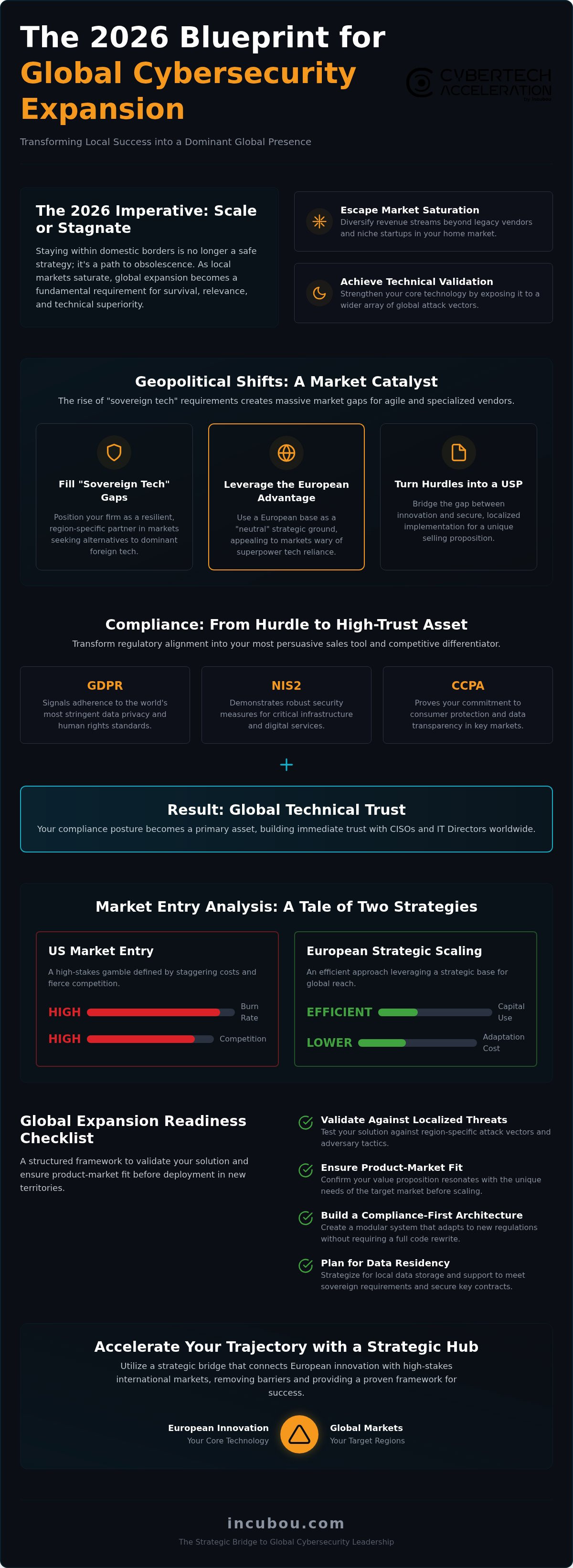
The Cybersecurity Expansion Checklist: Readiness and Penetration
Moving from strategic theory to operational execution requires a pivot in mindset. Before committing capital to a new territory, you must conduct a granular assessment of your firm's internal and external readiness. A successful international expansion for cybersecurity depends on more than just a superior product; it requires a solution that addresses specific, localized pain points. It isn't enough to scale; you must scale with precision. This involves auditing your technical stack, your distribution model, and your ability to support a global customer base without compromising service quality.
To ensure your firm is prepared for the 2026 landscape, use this four-point readiness framework:
- Technical Validation: Audit your detection logic to ensure it addresses the specific adversarial patterns and ransomware variants prevalent in your target region.
- Operational Localization: Confirm that your UI, technical documentation, and support workflows are fully adapted for non-English environments.
- Distribution Strategy: Decide between capital-intensive direct sales or leveraging the established trust of Managed Security Service Provider (MSSP) partnerships.
- Talent Acquisition: Assess the need for local technical talent and "boots on the ground" to meet the strict requirements of local government contracts.
Validating Product-Market Fit for International Buyers
Achieving fit in a new market requires more than simple translation. You must adapt your entire threat model to regional specificities. If your target market faces unique state-sponsored threats or localized cyber-espionage trends, your product's value proposition must reflect that reality. Localization also extends to your technical documentation; users in non-English markets expect a seamless experience in their native language. For a deeper dive into these validation strategies, explore our guide on cybersecurity product market fit to ensure your solution is truly ready for the global stage.
Building Localized Trust and Distribution Channels
Trust is the most difficult currency to earn in a new territory. To accelerate this process, leverage channel partners and local resellers who already possess established reputations and deep-rooted client relationships. Joining regional security alliances and industry bodies further signals your commitment to the local ecosystem and provides a platform for technical validation. You can also use "social proof" strategically. While a case study from your home market is valuable, a single testimonial from a recognized regional leader carries significantly more weight with local CISOs. If you're ready to refine your model for these diverse markets, our program for cybersecurity acceleration provides the strategic mentorship needed to navigate these entry points with confidence.
Accelerating Your Global Journey with Incubou
Execution is where strategy meets reality. While the 2026 blueprint provides the roadmap, Incubou serves as the steady hand for founders navigating international expansion for cybersecurity. We operate from the Vila Nova de Gaia tech hub, a location specifically chosen to function as a strategic bridge between European innovation and high-growth international markets. Our cybersecurity acceleration services provide the structured framework needed to bypass bureaucratic friction and accelerate your time-to-revenue. We don't just offer advice; we provide the institutional support required to scale with professional confidence.
Strategic Mentorship for Global Market Entry
Technical excellence alone doesn't secure a Series B or a major US contract. Our network of industry experts focuses on refining your business model to meet the specific expectations of international venture capital. We provide hands-on support for US market entry and cross-border regulatory compliance, ensuring your firm is hardened against the complexities of fragmented global standards. By joining the Portugal cybersecurity startup hub, you enter a collaborative ecosystem where peer-to-peer validation and elite mentorship drive rapid, purposeful development. We help you translate your technical roadmap into a compelling global growth story.
Leveraging a Certified Growth Ecosystem
Credibility is your most valuable currency when entering new territories. As an IAPMEI-certified accelerator, Incubou offers an institutional level of validation that opens doors to exclusive funding and global partnerships. This certification signals to international buyers and investors that your firm has been vetted by a recognized authority. We provide the technical resources required for product stress-testing and validation, ensuring your solution is battle-ready for the specific threats of your target markets. This comprehensive support system removes traditional barriers to international expansion for cybersecurity, allowing you to focus on innovation and market capture. Scale your cybersecurity firm globally with Incubou and transform your strategic vision into a dominant international presence.
Secure Your Global Footprint: The Path Forward
The 2026 cybersecurity landscape offers massive opportunities for founders ready to move beyond regional constraints. Success in this high-stakes sector requires more than a robust product; it demands a strategic alignment with global regulatory standards and a clear understanding of diverse buyer psychology. By treating compliance as a competitive tool and utilizing a structured readiness framework, you transform bureaucratic hurdles into an engine for growth. This is the moment to move from a local innovator to a global leader.
Navigating the complexities of international expansion for cybersecurity is a journey best undertaken with a sophisticated partner. As an IAPMEI-certified cybersecurity accelerator, Incubou provides the strategic gateway needed to bridge the gap between European innovation and the US market. Our expert-led mentorship focuses on refining your business model to meet the rigorous demands of global venture capital. Apply to Incubou and launch your global expansion strategy today to secure your place in the wider tech ecosystem. You've built the technology; now let's build the global presence it deserves.
Frequently Asked Questions
What are the biggest challenges in international expansion for cybersecurity startups?
Fragmented global regulations and the high cost of market entry represent the most significant hurdles for emerging firms. Founders often struggle to navigate the conflicting requirements of GDPR, CCPA, and NIS2 while simultaneously trying to build technical trust in unfamiliar territories. Overcoming these barriers requires a sophisticated approach to compliance and a clear strategy for establishing technical credibility without exhausting capital reserves too early in the growth cycle.
How does US market entry differ from expanding within Europe for cyber firms?
The US market demands higher capital intensity and an aggressive, high-velocity sales culture focused on rapid technical proof-of-concepts. In contrast, expanding within Europe allows firms to leverage the Digital Single Market's harmonized standards for more capital-efficient scaling. While the US offers a massive unified customer base, European expansion often provides a more structured regulatory environment that prepares a firm for the rigorous demands of the global stage.
What regulatory compliance is most important for global cybersecurity scaling in 2026?
Mastering NIS2 and GDPR remains foundational for any firm prioritizing international expansion for cybersecurity within the European ecosystem. For those targeting North America, alignment with CCPA and evolving federal data residency standards is essential. Viewing these regulations as strategic sales enablers rather than mere bureaucratic hurdles allows you to build immediate trust with risk-averse CISOs who prioritize data sovereignty and long-term resilience.
Why should a cybersecurity startup join an accelerator like Incubou for international growth?
Joining a specialized accelerator provides the strategic mentorship and institutional credibility needed to bypass traditional market entry barriers. We help you refine your business model for international venture capital and provide a steady hand for navigating complex cross-border regulations. Our ecosystem functions as a global bridge, connecting European innovation with high-stakes markets like the US through a structured and supportive framework.
Is product-market fit the same across different global regions for security tech?
Product-market fit varies significantly because threat landscapes and adversarial patterns are rarely uniform across borders. A solution that stops ransomware in one region may need technical adjustments to counter localized state-sponsored threats or specific cyber-espionage trends in another. Achieving true fit requires adapting your technical documentation and UI while ensuring your core detection logic solves the most pressing "local" threats faced by regional buyers.
How much funding is typically required for a cybersecurity firm to enter the US market?
Entering the US market requires significant capital reserves to support localized sales teams and the rapid technical cycles expected by American buyers. It's often the most expensive territory to penetrate due to high marketing costs and the need for a physical presence to establish technical trust. Founders must ensure they have a robust runway or strategic backing to sustain operations during the initial, capital-intensive phase of market penetration.
What role does data residency play in international cybersecurity sales?
Data residency has become a mandatory requirement for securing government contracts and enterprise deals in highly regulated jurisdictions. Many buyers now insist that security data remains physically stored and processed within their national borders to satisfy sovereign resilience laws. Successful international expansion for cybersecurity depends on your ability to deploy localized cloud infrastructure and provide technical support that respects these strict geographic boundaries.
How can an IAPMEI-certified accelerator help with global expansion?
An IAPMEI-certified accelerator provides a recognized seal of institutional credibility that attracts international investors and high-tier partners. This certification ensures you're operating within a vetted ecosystem that offers access to essential EU-wide grants and specialized business model refinement. It acts as a powerful validator for your firm, signaling to global markets that your technology and operational frameworks have met rigorous professional standards.


