

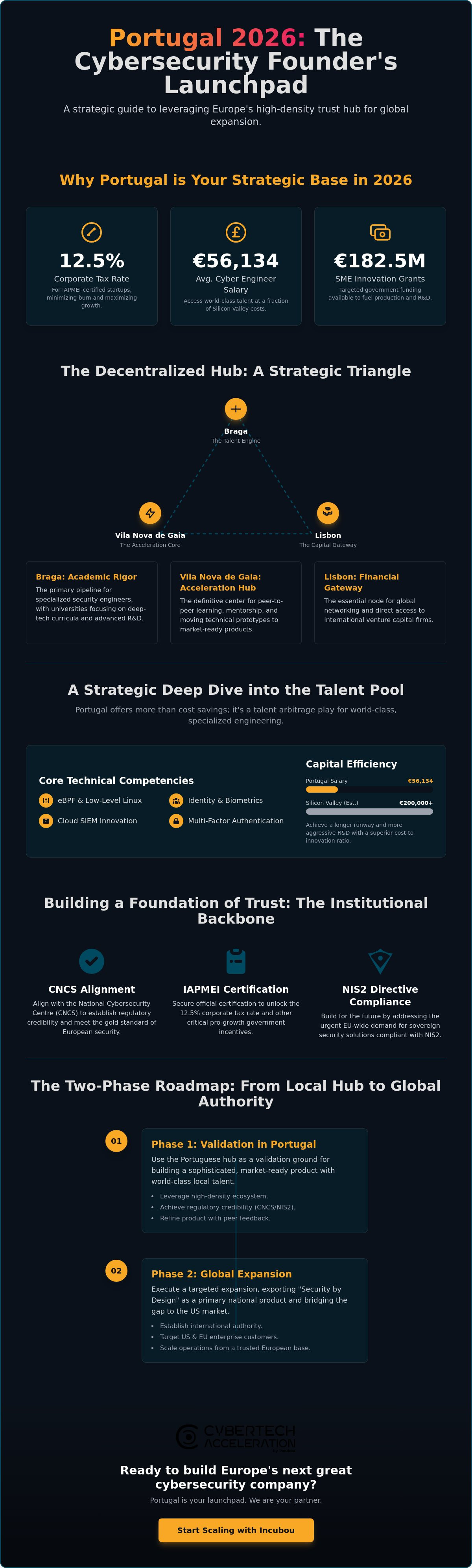
In 2026, the most strategic move for a security founder isn't to look toward Silicon Valley, but to look toward the Atlantic coast of Europe. Scaling a cybersecurity startup in Portugal has evolved from a simple cost-saving play into a high-density trust strategy that leverages the country's 12.5% corporate tax rate for certified startups. You've likely recognized the depth of the local engineering pool, yet the pressure of navigating the NIS2 transposition under Decree-Law No. 125/2025 and the challenge of bridging the gap to the US market remains a significant hurdle.
We understand that building a resilient security brand requires more than just code; it requires a strategic base that validates your innovation on a global stage. This guide explores why Portugal is now Europe's premier launchpad for cyber excellence, offering a roadmap to source engineers with average salaries around €56,134 while maintaining a sophisticated global vision. You'll discover how to navigate the CNCS regulatory landscape and leverage key ecosystem players to move from a local hub to international authority.
Key Takeaways
- Map the decentralized 2026 hub across Vila Nova de Gaia, Lisbon, and Braga to choose the optimal strategic base for your firm's specific technical requirements.
- Navigate the complexities of scaling a cybersecurity startup in Portugal by tapping into specialized academic pipelines focused on eBPF, low-level Linux, and Cloud SIEM innovation.
- Establish regulatory credibility through CNCS alignment and IAPMEI certification to ensure your startup meets the gold standard of European security trust.
- Leverage the high density of the Vila Nova de Gaia ecosystem to accelerate peer-to-peer learning and foster essential industry connections.
- Execute a two-phase roadmap that uses the Portuguese hub as a validation ground for building a sophisticated, US-ready product with local talent.
The Evolution of the Portugal Cybersecurity Startup Hub in 2026
The Portuguese tech landscape has undergone a radical transformation. By 2026, the nation moved beyond its reputation as a scenic destination for digital nomads to become a specialized powerhouse for high-stakes security innovation. Scaling a cybersecurity startup in Portugal now involves navigating a decentralized but highly integrated network. This hub isn't confined to a single city. It's a strategic triangle connecting the industrial grit of Vila Nova de Gaia, the academic rigor of Braga, and the financial pulse of Lisbon. This geographic diversity ensures that startups can access different types of support depending on their current stage of development.
Founders increasingly prioritize what we call the Trust Economy. In an era defined by the NIS2 Directive and the strict oversight of the National Cybersecurity Centre (CNCS), Portugal offers a regulatory environment that balances rigorous compliance with pro-growth incentives. The shift is palpable. The ecosystem transitioned from general IT outsourcing to the creation of specialized security products. This evolution is supported by the broader progress of Science and technology in Portugal, which laid the groundwork for deep-tech ventures and advanced R&D. National strategy now explicitly treats cybersecurity as a pillar of economic resilience, attracting significant venture interest from across the Atlantic.
Geographic Clusters: From Lisbon to Vila Nova de Gaia
Each node in the 2026 hub serves a distinct strategic purpose. Vila Nova de Gaia emerged as the definitive center for cybersecurity acceleration. It provides the specialized infrastructure and mentorship needed to move from a technical prototype to a market-ready product. Braga acts as the primary engine for the talent pipeline. Local universities have tailored their curricula specifically for security engineering, producing a high density of experts in low-level systems. Lisbon remains the essential gateway for international capital. It serves as the primary node for global networking and provides the most direct access to venture capital firms looking for sovereign security solutions.
Market Dynamics: Why 2026 is the Tipping Point
The year 2026 marks a tipping point driven by the urgent EU demand for sovereign security solutions. Portuguese startups aren't just building tools; they're exporting Security by Design as a primary national product. This momentum is fueled by targeted government funding, including a €182.5 million allocation for SME production innovation grants available through September 2026. The ecosystem's maturity is now reflected in its ability to convert raw technical talent into global market authority. Security founders are finding that the Portuguese base provides the perfect balance of technical excellence and strategic cost management.
Analyzing Cybersecurity Talent in Portugal: A Strategic Deep Dive
Scaling a cybersecurity startup in Portugal is fundamentally a talent arbitrage play. The academic engine, particularly in hubs like Braga and Coimbra, has shifted to meet the demands of the 2026 market. Portuguese universities have moved beyond theoretical computer science, integrating specialized labs that produce engineers proficient in low-level Linux and eBPF. This technical depth is critical for startups building kernel-level security tools or high-performance cloud SIEM solutions. You aren't just hiring developers; you're recruiting specialists trained in the architecture of modern trust.
Consider the economics of innovation. While a senior security engineer in Silicon Valley might command a salary that drains a seed round in months, the average annual salary for a Cyber Security Engineer in Portugal as of June 2026 is approximately €56,134. This isn't just about lower costs. It's about the cost-to-innovation ratio. You're securing world-class technical proficiency at a fraction of the capital burn, allowing for longer runways and more aggressive R&D. This economic advantage is a cornerstone of Portugal's ICT sector, which continues to pivot toward high-value security exports.
Core Competencies of the Portuguese Security Workforce
Portuguese engineers excel in identity management, biometrics, and multi-factor authentication (MFA). We're also seeing the emergence of AI-driven security specialists and Ruby on Rails experts who bridge the gap between robust backend security and rapid feature deployment. Culturally, these teams possess a bridge mentality. They're accustomed to working across time zones and aligning with US-market standards, making them ideal partners for founders with global ambitions. They don't just write code; they understand the mission-critical nature of the global security infrastructure.
Overcoming the Talent Shortage via Ecosystem Integration
Accessing this talent requires more than a standard job board. Strategic founders leverage local accelerators to tap into hidden pools of senior engineers who value technical autonomy over corporate stability. Utilizing cybersecurity industry connections is the most efficient way to source senior leadership without the overhead of traditional headhunters. Retention follows a similar logic. By building a security-first culture that prioritizes technical ownership, startups can secure long-term loyalty in a competitive market. If you're ready to build your elite team, specialized cybersecurity acceleration can provide the necessary local footprint to attract top-tier talent.
The Institutional Backbone: CNCS, IAPMEI, and Strategic Trust
Scaling a cybersecurity startup in Portugal requires more than just technical brilliance; it demands institutional validation. The National Cyber Security Centre (CNCS) acts as the primary authority, ensuring that the local regulatory framework isn't just compliant, but pioneering. By transposing the EU’s NIS2 Directive through Decree-Law No. 125/2025 on April 3, 2026, Portugal created a high-standard environment that forces startups to build with enterprise-grade maturity from day one. Founders can leverage the CERT.PT coordination for incident response and technology validation, effectively using the national infrastructure as a sandbox for global resilience.
Trust is the currency of the security industry. When a startup operates under the oversight of CNCS, it gains an immediate advantage in international markets. This government-backed credibility simplifies the arduous process of vendor risk assessments when pitching to US or EU enterprises. It transforms regulatory compliance from a cost center into a strategic sales tool. Institutional support provides a steady hand, positioning your organization as a reliable partner in a complex international market.
IAPMEI Certification as a Growth Catalyst
Obtaining IAPMEI certification serves as a definitive signal to the global investment community. This rigorous validation process ensures your startup is investor-ready by auditing both operational transparency and technical scalability. Certified entities gain exclusive access to targeted grants and the 12.5% reduced corporate income tax rate on their initial €50,000 of taxable income. Positioning your firm as an IAPMEI-certified partner allows you to bypass traditional trust barriers, presenting your technology as a verified solution to sophisticated global clients.
Regulatory Compliance as a Competitive Edge
Aligning with Portuguese standards pre-empts the requirements of the broader US and EU markets. By adhering to the CNCS framework, B2B startups can secure a place in the National Directory of Suppliers, a prestigious listing that acts as a pre-qualification for major contracts. This alignment simplifies the process of scaling a cybersecurity startup in Portugal into a global entity, as the technical hurdles for international certifications often mirror the criteria already met at home. Portugal's proactive transposition of advanced EU directives ensures that local startups are architecturally prepared for the next wave of global security mandates before they become law in other jurisdictions.
Strategic Networking and Industry Connections in the Hub
Scaling a cybersecurity startup in Portugal requires more than just technical brilliance; it demands a physical presence within high-density innovation clusters. While digital collaboration is essential, the industrial and technological density of Vila Nova de Gaia provides a unique strategic advantage. This ecosystem facilitates a high volume of spontaneous interactions between founders, venture capitalists, and specialized security engineers. By immersing your team in this environment, you leverage the 2026 cybersecurity startup ecosystem for peer-to-peer learning, allowing you to bypass common growth hurdles through shared intelligence.
The transition from a local hub to international boardrooms is rarely a solitary journey. It's a structured progression that begins with validating your business model among local peers. Networking in the 2026 hub isn't about collecting contacts; it's about building a reputation within a sophisticated circle of trust. These connections serve as the bridge to global markets, providing the warm introductions necessary for US-market entry and international venture rounds. Successful founders use the Portuguese hub as a launchpad, refining their pitch and technical architecture before presenting to global stakeholders.
Must-Attend Events and Innovation Hubs
Vila Nova de Gaia has become the definitive stage for high-stakes security dialogue. Founders should prioritize cybersecurity startup networking events held at local incubators like INOVAGAIA, where technical talent and capital intersect. These spaces are designed for deep-tech collaboration, offering the infrastructure needed for live technical demonstrations and secure networking. While virtual hubs maintain global visibility, the physical proximity found in Gaia’s innovation centers accelerates trust-building and shortens the sales cycle for B2B security solutions.
Accessing High-Level Mentorship
Specialized mentorship is the catalyst that converts technical potential into market authority. Finding mentors who have successfully navigated the Portugal-to-US expansion provides you with a blueprint for international scaling. The impact of cybersecurity startup mentorship extends beyond business advice; it offers technical validation that resonates with sophisticated investors. Incubou facilitates these high-level connections, acting as a strategic partner that understands the bureaucratic and technical nuances of global expansion. If you're ready to move beyond the local landscape, our team is here to help you begin scaling a cybersecurity startup in Portugal with a clear roadmap to global market dominance.
Navigating Global Expansion from Vila Nova de Gaia
Transitioning from a local innovator to a global leader requires a methodical execution of expansion phases. Scaling a cybersecurity startup in Portugal provides the unique architectural foundation needed to penetrate the most competitive markets in the world. This journey isn't a leap of faith but a structured progression that leverages local technical depth to fuel international commercial reach. By following a staged roadmap, founders can minimize risk while maximizing the strategic advantages of the Portuguese ecosystem.
Phase 1 focuses on validating your technology within the Portuguese hub, using the rigorous standards set by the CNCS as a benchmark for enterprise readiness. In Phase 2, founders leverage the high-density talent pools in Braga and Gaia to build a scalable, US-ready product. This ensures that the technical core is robust enough to handle the scrutiny of global CISOs. Phase 3 utilizes IAPMEI-certified acceleration to secure international funding, as this certification acts as a signal of operational maturity to foreign venture capitalists. Finally, Phase 4 involves executing a US market entry strategy while maintaining a lean, high-performance back-office in Portugal.
The Portuguese Back-Office, Global Front-Office Model
Maintaining R&D and core engineering in Portugal while establishing a sales and leadership presence in the US is a premier strategy for capital efficiency. This model allows you to retain the superior ROI of Portuguese engineers, whose technical proficiency remains world-class, without the overhead of a full Silicon Valley engineering team. Managing cross-border operations becomes a matter of cultural and technical alignment. The bridge mentality of local talent simplifies this process, ensuring that the innovation happening in Vila Nova de Gaia remains perfectly synchronized with the demands of the US market.
Incubou’s Strategic Role in Your Expansion
Refining a business model for the US landscape requires more than just a good product; it requires a deep understanding of international market penetration. We act as your strategic partner, helping you navigate the complexities of global scaling and ensuring your technical validation translates into commercial authority. Our program is designed to remove the traditional barriers to entry, providing the mentorship and connections needed to move from the Atlantic coast to the global stage.
Ready to scale? Discover how Incubou accelerates your journey from Portugal to the global stage.
Securing Your Position in the Global Trust Economy
Portugal has cemented its position as a high-density trust hub for security founders in 2026. By leveraging the technical depth of the local workforce and the regulatory rigor of CNCS, you can build a brand that's architecturally prepared for global scrutiny. The decentralized network spanning Vila Nova de Gaia to Braga provides the specialized infrastructure needed to maintain a high-performance R&D core while targeting international market dominance. This strategic base ensures your startup remains resilient and cost-efficient as you scale.
Scaling a cybersecurity startup in Portugal is a strategic move that converts technical innovation into market authority. Navigating the path from a local incubator to the US market requires a steady hand and a deep connection to the global security ecosystem. You don't have to navigate these bureaucratic and technical hurdles alone. Success in this complex international market depends on having a partner that understands the nuances of both local regulations and global expansion.
Accelerate your cybersecurity startup’s global expansion with Incubou’s IAPMEI-certified programs. As an IAPMEI-certified cybersecurity incubator, we offer strategic access to US market entry expertise and a specialized network of security industry mentors. Secure your place in the global ecosystem and lead the next wave of security innovation. Your journey to international authority starts today.
Frequently Asked Questions
Is Portugal a good hub for cybersecurity startups in 2026?
Portugal is a premier hub in 2026 because it offers a sophisticated balance of regulatory trust and financial incentives. The early transposition of the NIS2 Directive via Decree-Law No. 125/2025 provides a clear legal framework that builds international credibility. Certified startups also benefit from a reduced 12.5% Corporate Income Tax rate on their initial €50,000 of taxable income, providing a significant runway advantage.
How do I find cybersecurity talent in Portugal for my startup?
Target the specialized academic clusters in Braga and Coimbra to find high-level engineering talent. These regions produce graduates with deep expertise in kernel-level development and cloud security. Engaging with innovation centers in Vila Nova de Gaia is also essential for connecting with senior specialists who understand the nuances of scaling a cybersecurity startup in Portugal.
What are the benefits of IAPMEI certification for a tech company?
IAPMEI certification serves as a definitive signal of operational maturity to the global venture capital community. It unlocks access to exclusive grants and tax benefits, such as the 15% reduced CIT rate for SMEs. This certification ensures your firm is investor-ready by validating your business model and technical scalability within the European market.
Are there specific grants for cybersecurity startups in Portugal?
Yes, several funding avenues support security innovation through 2026. Small and medium enterprises can apply for a share of the €182.5 million SME Production Innovation grant until September 30, 2026. These funds are designed to accelerate digital transformation and help firms build the infrastructure needed for global expansion.
How does the National Cyber Security Centre (CNCS) support startups?
CNCS provides the institutional backbone that allows startups to operate with high-level authority. It manages the national cybersecurity framework and coordinates technical validation through CERT.PT. By aligning with CNCS standards, startups ensure their products meet the rigorous trust requirements of enterprise clients in the US and EU.
Can a Portuguese cybersecurity company easily expand into the US market?
Expanding into the US is a logical progression for Portuguese firms due to their technical alignment with global standards. Many founders utilize a "bridge model," keeping high-value R&D in Portugal while establishing a front-office presence in the US. This strategy leverages the local talent pool to build sophisticated, market-ready products at a superior ROI.
What makes Vila Nova de Gaia a strategic location for security firms?
Vila Nova de Gaia offers a high-density ecosystem where technical innovation and strategic mentorship intersect. The presence of specialized incubators like INOVAGAIA facilitates rapid trust-building and peer-to-peer learning. This proximity to other security-focused firms accelerates the development cycle and provides direct access to industry-specific networking opportunities.
What is the average experience level of cybersecurity professionals in Portugal?
The workforce is highly specialized in complex domains such as low-level Linux, eBPF, and identity management. As of June 2026, the average annual salary for a Cyber Security Engineer is approximately €56,134. This reflects a senior-level talent pool that delivers world-class technical proficiency without the extreme overhead found in traditional tech hubs.


