

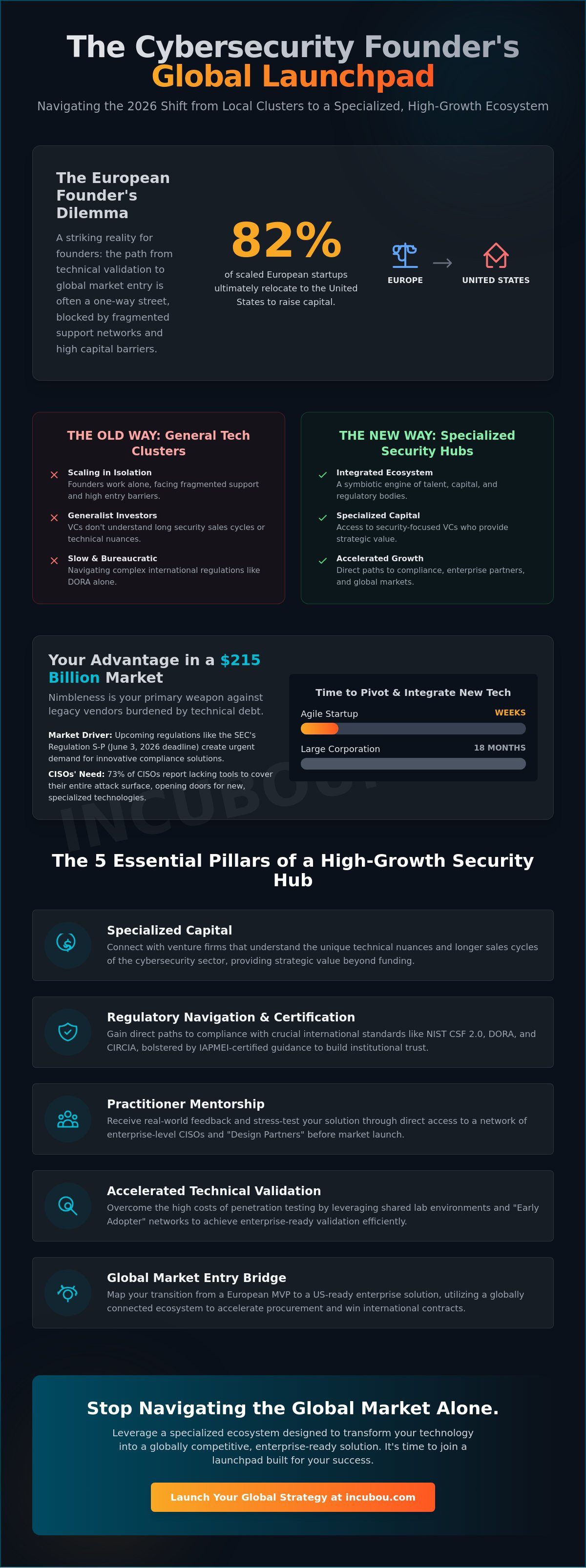
Did you know that 82% of European startups that successfully scale ultimately relocate to the United States to raise capital? This striking figure highlights a persistent reality for founders; the journey from technical validation to global market entry is often blocked by fragmented support networks and high entry barriers. You've likely felt the frustration of trying to prove your technology to enterprise practitioners while navigating a maze of international regulations like DORA or the SEC's latest oversight mandates. Finding the right cybersecurity startup ecosystem shouldn't feel like an uphill battle against geography and bureaucracy.
We understand the strategic ambition required to lead in a $215 billion market. You deserve a partner that acts as a global bridge, turning complex hurdles into clear competitive advantages. This article promises to decode the evolving pillars of the global security environment and show you how to leverage specialized hubs for rapid international scaling. We'll examine the 2026 investment climate, pinpoint high-value networking clusters, and provide a concrete roadmap for your expansion into the US and beyond. It's time to move past local clusters and join a specialized global launchpad designed for your success.
Key Takeaways
- Identify the strategic shift from general technology clusters to specialized security-first hubs that prioritize technical validation and regulatory compliance.
- Explore how AI-native startups can leverage European "Sovereign Cloud" initiatives to secure niche market positions and meet evolving data sovereignty demands.
- Map your transition from a European MVP to a US-ready enterprise solution by utilizing a globally connected cybersecurity startup ecosystem.
- Understand the critical role of IAPMEI-certified guidance in achieving investment readiness and securing capital from security-focused venture firms.
- Learn to evaluate acceleration programs based on their ability to provide direct access to enterprise-level practitioners and specialized international networking hubs.
What is a Cybersecurity Startup Ecosystem in 2026?
To grasp What is a Cybersecurity Startup Ecosystem in 2026?, founders must look past traditional office clusters and toward integrated networks of talent, capital, and regulatory bodies. This environment functions as a symbiotic engine where each component feeds the other. Technical talent produces the innovation; specialized capital provides the fuel; and regulatory bodies offer the necessary guardrails for institutional trust. In this high-stakes market, the cybersecurity startup ecosystem has matured into a specialized infrastructure that prioritizes security-first validation over general software growth.
Legacy vendors often struggle to keep pace with the shifting threat landscape because of their bloated internal processes and technical debt. Nimbleness remains your primary weapon. While a multinational corporation might take eighteen months to pivot toward a new AI threat detection model, a startup can integrate emerging research in weeks. This speed is essential as we face the June 3, 2026, compliance deadline for the SEC's amended Regulation S-P, which holds boards personally accountable for cyber oversight. Startups that can solve these immediate compliance hurdles gain a massive strategic advantage.
The Evolution of Security Hubs
Traditional incubators have largely been replaced by specialized security accelerators that offer more than just desk space. Modern hubs integrate "Design Partners," who are enterprise-level practitioners providing real-world feedback during the development phase. These partners ensure that your product isn't just theoretically sound but operationally viable in a multi-tenant, cloud-native environment. Data sovereignty laws and regional regulations, such as the EU's Digital Operational Resilience Act (DORA), now dictate where these hubs thrive. The modern cybersecurity ecosystem is a globalized network of validated tech and strategic capital.
Why Founders Can No Longer Scale in Isolation
Scaling a security firm in 2026 requires more than just a great product; it requires institutional trust-signals that are nearly impossible to generate alone. The rising cost of technical validation and rigorous penetration testing can drain a startup's seed capital before they ever reach a Series A. Ecosystem facilitators bridge this gap by providing access to "Early Adopter" networks and shared lab environments. Consider these essential benefits of ecosystem participation:
- Accelerated Procurement: Many B2B buyers now require pre-validated trust-signals that only recognized ecosystems can provide.
- Regulatory Navigation: Specialized hubs offer direct paths to compliance with CIRCIA and NIST CSF 2.0.
- Specialized Capital: Accessing investors who understand the longer sales cycles and technical nuances of the cybersecurity startup ecosystem.
Procurement teams are increasingly risk-averse, especially with the California Privacy Protection Agency's 2025 focus on automated decision-making audits. Joining a prestigious ecosystem provides the "certified institution" image that small teams need to win enterprise contracts. You don't just need a network; you need a strategic partner that understands the bureaucratic hurdles of international business expansion.
The 5 Essential Pillars of a High-Growth Security Hub
A high-growth hub delivers more than just premium office space; it provides a structured environment where technical innovation meets commercial reality. To thrive within a modern cybersecurity startup ecosystem, founders must align their ventures with five core pillars that transform a raw technology into an enterprise-ready solution. These pillars act as the foundation for scaling in a market where 73% of CISOs report they still lack the tools to cover their entire attack surface.
- Specialized Capital: Generalist venture capital often falters when faced with the long sales cycles typical of the security sector. You need investors who understand technical debt and the nuances of zero-trust architectures.
- Regulatory Certification: National bodies provide the necessary baseline for trust, ensuring your product meets international standards like NIST CSF 2.0.
- Practitioner Mentorship: Direct access to CISOs allows for real-world stress testing of your product against actual attack vectors before you hit the market.
- Market Access Bridges: These strategic pathways are essential for the 82% of European startups that eventually scale into the US market to raise capital.
- R&D Collaboration: Proximity to technical universities and research centers ensures your product pipeline stays ahead of emerging AI threats.
Specialized Cybersecurity Acceleration
Generic business coaching won't help you navigate the complexities of B2B procurement in 2026. Security-specific acceleration focuses on refining your business model for a world where boards are personally liable for cyber oversight under the SEC's latest mandates. These programs help you articulate value to both technical and non-technical stakeholders. Leveraging cybersecurity acceleration services allows you to bypass common pitfalls and move directly to rapid commercialization.
Institutional Trust and Certification
For European founders, IAPMEI certification acts as a vital seal of quality. It signals to international partners that your venture has met rigorous national standards for innovation and governance. This certification is often the key to unlocking government grants and state-backed innovation programs. Building a cybersecurity business scaling roadmap based on these certified milestones ensures your growth is both sustainable and attractive to late-stage investors. If you're ready to solidify your position in the cybersecurity startup ecosystem, finding a strategic partner to bridge these gaps is your next logical step.
2026 Trends: AI Specialization and Data Sovereignty
Accelerate your strategic positioning by embracing the twin forces defining the 2026 market: AI-native architecture and localized data sovereignty. The modern cybersecurity startup ecosystem has evolved into a series of specialized nodes rather than a single global hub. This shift is driven by the urgent need for infrastructure that supports high-compute research and the growing demand for "Sovereign Cloud" solutions. European initiatives are creating lucrative niche opportunities for startups that can guarantee data residency and localized encryption, effectively challenging the dominance of non-EU cloud providers.
Large legacy vendors are currently struggling with the "Nimbleness Gap." While these giants grapple with technical debt and slow procurement cycles, startups are outpacing them in automated threat response and real-time anomaly detection. Investors have noticed this shift, increasingly folding cybersecurity into a broader "Deep Tech" investment thesis. They aren't just looking for another SaaS dashboard; they're hunting for ventures that solve fundamental infrastructure vulnerabilities through advanced engineering and proprietary AI models.
The AI-Security Nexus
Success in 2026 requires more than a clever algorithm; it requires access to high-compute R&D resources. Leading ecosystems now provide founders with the GPU clusters and data lakes necessary to train Large Security Models (LSMs) without the crippling costs of public cloud credits. This infrastructure is vital for validating AI models against adversarial machine learning attacks, which have become a standard part of technical due diligence. AI specialization is the #1 factor in 2026 cybersecurity valuations.
Navigating Global Regulatory Fragmentation
The compliance burden has reached a tipping point for solo founders. With the June 3, 2026, deadline for the SEC’s amended Regulation S-P and the July 2025 CPPA regulations on automated decision-making, the legal landscape is more complex than ever. A robust cybersecurity startup ecosystem acts as a buffer, providing the specialized legal and bureaucratic support needed to navigate these waters. By leveraging ecosystem-wide trust signals, you can turn compliance from a hurdle into a competitive advantage. Startups that offer "compliance-by-design" provide a frictionless procurement experience that legacy competitors simply can't match. This institutional support allows you to focus on innovation while your ecosystem partners handle the administrative weight of international expansion.
The Global Bridge: Scaling from Portugal to the US Market
Transitioning from a local success to a global leader requires more than just capital; it requires a strategic bridge. For many ambitious founders in the cybersecurity startup ecosystem, Portugal has become that vital link. While the EU Inc. initiative proposed in March 2026 aims to harmonize the European market by 2027, the immediate path for rapid scaling still leads toward North America. Bridging this gap involves more than a simple office relocation. It demands a sophisticated understanding of how to translate European technical rigor into US market readiness.
The "Scale Up Now" program in January 2026 demonstrated that Portuguese startups possess the technical maturity to compete on a global stage. However, technical excellence alone won't secure a foothold in a market where the prime rate sits at 6.75% and enterprise procurement is increasingly risk-averse. Success requires a structured approach to international expansion that leverages both local technical talent and global commercial networks.
Vila Nova de Gaia: A Strategic Innovation Node
Vila Nova de Gaia is emerging as a premier European hub for security innovation by offering a unique combination of high-tier technical talent and competitive operational costs. Local hubs here provide the "Industry Connections" that act as a springboard for global visibility. By identifying cybersecurity industry connections within the Portuguese landscape, founders can validate their technology with European enterprise practitioners before attempting a high-stakes US market entry. This local validation serves as a critical trust signal for international investors.
Preparing for US Market Penetration
Preparing for US penetration means adapting your business model to meet specific procurement standards. With the June 3, 2026, compliance deadline for the SEC’s Regulation S-P, US boards are more selective than ever about their security vendors. High-growth firms now adopt a "Dual-Headquarter" mindset, maintaining R&D in Europe while establishing a strategic commercial presence in the US. Specialized "Soft Landing" programs remove entry barriers by providing the legal and cultural framework needed for this transition. Finding the right partners is essential; leveraging cybersecurity startup networking events allows you to connect with US-based practitioners who value European innovation. If you are ready to bridge the gap between Europe and America, explore our global expansion for cybersecurity services to accelerate your international journey.
Accelerating Your Journey within the Ecosystem
Selecting the right catalyst for your venture determines whether you remain a local innovator or transform into a global leader. In the high-stakes cybersecurity startup ecosystem of 2026, proximity to general tech hubs isn't enough. You need an environment that mirrors the complexity of the threats you're solving. True acceleration happens when technical validation, regulatory alignment, and strategic market access converge. This structured approach ensures that your growth is both rapid and resilient against the bureaucratic hurdles of international expansion.
Incubou acts as the steady hand for founders navigating this complex market. We recognize that the journey from a European MVP to a US-ready enterprise solution requires more than just a desk; it requires a sophisticated mentor who understands technical nuances and venture capital expectations. By providing a collaborative and prestigious atmosphere, we empower you to focus on your core mission while we help remove traditional barriers to entry.
Choosing the Right Growth Partner
Evaluate potential accelerators through the lens of specialized expertise rather than generic business coaching. Look for metrics that matter: success rates in global market entry and the ability to secure follow-on funding from security-focused investors. A partner's value lies in their network of CISOs and enterprise practitioners who can provide the "stress testing" your technology needs to survive procurement cycles. Specialized acceleration significantly reduces your time-to-market by aligning your business model with the institutional trust signals required by B2B buyers. It's about moving beyond "startup" labels and achieving true investment readiness through IAPMEI-certified guidance.
Next Steps for Cybersecurity Visionaries
Scaling requires a proactive audit of your current support network. If your current environment provides local desks but lacks global bridges, it's time to pivot. Transitioning to a high-growth trajectory involves refining your 2026 pitch to resonate with a global venture capital audience that prioritizes AI specialization and data sovereignty. Consider these immediate actions to solidify your position in the cybersecurity startup ecosystem:
- Audit Your Network: Ensure your mentors have direct experience with international security regulations like DORA and NIST 2.0.
- Validate Your Trust Signals: Seek certifications that act as a seal of quality for enterprise procurement teams.
- Refine Your Pitch: Focus on how your nimbleness solves the specific "Nimbleness Gap" left by legacy vendors.
The 2026 landscape rewards those who move with purpose and precision. Don't let fragmented support networks stall your global ambitions. It's time to leverage a specialized launchpad that understands the stakes of your mission. Apply for the Incubou Cybersecurity Accelerator today and take the definitive step toward becoming a global player in the security market.
Secure Your Place in the Global Security Arena
Success in 2026 requires more than a clever algorithm; it demands a strategic home within a specialized cybersecurity startup ecosystem. You've seen how the shift toward AI-native architectures and strict data sovereignty laws has redefined the rules of international growth. Founders who thrive today are those who leverage the essential pillars of technical validation, specialized capital, and regulatory mastery. By positioning your venture within a strategic hub like Vila Nova de Gaia, you gain the industry connections necessary to bridge the gap between European innovation and US market dominance.
We provide IAPMEI-certified guidance and specialized US market entry support to ensure your scaling journey is both rapid and secure. Don't let fragmented support networks limit your potential. It's time to transform your technical MVP into a globally recognized enterprise solution. Join the Incubou Accelerator and Scale Your Cybersecurity Vision Globally. We're ready to act as your steady hand in this high-stakes market. Your vision deserves a global stage, and we're here to help you reach it.
Frequently Asked Questions
What defines a cybersecurity startup ecosystem in 2026?
A modern ecosystem is a specialized network where technical talent, security-focused capital, and regulatory bodies converge to accelerate trust. Unlike general tech hubs, it prioritizes technical validation through "Design Partners" and provides the high-compute infrastructure necessary for AI-driven defense. It functions as a symbiotic environment where practitioners stress-test products early in the development cycle. This ensures that every venture is operationally viable and ready for the rigors of enterprise procurement.
How do I choose between a general accelerator and a cybersecurity-specific one?
Base your decision on the depth of the practitioner network and the specific knowledge of B2B security sales cycles. General accelerators often lack the technical expertise required to validate zero-trust architectures or navigate complex regulatory frameworks like DORA. A specialized cybersecurity startup ecosystem provides direct access to CISOs who understand your technical debt. Look for programs with high follow-on funding rates from VCs that specifically target deep-tech security ventures.
What role does IAPMEI certification play for Portuguese security startups?
IAPMEI certification serves as an essential institutional seal of quality that validates your venture's governance and innovative capacity. It signals to international partners and investors that your startup meets rigorous national standards for excellence. This certification is often a prerequisite for accessing state-backed innovation grants and specialized government programs. For founders, it provides the credibility needed to compete with established legacy vendors during high-stakes international procurement processes.
Can a cybersecurity startup scale to the US market from Europe?
Scaling to the US is entirely achievable through a "Dual-Headquarter" strategy and specialized "Soft Landing" programs. While many firms relocate to raise capital, the 2026 model favors keeping R&D in cost-effective European hubs like Vila Nova de Gaia while establishing a commercial presence in the US. This approach allows you to leverage European technical rigor while meeting US procurement standards. Success depends on finding a partner that provides a bridge between these two distinct markets.
What are the biggest trends in the cybersecurity startup ecosystem for 2026?
The rise of AI-native security tools and the expansion of Sovereign Cloud initiatives are the most significant drivers of change. Startups are increasingly focusing on automated threat response to close the "Nimbleness Gap" left by slower, legacy competitors. We're also seeing a massive push toward compliance-by-design as a response to the June 3, 2026, SEC deadline. These trends are creating niche opportunities for founders who can guarantee data residency and localized encryption.
How important is practitioner mentorship for early-stage security firms?
Practitioner mentorship is the difference between a theoretical tool and an operationally essential product. Direct feedback from active CISOs allows you to refine your business model against actual attack vectors and real-world budget constraints. This mentorship accelerates the technical validation phase, which is often the most expensive part of a security startup's journey. It helps you build the institutional trust-signals required to win your first enterprise contracts without wasting resources on irrelevant features.
What are the benefits of Vila Nova de Gaia as a tech hub?
Vila Nova de Gaia offers a unique combination of high-tier technical talent, competitive operational costs, and direct access to the broader EU market. It has emerged as a strategic node within the cybersecurity startup ecosystem because it allows founders to build and validate their MVPs in a supportive environment. The hub's proximity to research centers and technical universities ensures a steady pipeline of specialized talent, making it an ideal launchpad for global expansion.
How does an ecosystem help with cybersecurity regulatory compliance?
Ecosystems act as a buffer against the administrative weight of global regulatory fragmentation. They provide specialized legal support and bureaucratic guidance to help you navigate complex frameworks like NIST 2.0 and the latest SEC mandates. By leveraging shared compliance resources, you can turn a potential hurdle into a competitive market advantage. This institutional support allows your team to stay focused on technical innovation while ensuring your product meets the highest international standards for security.


