

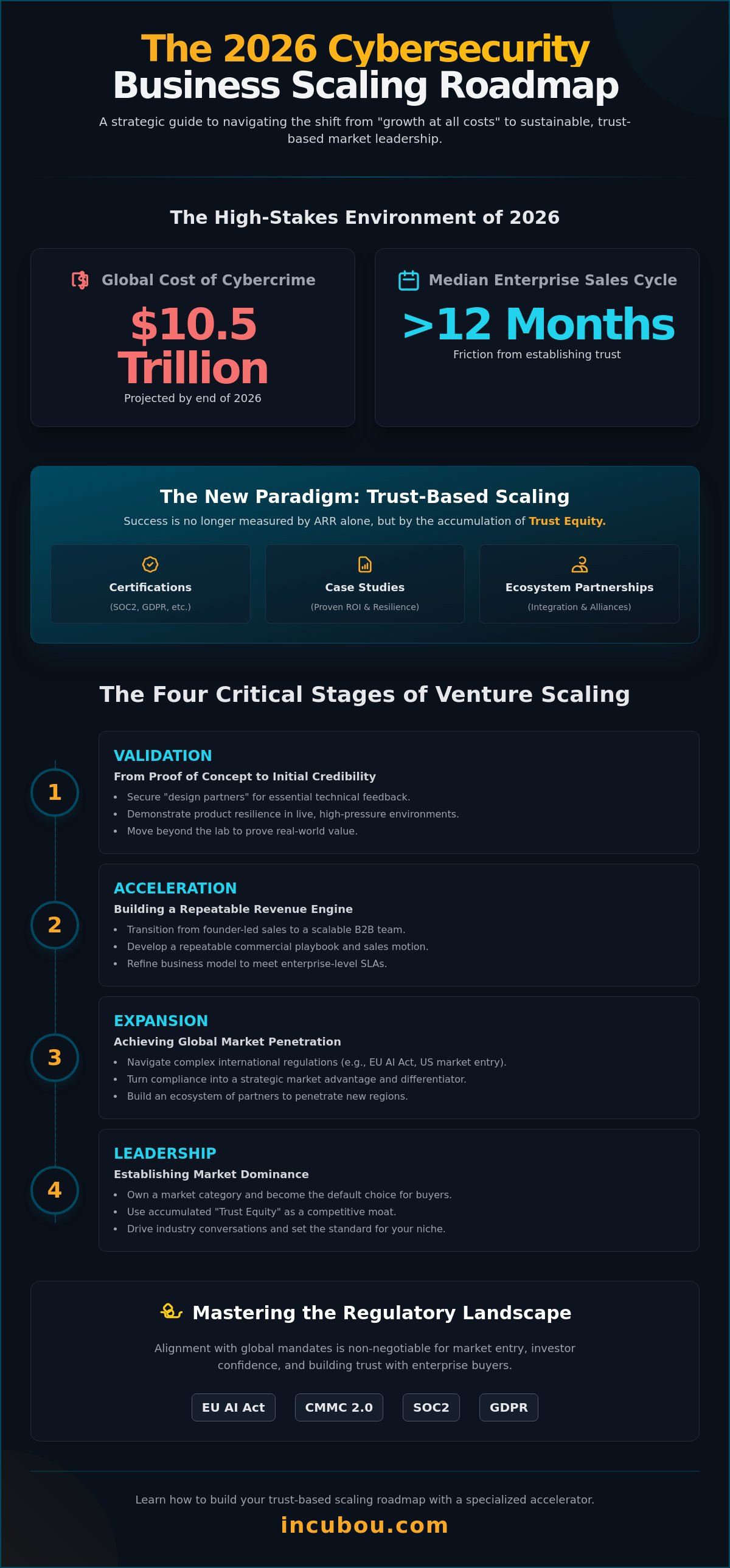
In a market where the annual global cost of cybercrime is projected to reach $10.5 trillion by the end of 2026, you might expect procurement to move with urgency. Instead, the median enterprise sales cycle often exceeds twelve months. You've likely felt the friction of trying to establish trust in new international markets while balancing the relentless pressure of technical debt against commercial growth targets. It's a high-stakes environment where a single misstep in regulatory alignment can stall your momentum for years.
This cybersecurity business scaling roadmap serves as your architectural guide to navigating these complexities with professional confidence. We'll show you how to master the transition from initial validation to global market dominance by building a repeatable, high-trust sales model. You'll learn to align your operations with critical 2026 mandates like the EU AI Act and CMMC 2.0; ensuring your venture is not just growing, but is fully investment-ready for Series A and B milestones. We'll explore the strategic phases of international expansion and the precise steps required to penetrate the world's most demanding tech ecosystems with a sophisticated, mission-driven approach.
Key Takeaways
- Learn why a successful cybersecurity business scaling roadmap in 2026 prioritizes sustainable, trust-based growth over traditional "growth at all costs" metrics.
- Discover the four critical stages of venture scaling, from foundational technical validation to building repeatable commercial playbooks for global reach.
- Gain insights into the CISO mindset to shorten enterprise sales cycles and position your solution as the secure, reliable choice for risk-averse buyers.
- Understand how to navigate complex international regulations, including the EU AI Act and US market entry, to turn compliance into a strategic market advantage.
- Identify the unique benefits of specialized cybersecurity accelerators and how they provide the institutional credibility needed for rapid market penetration.
Defining the Cybersecurity Business Scaling Roadmap for 2026
Scaling a security venture requires more than a robust codebase. It demands a strategic framework that moves a company from technical validation to commercial dominance. While a traditional Technology roadmap focuses on internal infrastructure and feature releases, a cybersecurity business scaling roadmap is an external-facing strategy designed to build market authority. It's the bridge between having a functional tool and owning a market category.
In 2026, the industry has moved past the "growth at all costs" era. Investors and enterprise buyers now prioritize sustainable, trust-based scaling. This shift is driven by the rising complexity of the global threat landscape and the high stakes of procurement. If you can't prove long-term viability and regulatory maturity, your growth will stall. Success is no longer measured solely by Annual Recurring Revenue (ARR). We now track Trust Equity. This represents the cumulative value of your certifications, case studies, and ecosystem partnerships. It's the currency that shortens the twelve-month sales cycles typical of this sector.
The Core Pillars of Cybersecurity Venture Growth
Founders must focus on three foundational pillars to ensure their growth isn't hollow. First, achieve technological validation. You must move beyond the Proof of Concept (PoC). Your product needs to demonstrate resilience in live, high-pressure environments. Second, build commercial infrastructure. Scaling requires a high-touch sales engine capable of speaking the language of both the CISO and the CFO. As part of this financial maturity, you might explore net 30 vendors to establish business credit and manage cash flow effectively. Third, prioritize ecosystem integration. Partnerships are the lifeblood of security scaling. You aren't just selling software; you're integrating into a complex defense stack where interoperability is a prerequisite for entry.
Aligning Technical Innovation with Market Demands
Innovation must be balanced with rigorous compliance. Features that don't align with GDPR, SOC2, or the EU AI Act are liabilities, not assets. In a recessionary market, buyers distinguish between "must-have" protection and "nice-to-have" visibility tools. Focus development on core risk mitigation that addresses specific pain points like supply chain security or AI-powered threats. This alignment ensures your cybersecurity business scaling roadmap remains grounded in market reality. Ultimately, a cybersecurity business scaling roadmap is a trust-building architecture that converts technical potential into global market authority.
The Four Critical Stages of Cybersecurity Venture Scaling
Scaling a venture in this sector requires a multi-year commitment. It isn't a simple 90-day implementation. Your cybersecurity business scaling roadmap must account for the high-trust requirements of enterprise buyers. Success depends on moving methodically through four specific phases: validation, acceleration, expansion, and leadership. Each stage demands a different set of priorities and a shift in how you allocate capital and talent. Skipping a phase often leads to the technical debt and commercial tension mentioned earlier.
Stage 1 & 2: From PoC to Repeatable Revenue
Foundational validation begins with the Proof of Concept (PoC). At this stage, your primary goal is securing "design partners" who provide the technical feedback and initial credibility you need. These early adopters are essential. They help you refine your product in a live environment before you attempt a wider rollout. As you move into commercial acceleration, you must transition away from founder-led sales. Relying on a founder's personal network isn't sustainable for long-term growth. You need a scalable B2B sales team that follows a repeatable playbook.
Refining your cybersecurity business model refinement is critical during this phase. You aren't just selling a tool; you're selling a solution that fits into existing procurement workflows. Organizations that successfully scale their cybersecurity efforts often find that their initial pricing or delivery model needs adjustment to meet the demands of enterprise-level Service Level Agreements (SLAs). This is where you build the commercial infrastructure necessary to handle the median twelve-month sales cycle.
Stage 3 & 4: Going Global and Dominating the Niche
International expansion is the next logical step, but it requires more than just hiring a local representative. Transitioning from a regional success, such as in Portugal, to a global market like the United States involves navigating complex regulatory hurdles. You can leverage cybersecurity acceleration services to bypass common market entry barriers. These services provide the institutional credibility and network access that would otherwise take years to build independently. They act as a bridge-builder between your technical innovation and international buyers.
The final stage is market leadership. Here, you focus on ecosystem dominance. You build a "moat" around your business through deep technical integrations with other major security players and by fostering a dedicated user community. Dominating a niche means your product becomes the default choice for specific use cases. If you're ready to accelerate your journey through these stages, explore how professional acceleration can streamline your path to global dominance. By the time you reach this phase, your cybersecurity business scaling roadmap has evolved from a survival guide into a blueprint for global influence.
Mastering the High-Trust Sales Cycle and Market Fit
Enterprise procurement in the security sector is rarely about the most innovative feature. It's about career insurance. The classic adage "nobody ever got fired for buying IBM" remains the silent mantra of the modern CISO. These executives are risk-averse by necessity. When you're building your cybersecurity business scaling roadmap, you must account for this psychological barrier. You aren't just competing against other startups; you're competing against the perceived safety of established incumbents. Overcoming this requires a shift from selling technical specifications to selling institutional trust.
The median sales cycle for enterprise deals in 2026 often exceeds twelve months. This duration is fueled by complex stakeholder maps involving technical teams, legal departments, and executive leadership. To reduce this friction, you must provide third-party validation early in the process. Independent audits, SOC2 Type II reports, and transparent compliance documentation are non-negotiable. Even when targeting smaller organizations, following frameworks like those outlined in the Cybersecurity for Small Business guidance can help establish a baseline of professional credibility that resonates with risk-conscious buyers.
Building a Trust-Centric Sales Engine
Move beyond generic marketing. Develop case studies that focus on tangible ROI and specific risk mitigation scenarios. Your sales engine should leverage technical influencers and white-hat community support to validate your claims. This peer-to-peer endorsement often carries more weight than any traditional advertising. Align your sales incentives with long-term customer success rather than just the initial contract signature. In a market where trust is the primary currency, a single failed implementation can damage your reputation across an entire geographic territory.
Achieving True Product-Market Fit in Security
True market fit in 2026 means identifying the "burning platform" your product solves. In a crowded market projected to reach $248 billion, buyers don't want another "nice-to-have" visibility tool. They need solutions for urgent problems like AI-adaptive threats or supply chain vulnerabilities. Distinguish your offering by moving from a "feature" mindset to a "platform" capability. Use feedback loops from your early design partners to harden your technology. This iterative process ensures that your cybersecurity business scaling roadmap stays aligned with actual buyer pain points rather than theoretical technical goals. By the time you reach the commercial acceleration stage, your product should feel like an indispensable component of the client's defense architecture.
Navigating International Expansion and Regulatory Compliance
Expanding into new territories is the ultimate stress test for any cybersecurity business scaling roadmap. While local success provides a proof of concept, global dominance requires navigating a patchwork of conflicting regulations and cultural procurement norms. The United States remains the "holy grail" for security firms due to its concentrated enterprise spend and mature venture capital ecosystem. However, winning in the US demands a fundamental shift in how you present your value proposition. You aren't just selling a technical solution; you're selling a scalable asset that fits into the world's most competitive tech stack.
Success in international markets also requires mastering the "Brussels Effect." European regulations like GDPR and the EU AI Act often become the de facto global standards. If your architecture is built to satisfy these rigorous requirements, you possess a significant advantage when entering less regulated regions. Strategic internationalization involves more than just chasing the largest market. It means identifying regions where your specific niche aligns with local government mandates and industry needs. Scaling effectively often involves building robust reseller networks and localized support to provide the high-touch service that enterprise clients demand.
US Market Penetration Tactics
Entering the American market requires more than a remote sales team. You must adapt your pitch to meet the aggressive expectations of US venture capital and enterprise buyers. They look for rapid market capture and clear evidence of scalability. Establishing a strategic presence in key innovation hubs provides the cultural proximity necessary to build high-level partnerships. Leveraging specialized accelerators can help bridge the gap between Vila Nova de Gaia and the US market, providing the mentorship and network access required to navigate this complex transition. If you're ready to take this step, apply for global expansion support to accelerate your international growth.
Compliance as a Competitive Advantage
Turn regulatory hurdles into sales enablement tools. With the EU AI Act requirements for high-risk systems set to apply on August 2, 2026, and Phase 2 of CMMC 2.0 beginning in November 2026, your ability to provide a verifiable security posture is your strongest selling point. When you demonstrate proactive alignment with these mandates, you remove friction from the procurement process and position yourself as a steady hand. Understanding local data sovereignty laws is no longer optional; it's a prerequisite for global scaling. Regulatory compliance serves as a high-security key that unlocks restricted markets and validates your technical integrity to skeptical global buyers. By integrating these requirements into your core product strategy, you transform a bureaucratic necessity into a powerful market entry advantage.
Leveraging Acceleration Ecosystems for Rapid Market Penetration
Scaling a security venture in isolation is an uphill battle. While generic startup programs offer broad advice, they often lack the technical depth and industry-specific networks required to move the needle in B2B security. A specialized cybersecurity business scaling roadmap leverages acceleration ecosystems to bypass the trial-and-error phase of market entry. These ecosystems provide "Trust Equity" by association, connecting you with a curated network of CISOs, venture capitalists, and technical mentors who understand the nuances of the 2026 threat landscape.
Accessing these networks allows you to refine your value proposition based on real-world feedback from decision-makers. It isn't just about mentorship; it's about institutional validation. In a market where the median disclosed funding round has reached $53.5 million in early 2026, being part of a recognized ecosystem significantly enhances your investment readiness for Series A and B rounds. You aren't just another vendor; you're a vetted innovator with a clear path to global scale. This connection to a wider ecosystem ensures your venture is seen as a high-level strategic partner rather than a mere service provider.
The Incubou Advantage: Strategic Growth in Vila Nova de Gaia
Incubou facilitates the transition from a local startup to a global player by providing a structured bridge to international markets. Based in Vila Nova de Gaia, we leverage a deep network of industry experts to help you refine your business model for the most demanding enterprise clients. Our status as an IAPMEI certified accelerator provides unique credibility routes and funding opportunities that generic programs can't match. We don't just offer advice; we provide a steady hand to help you navigate the bureaucratic and technical hurdles of global expansion, ensuring your growth is both rapid and sustainable.
Your Next Steps in the Scaling Journey
Your cybersecurity business scaling roadmap shouldn't be a static document. It requires active refinement and purposeful action. Start by auditing your current readiness using a comprehensive checklist. Do you have the documentation required for 2026 mandates like the EU AI Act? Can your sales team speak fluently to a CISO's risk management concerns? Identify the #1 bottleneck in your current sales cycle. Is it a lack of third-party validation or a friction-heavy procurement process? Once you've identified the barrier, you can apply targeted strategies to overcome it. Don't let your growth stall at the validation phase. Apply to the Incubou acceleration program today to fast-track your global growth and secure your position as a market leader.
Architecting Your Global Security Legacy
Transitioning from a technical proof-of-concept to a dominant market force requires more than robust code. It demands a sophisticated approach to building trust and navigating the complex regulatory landscape of 2026. By mastering high-trust sales cycles and aligning your innovation with global mandates, you transform compliance into a powerful commercial engine. Executing a successful cybersecurity business scaling roadmap is a journey from local validation to international influence; it's a path that is significantly shortened by the right strategic partnerships.
As an IAPMEI-certified incubator, Incubou provides the essential bridge to US and international markets that founders need to bypass traditional entry barriers. You gain direct access to a deep network of industry-specific mentors and CISOs who provide the vetting and validation required for rapid penetration. Ready to scale your cybersecurity venture? Explore the Incubou Acceleration Program today. With a steady hand and the right ecosystem behind you, your vision for global security dominance is well within reach.
Frequently Asked Questions
What is the most important metric in a cybersecurity scaling roadmap?
Trust Equity is the most critical metric for long-term growth. While Annual Recurring Revenue measures current financial performance, Trust Equity quantifies your market authority through certifications, peer-validated case studies, and strategic partnerships. A successful cybersecurity business scaling roadmap prioritizes this metric to reduce friction during the procurement process. Building this equity ensures your venture remains resilient against the long B2B sales cycles typical of the enterprise security sector.
How long does it typically take to scale a cybersecurity startup to the US market?
Expect a twelve to eighteen month timeline for meaningful US market entry. This period accounts for localizing your value proposition, establishing a strategic presence in key innovation hubs, and navigating the median enterprise sales cycle. Organizations often use this time to align with US-specific requirements like SOC2 or CMMC 2.0. Accelerating this process requires a dedicated network of local influencers and technical mentors who provide immediate institutional credibility.
Why do most cybersecurity startups fail during the scaling phase?
Most startups fail because they cannot bridge the gap between technical innovation and commercial maturity. The tension between managing technical debt and pursuing rapid growth often leads to hollow scaling that lacks a sustainable foundation. Without a clear cybersecurity business scaling roadmap, firms frequently run out of capital during the six to twelve month enterprise sales cycle. Success requires balancing aggressive market capture with the steady hand of regulatory compliance.
Do I need to be SOC2 compliant before I start scaling?
SOC2 compliance is a non-negotiable prerequisite for scaling into the enterprise market. Most procurement departments won't consider a vendor without this certification or an equivalent independent audit to verify security postures. It acts as a baseline of professional credibility that protects the buyer's internal stakeholders. Achieving this compliance early prevents your sales cycle from stalling at the legal review stage and positions you as a mature, investment-ready venture.
How does an accelerator like Incubou help with international expansion?
Incubou acts as a sophisticated bridge-builder for international expansion by providing a structured path to global markets. We offer direct access to a curated network of CISOs and industry mentors who validate your product for demanding global buyers. Our IAPMEI-certified status provides unique routes to funding and institutional support. We help you navigate the bureaucratic hurdles of new territories, ensuring your transition from a local startup to a global player is methodical.
Can a cybersecurity business scale without significant venture capital?
Scaling without significant venture capital is possible but requires exceptional capital efficiency and early revenue. You must secure design partners who provide both financial support and technical validation from the outset. This approach often involves focusing on high-margin, "must-have" security features that solve immediate regulatory pain points. While slower than the VC-backed route, this path allows founders to maintain greater control over their strategic vision and long-term business model refinement.
What is the role of Vila Nova de Gaia in the European cybersecurity ecosystem?
Vila Nova de Gaia serves as a strategic innovation hub within the European cybersecurity ecosystem. It offers a unique combination of technical talent and institutional support through specialized acceleration programs. This location provides a supportive environment for founders to refine their technology before attempting global expansion. It has become a central point for startups seeking to balance technical development with the practical realities of international business growth and commercial validation.
How do I shorten the B2B sales cycle for my security product?
Shorten your sales cycle by providing third-party validation at the initial contact stage. Share transparent compliance documentation and case studies that focus on tangible risk mitigation rather than just technical features. Engaging with technical influencers and white-hat communities can also provide the peer-to-peer endorsement that enterprise buyers value. Aligning your sales engine with the buyer's procurement workflow reduces friction and establishes the trust necessary for faster executive decision-making.


