

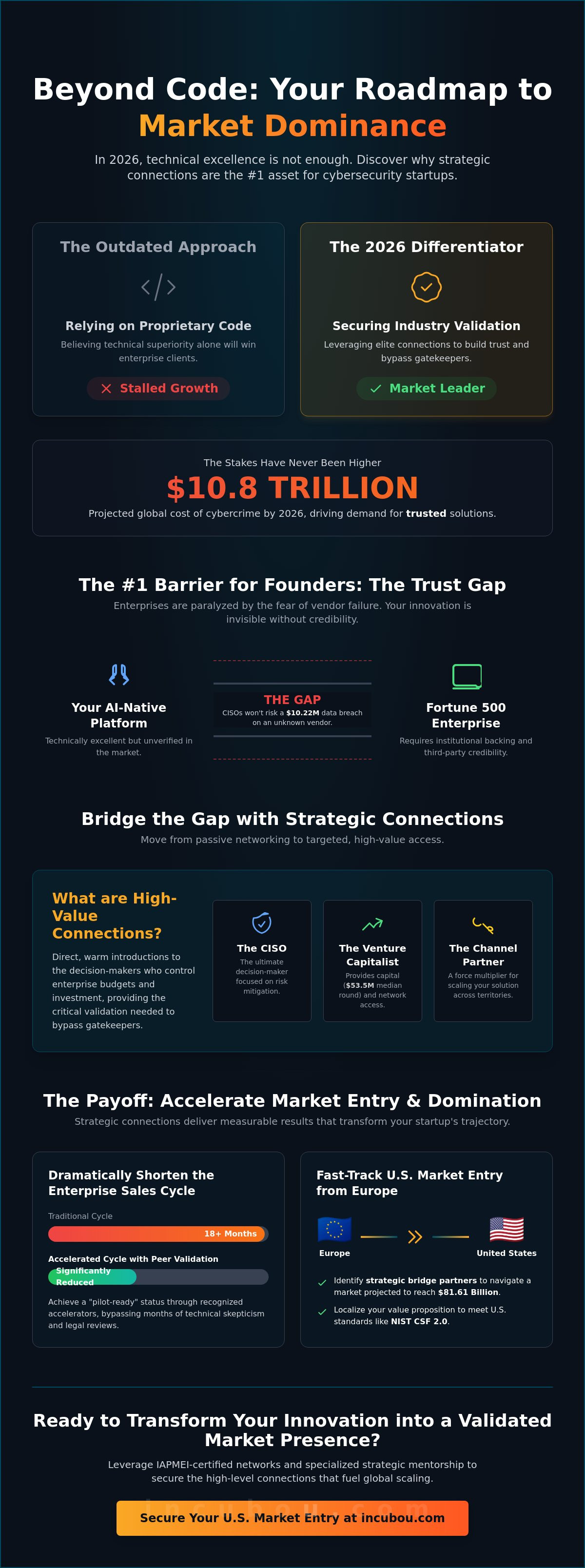
Your proprietary code isn't your most valuable asset in 2026; your industry validation is. You've likely spent months perfecting an AI-native platform only to find that technical excellence doesn't bypass the gatekeepers at major enterprises. Securing high-level cybersecurity industry connections has become the primary differentiator between startups that scale and those that stall. It's frustrating to watch generic networking events fail to deliver while the global cost of cybercrime climbs toward $10.8 trillion.
We understand that entering the U.S. market from Europe feels like a bureaucratic maze, especially with the 2026 enforcement of the EU AI Act and shifting NIST CSF 2.0 standards. This guide shows you how to leverage elite networks to bridge the gap between technical innovation and global market dominance. You'll discover a strategic roadmap for securing CISO introductions, obtaining investor-ready validation, and navigating a U.S. market projected to reach $81.61 billion this year.
Key Takeaways
- Define high-value cybersecurity industry connections as direct access to CISOs and VCs who provide the critical validation needed to bypass enterprise gatekeepers.
- Shorten your global sales cycle by leveraging peer-to-peer validation from industry veterans to confirm product-market fit before investing in heavy scaling.
- Bridge the "trust gap" with institutional backing, using specialized acceleration programs to provide the third-party credibility required by Fortune 500 decision-makers.
- Accelerate U.S. market entry from Europe by identifying strategic bridge partners and localizing your value proposition to meet American regulatory standards.
- Transform technical innovation into a validated market presence by utilizing IAPMEI-certified networks and specialized strategic mentorship.
What defines high-value cybersecurity industry connections for startups?
In a market projected to reach $248.28 billion in 2026, the noise level for security founders has never been higher. High-value cybersecurity industry connections are no longer defined by the quantity of business cards exchanged at conferences. Instead, they're measured by the degree of strategic access they provide to the decision-makers who control enterprise budgets. These connections represent a bridge between a technical proof-of-concept and a commercially viable platform that can withstand the rigors of a global market.
Trust serves as the primary currency in this high-stakes environment. With the global cost of cybercrime projected to hit $10.8 trillion by 2026, CISOs aren't looking for unverified vendors. They're searching for partners who have been vetted by the wider ecosystem. This baseline of integrity and availability defines high-value cybersecurity for founders, shifting the focus from simple technical features to long-term institutional trust. By cultivating the right cybersecurity industry connections, founders gain more than just a meeting; they gain a strategic alliance that validates their solution in a skeptical market.
The difference between networking and strategic access
Networking is often broad and passive. It's the collection of LinkedIn profiles that rarely lead to a discovery call. Strategic access is targeted, results-oriented, and relies on the "warm introduction." In the 2026 procurement cycle, gatekeepers at Fortune 500 companies ignore cold outreach. You need a champion inside the organization who can navigate the internal politics and regulatory hurdles of the EU AI Act or NIST CSF 2.0. These champions don't just open doors. They provide the internal validation that moves a startup from the "risky" pile to the "investor-ready" shortlist. They act as the catalyst for the entire sales cycle.
Key stakeholders in the cybersecurity ecosystem
Founders must identify and cultivate three specific types of stakeholders to achieve rapid market penetration:
- The CISO: The ultimate decision-maker. They prioritize risk mitigation and operational efficiency over technical novelty. Your connection here must be built on a foundation of proven reliability.
- The Venture Capitalist: In 2026, VCs provide more than just capital. The median disclosed funding round in early 2026 was $53.5 million, but the real value lies in an investor's ability to act as a bridge to their portfolio companies and professional networks.
- The Channel Partner: Resellers and integrators are the force multipliers. They possess the existing relationships and trust needed to scale your solution across entire territories, significantly reducing your customer acquisition costs.
How do strategic connections accelerate cybersecurity market entry?
Strategic cybersecurity industry connections act as a force multiplier for market expansion. In a sector where the average cost of a data breach in the U.S. reached an all-time high of $10.22 million in 2025, enterprise buyers are paralyzed by the fear of vendor failure. Peer-to-peer validation from trusted colleagues allows founders to bypass the "cold" phase of business development. This social proof is essential for cybersecurity market entry, as it signals that your solution has already survived the scrutiny of industry veterans who understand the high stakes of protecting critical infrastructure. Connections provide the necessary shortcuts through the noise of a crowded vendor landscape.
Shortening the enterprise sales cycle
Enterprise procurement is a gauntlet of security audits and legal reviews. Utilizing cybersecurity acceleration services provides founders with a structured path to bypass initial friction. Technical validation from a recognized accelerator acts as a pre-screening process for CISOs. Instead of months of back-and-forth, founders can lead with a "pilot-ready" status that addresses procurement concerns upfront. Pilot programs serve as a low-friction "foot-in-the-door" strategy, allowing you to prove value within a controlled environment before committing to a full-scale rollout. This methodical approach reduces the typical 18-month sales cycle significantly by addressing technical skepticism early.
Product-Market Fit through expert feedback
Generic business coaching fails to address the granular technical requirements of the security world. High-level cybersecurity industry connections grant access to "expert-in-residence" programs where former CISOs and security architects tear down and rebuild your value proposition. They help you align your roadmap with mandatory regulations like the EU's CSA2 or the reporting requirements of CIRCIA. Product-market fit is the alignment of technical capability with budget-holder priorities. Refining your business model based on these real-world pain points ensures that your solution solves a "burning house" problem rather than being a "nice-to-have" tool. If you're looking to refine your global strategy, connecting with specialized mentors can save you years of trial and error by ensuring your solution meets the specific operational needs of 2026.
Why is the trust gap the #1 barrier for cybersecurity founders?
Imagine a CISO at a Fortune 500 company reviewing your pitch. Their primary concern isn't "Does this code work?" but rather "Will this startup still exist in two years?" For a founder, technical innovation is a baseline requirement, but trust is an earned asset. Large enterprises are inherently risk-averse because the average cost of a data breach in the U.S. climbed to $10.22 million in 2025. Entrusting sensitive data to an unproven firm feels like a career gamble for a security executive. This is where elite cybersecurity industry connections become indispensable. They provide the social proof needed to bridge the gap between being a "risky startup" and a "trusted partner."
Building a brand of reliability without a portfolio of massive case studies requires you to borrow credibility from established sources. By aligning your startup with respected industry veterans and strategic partners, you create an aura of authority. This isn't about faking success; it's about demonstrating that your technical vision is supported by the very people the market already trusts. These cybersecurity industry connections act as a surrogate for the traditional five-year track record, allowing you to move through procurement cycles with the confidence of a much larger entity.
The psychology of the security buyer
Security buyers in the C-suite prioritize resilience over novelty. They look for signals of longevity and reliability that transcend a slide deck. Social proof from recognized industry leaders often overrides technical skepticism because it suggests that peers have already performed the necessary due diligence. In 2026, being "seen" in the right circles is a strategic necessity. Attending high-stakes cybersecurity startup networking events allows founders to demonstrate a consistent presence. It shows the market that your firm isn't a flash in the pan but a permanent fixture in the global security ecosystem.
Institutional validation as a trust catalyst
Founders often struggle to gain traction because they lack an institutional "stamp of approval." For international buyers, seeing a startup rooted in a certified hub like Vila Nova de Gaia provides a sense of security and regulatory alignment. The IAPMEI certification serves as a powerful signal to investors and customers alike, proving that the business has met rigorous institutional standards. Institutional backing acts as a de facto security audit for early-stage firms. This validation allows you to compete with established giants by leveraging the networks provided by a recognized accelerator. It transforms your startup from an outsider into a vetted participant in the global market.
How to leverage connections for US market entry from Europe?
Crossing the Atlantic requires more than a superior product; it demands a network that translates European innovation into American commercial success. The U.S. cybersecurity market is estimated to reach a value of $81.61 billion in 2026, representing a massive but highly competitive opportunity. European founders often fail by treating the U.S. as a larger version of their home market. Success depends on building cybersecurity industry connections that provide local context and regulatory alignment. Follow this four-step roadmap to bridge the gap effectively.
- Identify "bridge" partners: Target organizations and mentors who maintain active operations in both EU and U.S. territories. They understand the friction between the EU AI Act and U.S. procurement standards.
- Localize the value proposition: Technical excellence isn't enough. Your solution must meet specific U.S. regulatory benchmarks like SOC2 or FedRAMP to even enter the conversation with enterprise buyers.
- Utilize accelerator networks: Leverage established hubs to secure your first "anchor" clients. These networks provide the warm introductions to North American CISOs who prioritize vetted innovation over unproven tools.
- Scale through U.S.-based VC introductions: Accessing American venture capital provides more than just funding; it offers a direct line to future customers and strategic board-level guidance.
Navigating the "Atlantic Divide"
European founders frequently stumble over the aggressive pace and different communication styles of the U.S. market. A local presence in a strategic hub like Vila Nova de Gaia serves as a vital launchpad for global expansion. This environment provides the strategic advisory needed to adjust your sales pitch for a U.S. audience, ensuring your messaging resonates with the fast-moving priorities of American security leaders. Moving from a technical focus to a risk-mitigation narrative is essential for capturing U.S. interest.
Securing anchor clients
Your first U.S.-based reference customer is your most valuable asset. High-value cybersecurity industry connections facilitate "design partner" relationships, where an American enterprise helps you refine your tool for their specific operational environment. This collaboration provides the "Made in USA" validation that skeptical procurement teams require. If you're looking to establish this critical foothold, our global expansion for cybersecurity services can help you find the right entry point and secure the partners you need to scale rapidly.
How does Incubou facilitate elite cybersecurity industry connections?
Incubou functions as a high-level strategic partner rather than a mere service provider. Based in the Vila Nova de Gaia innovation hub, we've built a specialized ecosystem where technical innovation meets commercial validation. We recognize that for a founder in 2026, the primary hurdle isn't building the tool; it's securing the cybersecurity industry connections that lead to global contracts. Our acceleration program is designed to transform your technical vision into a market-dominant reality by providing a steady hand through the complexities of international expansion.
The power of a certified ecosystem
Validation is the cornerstone of our approach. As an IAPMEI-certified growth partner, Incubou provides the institutional credibility that early-stage firms often lack. This certification acts as a trust catalyst, signaling to Fortune 500 procurement teams that your firm has been vetted by a recognized authority. Inside the Vila Nova de Gaia hub, we've created an environment that removes the traditional barriers to entry. We provide the legal frameworks and community support required to handle overlapping regulations like the EU AI Act and the California Delete Act. This structured journey ensures you aren't just entering a market; you're entering it with a roadmap for long-term security and compliance.
Direct access to the security elite
Strategic access is about more than just a name on a list. We facilitate direct mentorship from industry veterans who have scaled firms to the point of major M&A activity. These mentors help you refine your value proposition to meet the proactive "deter and disrupt" posture of the latest U.S. cyber strategy. Through our network, you gain structured introductions to venture capitalists who are specifically looking for high-growth, AI-native platforms. These cybersecurity industry connections provide the peer-to-peer validation necessary to bypass gatekeepers and reach the CISO's desk. We focus on quality over quantity, ensuring every introduction is a step toward a commercial alliance rather than a dead-end conversation.
Scaling a security firm in 2026 requires a partner who understands both the technical nuances and the global vision required for success. We invite you to join a community that values efficiency, rapid development, and strategic advantage. Scale your cybersecurity startup with Incubou’s elite network today and bridge the gap to global market dominance.
Securing Your Place in the 2026 Global Security Market
The path to global dominance requires more than technical ingenuity; it demands a network that translates innovation into institutional trust. You've seen how high-value cybersecurity industry connections bypass enterprise gatekeepers and shorten the grueling sales cycle. By leveraging the social proof of industry veterans, you transform your startup from a technical experiment into a validated market player. The 2026 landscape respects results, but it rewards the founders who arrive with the right champions behind them.
Building this foundation alone is a high-risk strategy. As an IAPMEI-certified cybersecurity incubator located in the Vila Nova de Gaia innovation hub, we provide the specialized U.S. market entry support needed to bridge the Atlantic divide. We help you navigate complex regulatory landscapes while connecting you with the CISOs and investors who define the future of security. Our mission is to ensure your technical vision meets the commercial validation it deserves.
Don't let the trust gap stall your momentum in a market moving at breakneck speed. Apply to the Incubou Accelerator and access our global network to begin your journey toward international expansion. We're ready to act as your steady hand in this complex global market.
Frequently Asked Questions
How do I build industry connections if I am a technical founder with no sales background?
Focus on peer-to-peer technical validation. Technical founders should lead with the specific problem they solve rather than a polished sales pitch. Engaging in specialized technical forums allows you to build cybersecurity industry connections based on merit and expertise. Joining an accelerator provides the commercial layer through structured introductions, allowing you to remain the technical authority while experts facilitate the market entry and procurement conversations.
Which cybersecurity conferences offer the best networking ROI for startups in 2026?
RSA Conference and Black Hat remain the gold standards for high-level enterprise access. However, for early-stage startups, smaller, more focused events like specialized European summits often yield a higher ROI. These venues facilitate deeper conversations with CISOs and VCs who are actively seeking niche innovations. Success at these events depends on having a pre-vetted presence and a clear strategic objective for every meeting you schedule.
Can an accelerator really provide better connections than I can find on LinkedIn?
Accelerators provide warm introductions that LinkedIn’s cold outreach cannot replicate. While LinkedIn is a directory, an accelerator acts as a curator and a validator. High-value cybersecurity industry connections are built on trust; an accelerator’s endorsement serves as a pre-screening process that enterprise gatekeepers respect. This institutional backing ensures your pitch reaches the decision-maker’s desk instead of being filtered out by automated procurement systems or ignored in a crowded inbox.
How much time should a cybersecurity CEO spend on networking vs. product development?
Founders should aim for a 40/60 split between strategic networking and product oversight during the early growth phase. Once the product reaches a stable proof-of-concept, your primary role shifts toward being the face of the company’s reliability. Building strategic alliances is a core business function, not a distraction. Efficient networking involves delegating granular technical tasks to a CTO so you can focus on securing the partnerships that drive market penetration.
What is the role of IAPMEI certification in building trust with international investors?
IAPMEI certification acts as an official seal of quality that de-risks the investment for international venture capitalists. It proves that your startup has met rigorous institutional standards for business health and innovation potential. For investors looking at European firms, this certification provides the necessary due diligence baseline. It signals that the business is rooted in a stable, recognized ecosystem, making it a safer bet for those looking to fund global expansion.
How can a European cybersecurity firm get introductions to US-based CISOs?
Secure introductions by leveraging bridge organizations that maintain a physical and professional presence in both markets. U.S. CISOs rarely respond to unsolicited outreach from foreign entities. They rely on their trusted network of peers, accelerators, and established vendors to vet new solutions. Utilizing a specialized expansion service allows you to access these existing trust circles, providing the peer-to-peer validation required to gain a seat at the table in the American market.
What are the most common mistakes founders make when reaching out to industry experts?
The most frequent error is leading with a generic sales pitch rather than a specific request for technical feedback. Industry experts value their time and prefer to engage with founders who show a deep understanding of their specific operational pain points. Cold, automated messaging is another major pitfall. A single, well-researched, personalized outreach through a mutual connection is worth more than a thousand generic emails sent to a broad list of security executives.
Is Vila Nova de Gaia a recognized hub for global cybersecurity expansion?
Vila Nova de Gaia is rapidly becoming a premier innovation hub for cybersecurity firms looking to scale internationally. Its strategic location and focus on creating a certified ecosystem provide founders with a unique launchpad for both European and U.S. markets. The hub’s integration with specialized accelerators and institutional support makes it a recognized center for high-growth startups. It offers the community, legal frameworks, and strategic access necessary to compete on a global scale.


