

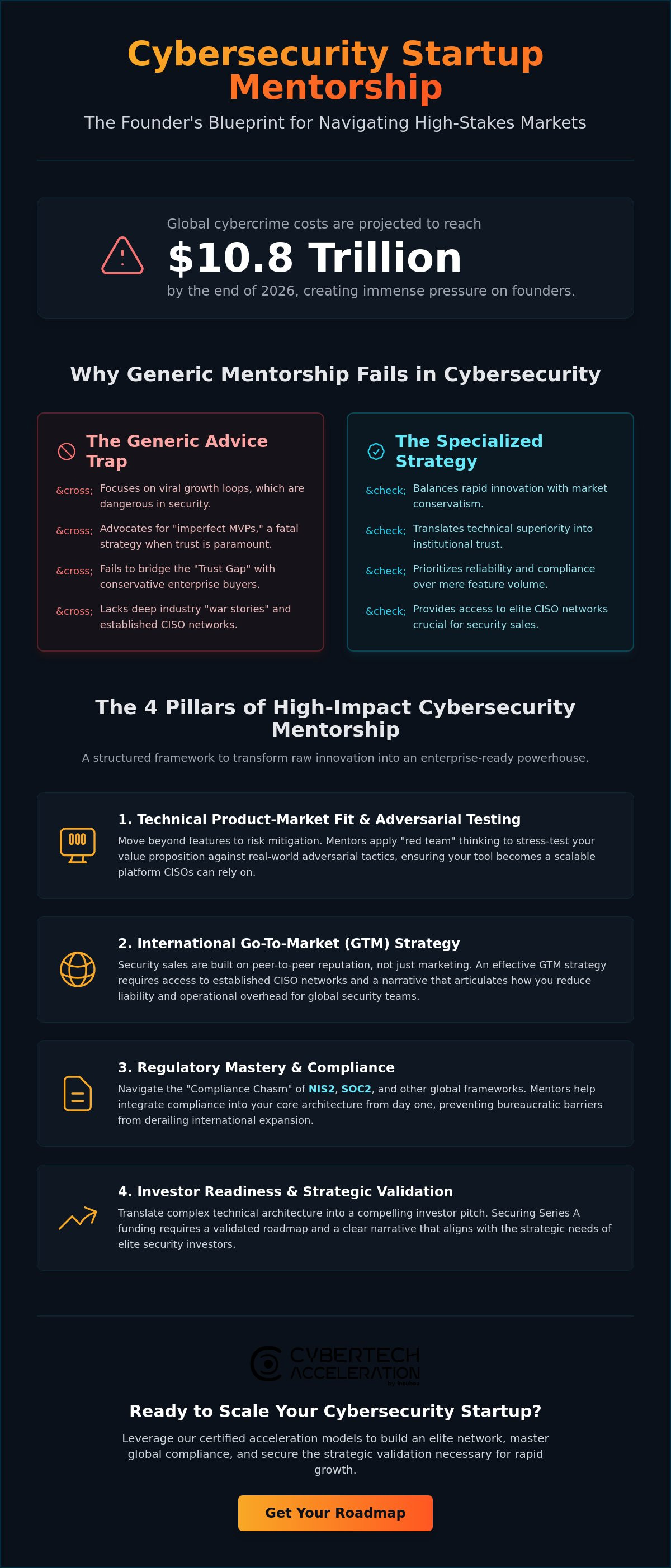
With global cybercrime costs projected to reach $10.8 trillion by the end of 2026, the pressure on founders to deliver flawless security solutions has never been higher. You likely recognize that generic business advice falls short in a sector defined by NIS2 compliance, SOC2 audits, and the high-stakes demands of global CISOs. Technical superiority is a prerequisite; however, it's rarely enough to secure market dominance on its own. This is why specialized cybersecurity startup mentorship is no longer a luxury but a strategic necessity for those aiming to bridge the gap between innovative code and international expansion.
We understand that translating complex technical architecture into a compelling investor pitch is a unique challenge. You deserve a roadmap that respects the nuances of the security industry while accelerating your path to product-market fit. This guide explores how to leverage expert guidance to navigate shifting regulations, build a network of elite security investors, and validate your strategic roadmap. By the end of this article, you will have a clear blueprint for securing Series A funding and achieving rapid growth in the world's most competitive security territories.
Key Takeaways
- Learn why generic business advice fails in high-compliance sectors and how specialized cybersecurity startup mentorship closes the trust gap with global buyers.
- Shift your focus from building a technical tool to developing a scalable security platform that aligns with the specific needs of enterprise CISOs.
- Navigate the regulatory hurdles of international expansion by mastering compliance frameworks like NIS2 and SOC2 across multiple territories simultaneously.
- Identify the critical traits of high-level mentors who can bridge the gap between technical engineering and strategic investor relations.
- Leverage certified acceleration models to build an elite network and secure the strategic validation necessary for rapid global growth.
Why Generic Mentorship Fails Cybersecurity Founders in 2026
Most entrepreneurial guidance focuses on rapid customer acquisition and viral growth loops. While these metrics matter for general software, they often lead security founders into a dangerous "growth at all costs" trap. True cybersecurity startup mentorship is a specialized strategic partnership designed for technical founders who must balance rapid innovation with the extreme conservatism of the security market. It isn't just about business advice; it's about translating technical superiority into institutional trust.
The primary hurdle for any new security firm is the "Trust Gap." Unlike standard B2B SaaS, where a software glitch might cause a minor productivity dip, a failure in a security product can lead to catastrophic data breaches and legal ruin. Consequently, security buyers require a level of validation that generalist Startup accelerators rarely understand. Following generic advice like "launch an imperfect MVP" can be fatal in this industry. If your early-stage product fails a single stress test or leaks client data, your brand is effectively finished before you've even reached your first funding round.
Effective mentors provide more than just a sounding board. They offer deep industry "war stories" and access to established CISO networks. These connections are vital because security sales are built on peer-to-peer reputation rather than flashy marketing. A mentor who has navigated the "founder-to-CEO" transition within this niche understands that your roadmap must prioritize reliability and compliance over mere feature volume.
The Technical Validation Trap
Many founders believe that having the most sophisticated algorithm or the fastest detection engine guarantees success. In 2026, the market is saturated with "better tech" that fails to solve actual operational pains for security teams. Specialized mentorship forces you to move beyond the lab and stress-test your claims against real-world adversarial tactics. Technical validation is the process of proving efficacy under adversarial conditions. Without this rigorous proof, your product remains a tool rather than a scalable security platform that an enterprise can rely on.
Navigating the Compliance Chasm
Regulatory hurdles often become the graveyard for promising security startups. Navigating the complexities of the NIS2 Directive in Europe or evolving federal requirements in the U.S. takes more than just a legal team; it requires a strategic vision. Specialized mentors help you bypass years of regulatory trial-and-error by integrating compliance into your core product architecture from day one. Utilizing a proven cybersecurity business scaling roadmap ensures that your global expansion plans aren't derailed by unforeseen bureaucratic barriers or certification delays.
The Four Pillars of High-Impact Cybersecurity Startup Mentorship
High-impact cybersecurity startup mentorship rests on a structured framework designed to transform raw innovation into an enterprise-ready powerhouse. While general business coaching focuses on broad KPIs, specialized security mentorship targets the specific friction points of the defense sector. Success in 2026 requires a rigorous focus on four foundational pillars: technical product-market fit, international go-to-market (GTM) strategy, regulatory mastery, and investor readiness. Each pillar serves as a critical checkpoint, ensuring your solution survives the scrutiny of both sophisticated attackers and skeptical procurement officers.
Technical PMF and Adversarial Testing
Effective mentors apply "red team" thinking to your business model, not just your code. They challenge your assumptions about how a product integrates into a modern Security Operations Center (SOC). To achieve true relevance, you must validate your use cases within the wider cybersecurity startup ecosystem. This involves moving beyond "feature" talk to "risk mitigation" talk. Instead of explaining how your AI detects threats, your narrative must articulate how it reduces a CISO's liability and operational overhead. Mentorship helps you stress-test these value propositions before you face a live enterprise pilot, ensuring your technology functions as a scalable platform rather than a siloed tool.
International GTM and Entry Barriers
Expanding across borders introduces a labyrinth of procurement hurdles and cultural sales nuances. A mentor acts as a global bridge-builder, opening doors to high-level cybersecurity industry connections that would otherwise take years to cultivate. For European innovators eyeing the North American market, understanding initiatives like America's Seed Fund can provide a blueprint for how the U.S. government fosters high-tech growth. Simultaneously, mentors help you adapt sales cycles for different regions. While U.S. procurement might prioritize speed and performance, EU markets often demand exhaustive proof of data sovereignty. Having "boots on the ground" mentorship allows you to navigate these regional preferences with precision. If you are looking to accelerate this transition, exploring specialized cybersecurity acceleration can provide the dedicated resources needed for such a complex expansion.
The final two pillars focus on turning bureaucracy into a weapon and securing the capital to scale. Regulatory and compliance mastery isn't just about checking boxes; it's about using certifications like NIS2 or SOC2 as a competitive sales advantage. Finally, investor readiness involves crafting a narrative that resonates with specialized cybersecurity VCs who understand the long sales cycles and high barriers to entry inherent in this field. By mastering these four pillars, founders move from technical experimentation to global market dominance.
Evaluating Mentorship Models: General Accelerators vs. Specialized Security Hubs
Choosing a mentorship model is a strategic decision that dictates your startup's trajectory for years. While generalist accelerators offer broad visibility and high-volume networking, they often lack the specialized CISO-level connections required to validate a security product. Cybersecurity startup mentorship within a dedicated hub provides a concentrated environment where every resource is tailored to the defense sector. These hubs integrate high-touch cybersecurity acceleration services with 1:1 mentorship, ensuring that technical founders aren't just building a business, but are aligning with the specific procurement realities of global security leaders.
Institutional credibility is another significant differentiator. Government-certified incubators provide a "seal of approval" that resonates with risk-averse enterprise buyers. This certification acts as a strategic shortcut to trust, signaling that your technology and business processes have undergone rigorous vetting. In a market where buyers are inundated with new tools, this institutional backing can be the deciding factor in securing a pilot program with a Fortune 500 company.
The Specialized Network Effect
A mentor's Rolodex is often the most valuable asset in your arsenal. In the security world, there is a profound difference between "knowing a guy" and having a seat at the CISO table. Generalist mentors might understand SaaS metrics, but they rarely have the direct line to the decision-makers who manage multi-million dollar security budgets. Specialized programs leverage cybersecurity startup networking events to accelerate trust through peer-to-peer introductions. These events aren't just mixers; they are high-stakes environments where founders can demonstrate technical depth to the very people who will eventually sign their contracts.
Cost-Benefit of Specialized Programs
Founders must weigh the cost of equity-based mentorship against the potential ROI of rapid market entry. While paid advisory services offer flexibility, cohort-based models often provide deeper integration into the investor ecosystem. The long-term ROI of avoiding a failed international market entry far outweighs the initial equity or fee commitment. Specialized hubs deliver superior ROI by cutting market penetration timelines in half compared to the trial-and-error approach of generalist programs. By choosing a specialized path, you invest in a roadmap that has been battle-tested by those who have already scaled global security firms.
A Founder’s Guide to Vetting High-Level Cybersecurity Mentors
Selecting a mentor is one of the most consequential strategic decisions you'll make as a technical founder. In the high-stakes security market, a mismatched advisor doesn't just waste time; they can lead you into regulatory traps or burn your reputation with elite investors. High-level cybersecurity startup mentorship requires a partner who has lived through the specific "Founder-to-CEO" transition. This evolution involves a radical shift from managing code repositories to managing global boardrooms and complex security ecosystems.
Prioritize technical depth that matches your own. Your mentor must speak the language of your engineering team while simultaneously translating that value for Series A investors. If they can't articulate how your architecture reduces a CISO's cyber-insurance premiums or aligns with the latest NIST framework updates, they won't be able to help you scale. Ensure their network reach extends into your target expansion markets. A mentor with deep roots in the U.S. security community is invaluable if you plan to move beyond European borders.
Assessing Strategic Alignment
Ask direct questions about enterprise procurement cycles. How do they handle the 12-month sales lag common in the defense sector? A major red flag is a lack of recent industry experience. The security landscape of 2026 moves too fast for advisors who haven't dealt with AI-driven threats or the operational realities of modern SOCs. Structure your engagement with clear, result-oriented milestones. Accountability ensures the relationship remains a strategic asset rather than a casual social call. Demand a mentor who is committed to long-term sustainable growth rather than quick, unvalidated wins.
Vetting for Global Expansion
Prioritize mentors who have successfully navigated the complexities of international market entry. This requires more than just sales contacts; it demands a sophisticated understanding of international data sovereignty laws and regional security requirements. Emerging tech hubs like Vila Nova de Gaia are becoming central to this global bridge-building effort. A mentor rooted in such a hub offers a unique vantage point on bridging European innovation with North American capital. They understand the bureaucratic hurdles of both regions and can provide the "boots on the ground" perspective necessary for a smooth transition. If you are ready to professionalize your scaling strategy, partner with our cybersecurity acceleration experts to access a vetted network of industry veterans.
Scaling Globally: The Incubou Mentorship Advantage
Accelerating your growth in the global security market requires a partner that offers both institutional credibility and deep industry expertise. Incubou distinguishes itself by integrating IAPMEI-certified acceleration with elite cybersecurity startup mentorship; we create a high-performance environment where technical innovation meets strategic execution. We act as a global bridge-builder, ensuring that European innovators don't just survive the transition to international markets but dominate them. By providing direct access to a proprietary network of industry experts and global CISOs, we remove the traditional barriers to entry that stall most early-stage firms.
Vila Nova de Gaia serves as our strategic launchpad, offering a sophisticated ecosystem for international security scaling. This location allows founders to leverage the benefits of a European base while executing a precise go-to-market strategy for the North American territory. Our approach is methodical and energetic, moving you quickly from high-level vision to granular, validated results. You aren't just joining a program; you're entering a collaborative and prestigious atmosphere designed to professionalize every aspect of your operation.
The Power of IAPMEI Certification
Securing IAPMEI certification provides more than just a title; it offers a strategic shortcut to institutional trust and funding access. This certification signals to investors and enterprise buyers that your business has met rigorous standards of excellence and operational reliability. An IAPMEI-certified partner in the EU ecosystem provides a recognized seal of excellence that streamlines access to specialized funding and institutional partnerships. We leverage this status to remove bureaucratic hurdles, allowing you to focus on product evolution and market penetration while we handle the complexities of the regulatory landscape.
Bridging the Gap to the US Market
Expanding into the United States is a primary goal for many cybersecurity firms, yet the complexities of international operations can be overwhelming. Incubou offers specific mentorship tracks designed to navigate these waters, from aligning with U.S. procurement cycles to mastering local data sovereignty requirements. We provide the perspective needed to adapt your sales narrative for North American CISOs without losing your technical core. This ensures your global expansion is both sustainable and rapid.
Ready to transform your technical innovation into a global security leader? Take the next step in your scaling journey and Apply for the Incubou Cybersecurity Acceleration Program today. Our structured journey is designed to guide you through every stage of international expansion with professional confidence and strategic ambition.
Securing Your Strategic Path to Global Dominance
The journey from technical innovation to global market leadership requires more than just a superior product; it demands a synchronized strategy of validation and regulatory navigation. You've discovered how specialized cybersecurity startup mentorship bridges the trust gap with enterprise buyers and provides the institutional credibility needed for rapid expansion. By aligning your roadmap with the needs of elite CISOs and mastering international compliance, you transform your startup from a niche tool into a scalable security powerhouse.
Incubou offers the professional confidence and strategic ambition required to navigate these high-stakes waters. As an IAPMEI-certified cybersecurity incubator, we provide specialized US market entry support and direct access to a global network of security industry experts. Don't let your innovation stall at the border of technical excellence. Scale your security innovation with Incubou's elite mentorship and build the bridge to your international future. Your vision for a secure global ecosystem is within reach; let's build it together.
Frequently Asked Questions
What is the difference between a business coach and a cybersecurity startup mentor?
A business coach typically focuses on general growth metrics and organizational hiring—a path often taken by B2C leaders through programs like Founder Freedom. In contrast, a cybersecurity startup mentor provides specialized guidance on technical validation, adversarial testing, and navigating the complex procurement cycles of enterprise CISOs. They understand the "Trust Gap" unique to the security industry, helping technical founders move from building a tool to managing a scalable security platform.
How do I find a mentor who understands cybersecurity regulations like NIS2 or SOC2?
Seek mentors within specialized security hubs or government-certified incubators that prioritize regulatory mastery. These professionals often have direct experience implementing compliance frameworks as a competitive sales advantage. High-level cybersecurity startup mentorship ensures your product architecture aligns with international data sovereignty laws from day one, saving you from costly technical debt during global expansion.
Does a cybersecurity startup really need a specialized mentor to scale?
Yes, because the security market operates under higher stakes than standard B2B SaaS. Generic business advice often ignores the rigorous stress-testing and institutional vetting required by enterprise buyers. A specialized mentor provides the "war stories" and peer-to-peer reputation needed to secure pilots with risk-averse organizations, which is critical for achieving rapid product-market fit.
How much equity do cybersecurity mentors typically expect?
Individual advisors often request between 0.25% and 1% equity, depending on their involvement and the startup's current stage. Structured acceleration programs may have different models that integrate mentorship with broader scaling services. You should prioritize mentors who demonstrate a commitment to long-term sustainable growth rather than those seeking quick, unvalidated wins.
Can a mentor help my cybersecurity startup enter the US market from Europe?
Strategic bridge-builders specialize in facilitating this specific transition. They help you adapt sales cycles for North American procurement and navigate federal security requirements. A mentor with "boots on the ground" in both regions can open doors to elite investor networks and help you establish the local market presence necessary for international dominance.
What should I look for in a cybersecurity mentor's background?
Prioritize individuals who have successfully navigated the "Founder-to-CEO" transition within the security niche. They must possess the technical depth to speak with your engineers and the strategic vision to engage with your board. Look for a proven track record of scaling security firms and an active Rolodex of CISO-level industry connections.
How often should a founder meet with their cybersecurity mentor?
Most successful founders maintain a bi-weekly cadence for strategic alignment and roadmap reviews. This frequency allows for consistent stress-testing of business assumptions without micromanaging daily operations. Ad-hoc sessions are often necessary during critical phases like Series A fundraising or major international pilot launches to ensure you remain agile.
Is mentorship included in cybersecurity acceleration programs?
Mentorship is a foundational pillar of any high-impact acceleration program. These programs integrate 1:1 guidance with cohort-based learning and institutional credibility. By participating in a certified program, you gain access to a structured journey that combines expert mentorship with the technical and legal resources required for global scaling.


