

Why do most cybersecurity founders treat international growth as a sales challenge when it's actually a trust-validation exercise? You already know that scaling your technology across borders requires more than a localized pitch. It demands navigating a fragmented regulatory landscape where the SEC’s Regulation S-P compliance deadline of June 3, 2026, and California’s updated CCPA audit requirements create high stakes for any newcomer. Mastering global expansion for cybersecurity firms means moving beyond the fear of failed market entry and the high costs of regulatory missteps. You need a steady hand to guide you through these bureaucratic hurdles while you focus on innovation.
This guide empowers you to conquer these complexities by providing a clear roadmap for U.S. market entry and sophisticated selection criteria for expansion partners. You'll learn how to bridge the gap between foreign sovereign security requirements and your growth ambitions. We explore the strategic frameworks necessary to reduce your time-to-revenue, validate your technology in new territories, and secure a dominant position in the $522 billion global security market. From managing AI-driven threat landscapes to meeting the 72-hour CIRCIA reporting mandates, this is your blueprint for sustainable international success in an increasingly complex world.
Key Takeaways
- Define global expansion for cybersecurity firms as a strategic alignment of technology, compliance, and localized trust frameworks. Learn why digital sovereignty demands a security-first approach to internationalization.
- Identify high-growth opportunities by prioritizing market accessibility and regulatory alignment over sheer market size. Evaluate the gap between your current certifications and specific regional requirements.
- Distinguish between generic business consultants and specialized cybersecurity accelerators to ensure your partner understands technical nuances. Discover why IAPMEI certification is a critical benchmark for European-based startups.
- Navigate the complexities of U.S. market entry by breaking down the distinct tracks for Federal and Commercial sales. Stop treating the U.S. as a monolithic entity and start targeting specific high-value sectors.
- Leverage a certified launchpad like the Vila Nova de Gaia hub to scale your security technology with reduced risk. Accelerate your global journey through a structured, high-reward bridge to international markets.
What is Global Expansion for Cybersecurity Firms in 2026?
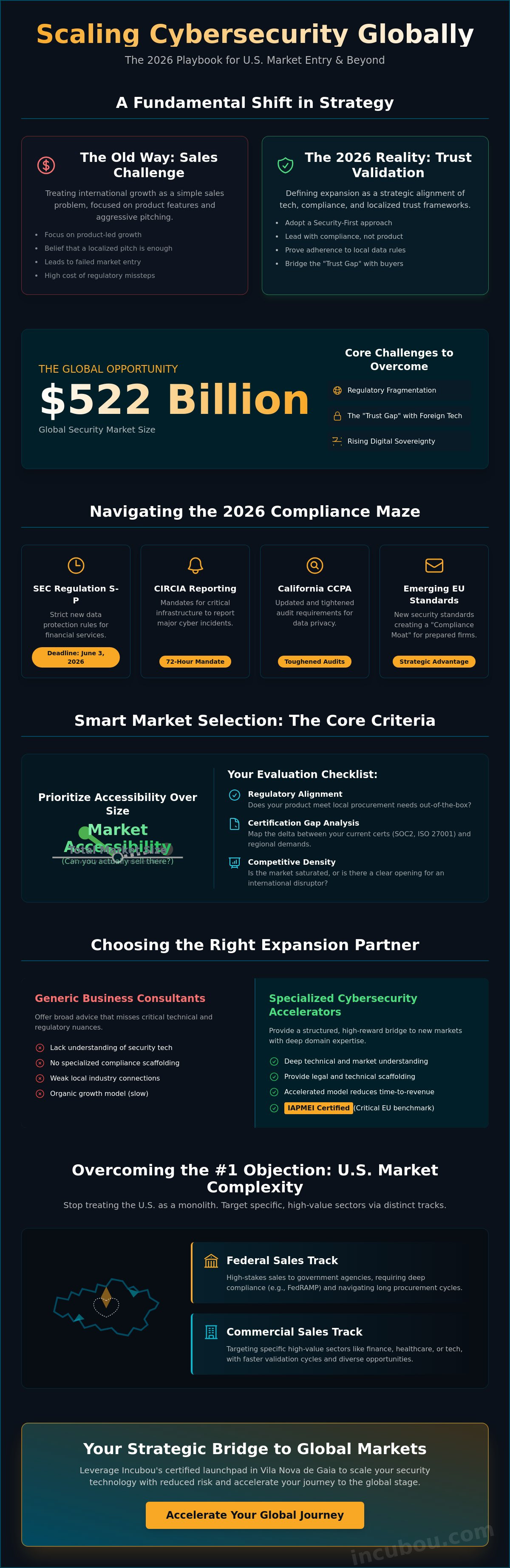
Global expansion for cybersecurity firms in 2026 represents a fundamental shift in how security technology crosses borders. It isn't merely a sales exercise; it's the strategic process of localizing technology, aligning with specific compliance mandates, and building trust frameworks within sovereign markets. While older market entry strategies focused on broad reach, today's winners prioritize a "Security-First" approach. This means your expansion is compliance-led rather than product-led. If you don't prove you meet local data residency and incident reporting rules, your product's features won't matter to the sophisticated buyer. Organic growth often stalls because it lacks this regulatory focus, whereas accelerated models provide the necessary legal and technical scaffolding from day one.
The Evolution of International Market Entry
The 2020 era of "growth at all costs" has been replaced by a focus on sustainable, high-validation entry. In 2026, the landscape is defined by its fragmentation. AI-driven threat landscapes move too fast for centralized, one-size-fits-all defenses, requiring solutions that are tuned to local nuances. This acceleration forces firms to adopt regional hubs that can respond to localized threats and regulations in real time. Rather than managing everything from a distant central headquarters, successful firms use these hubs to embed themselves into the local ecosystem. These hubs act as nerve centers, ensuring the firm remains agile while meeting the specific demands of regional critical infrastructure.
The "Trust Gap" in Cross-Border Security Sales
Security is inherently personal and political. Buyers often hesitate to purchase foreign security software due to fears of backdoors, data leaks, or jurisdictional conflicts. Bridging this "trust gap" requires more than a translated website; it requires local validation and deep industry connections that prove you're a safe partner. Navigating regulatory fragmentation, such as the gap between GDPR and the June 2026 SEC compliance deadline for Regulation S-P, is no longer optional. In 2026, Digital Sovereignty is defined as the absolute authority of a nation to govern its digital infrastructure, data, and security protocols independently of foreign influence. To succeed, you must demonstrate that your technology respects these boundaries while providing superior protection. Localized trust isn't a secondary goal. It's the primary requirement for any firm hoping to scale its security technology across international borders.
Core Criteria for Evaluating International Markets
Scale demands precision. While Gartner forecasts global security spending to reach $240 billion in 2026, chasing the largest Total Addressable Market (TAM) often leads to friction. Successful global expansion for cybersecurity firms requires a clinical assessment of market accessibility. Can you actually sell there? Market size is a vanity metric if the regulatory hurdles or the "Trust Gap" prevent you from closing your first ten enterprise deals. You must prioritize regions where your current technical certifications align with local procurement needs, reducing the friction of your initial entry.
Your current certifications act as your passport. If you've mastered SOC2 or ISO 27001, you're halfway there, but 2026 brings new hurdles. The SEC’s Regulation S-P deadline on June 3, 2026, and California’s tightened CCPA reporting rules demand specific technical adjustments. Map the delta between your current posture and these local requirements before committing capital. Beyond compliance, evaluate competitive density. Is the market saturated with local incumbents, or is there a clear opening for international disruptors with superior AI-driven defenses?
Regulatory and Compliance Mapping
Treat compliance as a strategic asset. By aligning your product with the May 2026 CIRCIA mandates or the emerging 2026 EU security standards early, you build a "Compliance Moat" that keeps less agile competitors out. Using a cybersecurity business scaling roadmap helps you sequence these entries based on where your current tech stack has the least friction. It’s about finding the path of least resistance to revenue while ensuring your data handling meets the highest regional standards.
Assessing Ecosystem Maturity
Look beyond the customers. Evaluate the availability of specialized talent and the strength of the local support ecosystem. Are there specialized security investors and a robust network of channel partners? Resources like the U.S. Commercial Service provide invaluable intelligence for firms eyeing the $18.8 billion federal market. Identify "Early Adopter" industries, such as marine transportation, which faces a January 12, 2026, deadline for new cybersecurity training regulations. These pockets of urgent demand offer the best opportunities for local pilot programs and technical validation. Success hinges on moving from a broad vision to a granular execution plan. If you're ready to validate your tech in a high-growth environment, consider how partnering with a specialized accelerator can streamline your entry into these complex territories.
Selecting an Expansion Partner: A Strategic Buying Guide
Choosing a partner to facilitate global expansion for cybersecurity firms is a decision that determines your trajectory for the next decade. You aren't just buying advice; you're buying a network and a validation engine. Generic business consultants often struggle with the technical nuances of security procurement, such as the trust gap discussed earlier. They might understand market entry, but they don't understand how a CISO evaluates a foreign-made kernel-level agent. You need a partner that acts as a sophisticated mentor, bridging the gap between your engineering excellence and the bureaucratic hurdles of international business.
Accelerator vs. Consultancy: Which Do You Need?
The distinction between these two models is fundamental to your speed-to-market. Consultancies typically provide the "what"—market reports and high-level strategy—often for a significant upfront fee. In contrast, specialized cybersecurity acceleration services provide the "how" and the "who." They offer hands-on support, technical validation, and direct introductions to decision-makers. For technical founders, an equity-based acceleration model often aligns interests better than a fee-based consultant, as the accelerator's success is directly tied to your international revenue growth. They don't just tell you to enter the U.S. market; they walk you through the door.
Validation from a certified institution, such as an IAPMEI-certified partner, is indispensable for European startups. It provides a layer of credibility that helps overcome the hesitancy of foreign buyers. This is particularly vital in a year where the Global Cybersecurity Outlook 2026 highlights increasing geopolitical tensions and regulatory volatility. With 94% of security leaders identifying AI as the primary driver of change, your partner must possess the technical depth to validate your AI-driven defenses in front of local regulatory bodies and industry giants. A partner with a "Network Effect" that reaches directly into the offices of global CSOs is your most valuable asset.
Key Questions to Ask Potential Partners
Don't settle for vague promises of global reach. Use these specific questions to vet your potential expansion partner and ensure they offer the hands-on support your technology deserves:
- "What is your specific track record with US market entry for European startups?" Look for recent case studies that match your sub-sector and technical complexity.
- "Do you provide technical validation or just business development?" A partner who can't speak the language of your CISO leads is a strategic liability.
- "How do you facilitate connections with local regulatory bodies?" They should have a clear process for navigating the June 2026 SEC compliance deadlines and CIRCIA mandates.
- "Does your model offer 'hands-on' operational support?" Determine if they'll help you hire your first local sales engineer or simply provide a list of recruiters.
Overcoming the #1 Objection: The Complexity of US Market Entry
Many founders hesitate because they view the U.S. as an impenetrable monolith. In reality, the U.S. is a diverse patchwork of distinct regulatory environments and procurement tracks. Success in global expansion for cybersecurity firms requires you to choose your lane early: the $18.8 billion federal market or the high-velocity commercial sector. Each path demands a different approach to validation. While federal contracts often require rigorous FedRAMP certification, commercial success hinges on meeting a growing list of state-level privacy laws like California’s CCPA. You don't need to conquer every state at once. Start where your technology has the strongest regulatory alignment.
Soft landing programs significantly reduce the risk and overhead of this entry. Instead of committing to a massive local headcount, you can leverage a structured go-to-market strategy for cybersecurity to navigate these waters. These programs provide the physical and legal infrastructure needed to establish a U.S. presence without the traditional price tag. They offer a low-risk environment to test your value proposition before scaling your operations.
Navigating the US Regulatory Maze
Compliance is the price of entry. In 2026, U.S.-based data residency has become a non-negotiable requirement for critical infrastructure and financial services. You must align with the SEC's Regulation S-P requirements by the June 3, 2026, deadline while managing the evolving complexities of CCPA and CPRA audits. The 2026 Executive Order on foreign software procurement mandates that all international security vendors provide verified transparency reports to ensure national digital resilience. Mastery of these rules transforms a bureaucratic hurdle into a competitive advantage.
Building a US Presence Without the US Price Tag
Smart scaling avoids the burn rate of a full-scale Silicon Valley office. Use virtual offices and fractional U.S. leadership to maintain a local face while keeping your R&D in lower-cost regions. Bridge accelerators that operate across both EU and U.S. time zones provide the energetic momentum needed to stay connected to both markets. These partners help you execute cybersecurity market penetration tactics that focus on high-impact pilot programs rather than broad marketing spend. If you're ready to bypass the traditional barriers to entry, explore how our specialized acceleration services can facilitate your U.S. debut with surgical precision.
Incubou: Your Strategic Bridge to Global Cybersecurity Markets
Incubou stands as the definitive partner for founders ready to transcend local boundaries. As an IAPMEI-certified cybersecurity accelerator, we don't just offer high-level advice; we provide the structural support necessary for sustainable global expansion for cybersecurity firms. Our Vila Nova de Gaia hub serves as a prestigious, low-risk launchpad, strategically positioned to connect European innovation with the massive potential of the U.S. and wider international markets. We understand that in 2026, technical excellence must be matched by regulatory mastery and a refined business model that speaks the language of global enterprise.
Our approach balances business model refinement with rigorous technical validation. This dual focus ensures your technology isn't just functional but also "market-ready" for the most demanding CSOs and CISOs. We provide the steady hand needed to navigate the June 2026 compliance deadlines and the shifting requirements of digital sovereignty. By acting as a sophisticated mentor, we empower you to bypass the traditional hurdles that often lead to failed market entries, turning international growth into a predictable, repeatable process.
Tailored Acceleration for Security Innovators
We design custom programs that mirror the unique lifecycle of security technology. Our mentors aren't generalists; they're seasoned industry experts and C-level leaders who have navigated the same bureaucratic hurdles you face today. These experts provide direct lines to key decision-makers, helping you build the localized trust essential for cross-border success. We remove the friction of international expansion by handling the heavy lifting of ecosystem integration, allowing you to focus on your core mission of protecting digital assets.
Next Steps: Validating Your Global Potential
Your journey toward global leadership begins with a clinical validation of your potential. When you apply for our specialized acceleration programs, we look for innovators ready to scale their impact across the $522 billion security market. In the first 90 days of an Incubou partnership, you'll refine your U.S. market entry strategy, secure technical validation from local experts, and begin establishing the industry connections that drive long-term revenue. It's a structured, energetic journey from local innovator to global authority. Scale your cybersecurity firm globally with Incubou and secure your strategic advantage in the 2026 landscape.
Secure Your Global Future Today
The window for international leadership is wide open for those who prioritize trust over simple transactions. You've now identified the core criteria for market selection and the critical differences between generic consulting and specialized acceleration. Success in 2026 hinges on your ability to turn complex regulatory hurdles into sustainable competitive moats. Mastering global expansion for cybersecurity firms requires a clinical focus on technical validation and the strategic alignment of your product with regional digital sovereignty. It's about moving from a local innovator to a global authority with precision and speed.
Incubou provides the steady hand you need to navigate these high-stakes transitions. As an IAPMEI-certified cybersecurity accelerator, we offer specialized US market entry support from our hub in the emerging tech center of Vila Nova de Gaia. We bridge the gap between your engineering excellence and the bureaucratic demands of global procurement. Your mission to protect the digital world deserves a partner that understands the technical and strategic nuances of the security sector. Partner with Incubou for your global expansion strategy and transform your vision into a dominant international reality. The global stage is ready for your innovation.
Frequently Asked Questions
Why is global expansion more difficult for cybersecurity firms than other SaaS companies?
Cybersecurity expansion is uniquely complex because it requires overcoming a deep "Trust Gap" and navigating digital sovereignty. Unlike general SaaS, security tools often require deep system access, which triggers national security concerns and jurisdictional hesitancy from foreign buyers. Success in global expansion for cybersecurity firms depends on your ability to prove your technology respects local data residency while providing superior AI-driven protection.
What are the most important certifications for entering the US cybersecurity market in 2026?
You must prioritize FedRAMP for federal contracts and SOC2 for the commercial sector. Additionally, your technology must align with the SEC’s Regulation S-P requirements by the June 3, 2026, compliance deadline. Meeting California’s updated CCPA audit requirements is also essential for any firm targeting the U.S. commercial market, as these certifications serve as critical trust markers for enterprise buyers.
How long does the typical global expansion process take for a Series A startup?
A typical journey for a Series A startup to achieve significant revenue in a new market takes 12 to 18 months. This timeline includes technical validation, regulatory alignment, and building local industry connections. Specialized acceleration models aim to reduce this time-to-revenue by providing an established framework for global expansion for cybersecurity firms, allowing you to bypass common bureaucratic hurdles and pilot your technology faster.
Can a European cybersecurity firm realistically compete with US-based incumbents?
European firms possess a strategic advantage by leveraging high privacy standards and sophisticated AI-driven defense mechanisms. You can compete effectively by highlighting your compliance with GDPR and your ability to meet the strict 2026 U.S. Executive Order transparency reports. Success requires a localized sales track and technical validation from a partner who understands the nuances of the U.S. procurement landscape.
What is an IAPMEI-certified accelerator and why does it matter for my startup?
An IAPMEI-certified accelerator is a partner recognized by Portugal’s Agency for Competitiveness and Innovation for its high standards in supporting high-growth firms. This certification provides a layer of institutional credibility that is vital when entering foreign markets. It ensures your startup receives sophisticated mentorship and access to a global ecosystem of investors and industry leaders who understand the high-stakes nature of security technology.
How much equity do cybersecurity accelerators typically take for expansion support?
Equity requirements vary depending on the depth of the "hands-on" support and the level of technical validation provided. These models align the interests of the accelerator with your own international scaling milestones. Rather than charging high upfront fees, this structure ensures your partner is fully invested in reducing your time-to-revenue and securing your dominant position in the global market.
Is Vila Nova de Gaia a viable hub for international cybersecurity scaling?
Vila Nova de Gaia has emerged as a high-reward tech hub that offers a strategic bridge between European innovation and global markets. It provides a lower-cost environment for R&D while maintaining the sophisticated infrastructure needed for international scaling. This location allows technical founders to refine their business models and validate their technology before committing to the higher overhead of a U.S. headquarters.
What is the "Soft Landing" approach to US market entry?
The "Soft Landing" approach allows firms to establish a U.S. presence without the massive costs of immediate local hiring. By utilizing virtual offices, fractional leadership, and bridge accelerators, you can validate your product in the U.S. market while keeping your core operations in a lower-cost region. This strategy minimizes initial overhead and provides a structured environment to test your value proposition before scaling your local headcount.


