

With global end-user spending on information security projected to reach $240 billion by the end of 2026, the real question isn't whether the budget exists, but why so many innovative firms fail to capture it. Achieving successful cybersecurity market penetration requires more than a superior product; it demands a surgical approach to overcoming the high noise-to-signal ratio that defines the current sector. You've likely felt the frustration of having a transformative solution that remains buried under the weight of complex US regulatory hurdles or the skepticism of enterprise CISOs. We understand that building trust in a market where the average cost of a data breach has climbed to $10.22 million is a high-stakes challenge that requires a steady, expert hand.
This guide provides the master frameworks and accelerated tactics you need to penetrate the competitive global market and scale your innovation with confidence. You'll gain a clear roadmap for international scaling that bypasses traditional bureaucratic delays and accelerates your growth. We'll explore validation strategies for new security tech and specific methods to reduce your time-to-market for global entry. From navigating the final CMMC rules to aligning with the latest NIST 2.0 governance standards, you're about to learn how to transform your technical edge into a dominant global presence.
Key Takeaways
- Shift from general security tools to specialized AI defensive platforms to meet the specific demands of the 2026 security landscape.
- Overcome the trust gap with enterprise CISOs by prioritizing technical validation for more effective cybersecurity market penetration.
- Minimize time-to-market and avoid the high costs of solo entry by utilizing specialized launchpads for international expansion.
- Transition your security solution from a standalone tool to a comprehensive strategic platform to align with global enterprise needs.
- Utilize certified acceleration frameworks to bridge the critical gap between European innovation and the complex US security market.
The 2026 Cybersecurity Market Penetration Landscape
Strategic market penetration in the current year isn't just about sales volume. It's about the evolution from a niche innovator to a scalable enterprise partner. By 2026, the cybersecurity market has matured into a $300 billion ecosystem where generalist tools are losing ground. Today's successful entrants focus on specialized, AI-defensive platforms that address specific, high-stakes vulnerabilities as part of their cybersecurity market penetration strategy. The old "brute force" sales models that relied on sheer volume are failing. CISOs are facing a high noise-to-signal ratio and have become immune to generic pitches. They don't want more tools; they want validated security. This shift has made "security-by-validation" the primary driver for successful entry. You must prove your technology works in real-world scenarios before you ever reach the negotiation table. This requires a shift in mindset from "selling features" to "proving outcomes" through rigorous, third-party testing and transparent performance data.
The Impact of Generative AI on Entry Speed
Generative AI has fundamentally changed the tempo of the industry. AI-driven threats, such as sophisticated deepfakes and automated exploit generation, have significantly compressed the window for successful cybersecurity market penetration. If you can't demonstrate your solution's effectiveness against these rapid-fire threats immediately, you'll be left behind. Procurement teams now prioritize vendors who can show proactive defense rather than reactive patching. They look for systems that can anticipate adversarial shifts in real-time. AI-resilience is the new baseline for 2026 procurement. You need to show that your platform isn't just "AI-powered" but is actually capable of neutralizing AI-native attacks that evolve hourly.
Integrating these data streams into the high-performance visual environments used in mission-critical control rooms, such as those designed by Activu Corporation, allows security teams to respond to intelligence with maximum speed and clarity.
Regional Dynamics: Why the US Remains the Primary Target
North America continues to command the lion's share of global cybersecurity spend, with Gartner projecting end-user spending to hit $240 billion globally this year. The concentration of venture capital and enterprise headquarters makes the US an unavoidable destination for any serious scaling effort. However, entry isn't free. US-based compliance standards like SOC2 and HIPAA act as significant filters that can stall a launch for months. European startups often struggle because they treat these as afterthoughts rather than core GTM requirements. You can't just export a European strategy and expect it to stick. You must pivot your messaging and operations to meet the specific, aggressive expectations of the US market. Successful expansion requires aligning your technical validation with the rigorous regulatory hurdles that US enterprises use to vet their strategic partners. It's a high-stakes environment that rewards those who arrive prepared with both technical proof and regulatory compliance.
Overcoming the Trust Gap: The Core Barrier to Penetration
Enterprises often fear "startup risk" more than the cyber threats themselves. This inherent skepticism creates a formidable barrier to cybersecurity market penetration. When a CISO evaluates a new solution, they aren't just looking at the code; they're looking at the company's longevity and reliability. To bridge this gap, you must move beyond marketing claims and provide tangible technical validation. Third-party certifications and rigorous stress testing act as the foundation of this trust. They provide the objective proof that your tech can withstand the threat vectors of 2026. You don't want to be seen as a gamble; you want to be seen as a certainty.
Leverage design partners to build the social proof required for high-level entry. These early adopters provide the case studies and testimonials that validate your solution in real-world environments. Strategic alignment with established security ecosystems also helps. By integrating with existing platforms, you bypass the friction of a "cold entry" and position your innovation as a complementary asset rather than a disruptive risk. This approach aligns with the broader goals of the U.S. International Cyberspace & Digital Policy Strategy, which emphasizes secure, resilient digital ecosystems. By demonstrating how your tool fits into this global framework, you build immediate credibility with institutional buyers.
Regulatory Compliance as a Penetration Tool
Don't treat GDPR or SOC2 as mere checkboxes. Use them as competitive advantages. In a landscape defined by strict data sovereignty laws, being "compliant by design" allows you to enter restricted markets faster than less-prepared competitors. For European firms, obtaining IAPMEI certification is a critical step in signaling institutional trust to global partners. It shows you've met high standards of business excellence and technical rigor. Navigating these requirements early ensures you don't hit a wall during the final stages of a deal.
The Mentorship Advantage
Industry-specific mentorship is the fastest way to navigate the trust gap. It's about more than advice; it's about access. Accelerator networks provide the warm introductions to global CISOs that would take years to build independently. These mentors help you refine your business model to meet the specific, often grueling, procurement cycles of large enterprises. If you want to accelerate this journey, exploring cybersecurity acceleration programs can provide the strategic bridge you need to reach global markets. By aligning your innovation with the reliability of a certified institution, you reduce the perceived risk for enterprise buyers and accelerate your cybersecurity market penetration.
Organic Growth vs. Accelerated Market Entry
Choosing between organic growth and accelerated entry is a pivotal decision for any security founder. Solo market entry often results in a multi-year timeline filled with trial and error. This "learning by doing" approach carries hidden costs that can cripple a startup during international expansion. You aren't just spending money; you're burning through your most valuable asset: time. Achieving cybersecurity market penetration requires a level of precision that solo efforts rarely match. By using a specialized launchpad, you replace uncertainty with a proven framework. This preserves your capital for Series A and ensures your burn rate stays manageable during the critical expansion phase. Accelerators act as a vital filter, helping you avoid the common market entry mistakes that derail even the most technical innovations.
The Cost of Delayed Entry
A failed six-month pilot in the US market isn't just a loss of budget. It's a loss of momentum that competitors will exploit. In the 2026 security landscape, being a "fast follower" is a dangerous gamble. The market moves too quickly for those who wait to see what works for others. A delayed entry allows incumbents to patch their vulnerabilities and lock in enterprise contracts before you even arrive. Accelerated entry can reduce customer acquisition costs (CAC) by leveraging pre-validated trust and established channel partnerships. You get to the "yes" faster because the groundwork of credibility has already been laid, allowing you to capture market share while the opportunity is still fresh.
Strategic Network Effects
Success in internationalization isn't a solitary pursuit. Being part of a curated cybersecurity ecosystem in Vila Nova de Gaia provides immediate access to peer-to-peer founder networks. These connections accelerate your learning curve by sharing real-time market intelligence that you won't find in any industry report. You benefit from the collective experience of those who have already navigated the specific hurdles of cybersecurity market penetration in diverse regions. Leveraging the reputation of a certified incubator also helps you attract top-tier talent who want the stability of a validated venture. It transforms your expansion from a risky bet into a strategic move supported by a global community of innovators and experts.
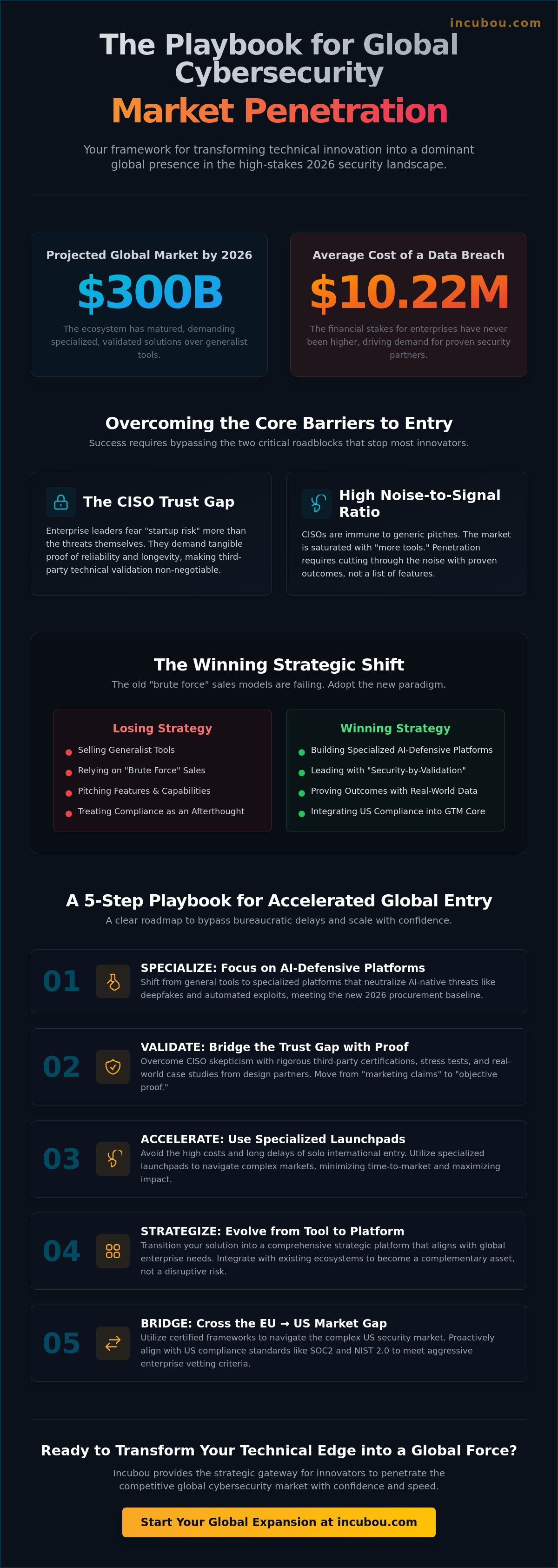
A 5-Step Playbook for Global Cybersecurity Penetration
Success in international expansion isn't a matter of luck. It's the result of a deliberate, repeatable process. Achieving deep cybersecurity market penetration requires a structured methodology that addresses both technical superiority and business alignment. This playbook outlines the critical phases for scaling your innovation across borders.
- Step 1: Technical Validation. You must stress-test your solution against the latest 2026 threat vectors. This includes neutralizing AI-generated exploits and synthetic identity fraud.
- Step 2: Business Model Refinement. Transition your offering from a standalone "tool" to a "strategic platform." Enterprise buyers want integrated solutions that reduce tool sprawl.
- Step 3: Ecosystem Integration. Identify the right API and channel partners. Your solution must play well with existing security infrastructure and common enterprise security platforms.
- Step 4: Regional Compliance. Secure the necessary certifications for your target territory. For the US market, this means aligning with the CMMC final rule issued in late 2025.
- Step 5: Accelerated Launch. Leverage a certified incubator to execute a high-impact entry. This provides the institutional backing needed to bypass traditional sales friction.
Refining the B2B Sales Strategy
Modern procurement has moved past technical feature-dumping. The C-suite cares about value-based outcomes, not just lines of code. Implement a "Land and Expand" strategy where you secure an initial foothold and grow your footprint through proven results. Shift your focus from a Proof of Concept (PoC) to a Proof of Value (PoV). While a PoC shows that it works, a PoV demonstrates the actual business impact and ROI. This approach accelerates cybersecurity market penetration by speaking the language of risk management rather than just technical defense. It turns your product into a business necessity.
Preparing for Investment Readiness
Your market penetration metrics will directly influence your Series A and Series B valuations. In 2026, cybersecurity investors look for more than just simple MRR. They want to see international growth, AI-resilience, and a diversified cap table that includes global stakeholders. Demonstrating a clear roadmap for international scaling proves that your business model is portable and resilient. Investors reward companies that show they can navigate complex regulatory environments like the NIST 2.0 framework. If you're ready to prove your global potential, you can join our cybersecurity expansion program to refine your metrics and connect with top-tier investors who value global vision.
Incubou: Your Strategic Gateway to Global Cybersecurity Success
Incubou serves as the premier IAPMEI-certified accelerator designed specifically for security innovators ready to scale. We recognize that technical brilliance isn't enough to secure a foothold in a market defined by high barriers and institutional skepticism. Our specialized mentorship program removes the traditional friction points that stall growth. By working with an IAPMEI-certified growth partner, you gain the credibility required to engage with global stakeholders. We act as a sophisticated mentor, guiding you through the technical nuances and bureaucratic hurdles of international business expansion. Our approach ensures you don't just enter a market; you command it.
Bridging the gap between European innovation and US market demand is our core mission. We help you translate your technical edge into a language that US procurement teams and CISOs respect. This strategic alignment is essential for successful cybersecurity market penetration in a landscape where trust is the primary currency. Our industry connections extend far beyond local borders, providing you with a global bridge-builder that understands the high-stakes nature of the technology sector. We empower founders to move from local success to global dominance with professional confidence and strategic ambition.
Vila Nova de Gaia: The Emerging Cyber Innovation Hub
Choosing the right location for your expansion provides a unique strategic advantage. Vila Nova de Gaia has emerged as a curated community of experts, investors, and fellow founders who share a common vision for the future of security. This ecosystem fosters rapid development and peer-to-peer learning, allowing you to bypass the "learning by doing" phase mentioned earlier. You gain access to a dense network of professionals who understand the specific challenges of the 2026 security environment. It's a high-level strategic partnership that places you at the center of a wider, connected ecosystem that values both innovation and reliability.
Next Steps for Your Global Expansion
Preparing your startup for the next level of cybersecurity market penetration requires more than just a plan; it requires the right partners. You need to ensure your technical validation is airtight and your business model is refined for global procurement cycles. Our acceleration programs are designed to stress-test your strategy and prepare you for high-impact market entry. We move quickly from high-level vision to granular benefits, ensuring you're ready for the fast-paced nature of the startup world. If you're ready to scale your innovation and secure your place in the global market, the path forward is clear. Fast-track your market entry with Incubou today and join a prestigious community of innovators redefining the digital landscape.
Secure Your Global Future
Mastering the 2026 security landscape requires a shift from technical isolation to strategic integration. Successful cybersecurity market penetration now depends on your ability to prove technical resilience while navigating complex international regulations. You've learned that transitioning from a standalone tool to a strategic platform is essential for capturing enterprise interest. By prioritizing third-party validation and leveraging established networks, you can bypass the "burn rate trap" and secure your expansion with confidence. The path to global dominance is no longer a mystery; it's a structured journey that rewards those who arrive prepared.
As an IAPMEI-certified cybersecurity incubator, we provide the specialized focus required for seamless US and international market entry. Our deep network of industry-specific mentors and investors stands ready to act as your global bridge-builder. Don't let your innovation get lost in the noise of a saturated market. Apply to Incubou and scale your cybersecurity innovation globally. We're here to help you turn your technical edge into a dominant global presence. Your journey toward international success starts with a single strategic step. We look forward to building the future of security together.
Frequently Asked Questions
What is the most effective cybersecurity market penetration strategy in 2026?
The most effective strategy focuses on AI-resilience and Proof of Value (PoV) rather than traditional feature-dumping. Successful cybersecurity market penetration requires integrating your solution into established platforms like Prisma 3.0 or CrowdStrike Falcon. This approach reduces friction and aligns with the industry trend toward platform consolidation. Buyers want solutions that neutralize AI-native threats in real-time, moving from a tool-centric pitch to becoming a strategic risk-management partner for the C-suite.
How much does it cost for a cybersecurity startup to enter the US market?
Entering the US market requires a significant investment in legal compliance, talent acquisition, and local marketing. While specific figures vary based on sector, expenses typically cover SOC2 audits, regulatory filings, and establishing a local sales presence. Many firms find that the "hidden costs" of learning by doing can quickly deplete their capital. Using an accelerator helps mitigate these financial risks by providing a structured roadmap and shared resources that optimize resource allocation.
Why do most cybersecurity startups fail during international expansion?
Most failures stem from underestimating the "Trust Gap" and the complexity of regional regulatory hurdles. Startups often attempt a "cold entry" without the social proof or local validation that enterprise CISOs demand. Relying on a generic sales pitch instead of demonstrating resilience against 2026 threat vectors like synthetic identity fraud leads to rejection. Without a warm network or institutional backing, building the necessary credibility takes longer than most startup burn rates allow.
What certifications are required for cybersecurity market entry in North America?
Essential certifications include SOC2, HIPAA for healthcare, and the CMMC final rule for defense-related contracts. Compliance with the NIST Cybersecurity Framework 2.0 is now a baseline requirement for most enterprise procurement processes. These aren't just legal hurdles; they serve as critical validation tools that signal reliability to risk-averse buyers. Securing these credentials early is a prerequisite for any serious cybersecurity market penetration attempt in the US and Canada.
How does a cybersecurity accelerator help with market penetration?
An accelerator provides the institutional backing and warm introductions needed to bypass traditional sales friction. It offers specialized mentorship to refine your business model for global procurement cycles and stress-tests your technology against current threat vectors. These programs act as a strategic bridge, connecting innovators with US-based investors and enterprise partners. By providing a pre-validated framework, an accelerator reduces your time-to-market and ensures your solution meets international standards from day one.
Can a European cybersecurity startup successfully compete in the US market?
European startups can successfully compete by leveraging their rigorous focus on data privacy and sovereign security as a competitive advantage. Success depends on pivoting the go-to-market strategy to meet the aggressive expectations for speed and scalability in the US. Aligning with international digital policy standards and securing local certifications allows European firms to challenge established incumbents. The key is to present as a global strategic partner rather than a regional niche provider.
What is the role of IAPMEI certification for tech startups in Portugal?
IAPMEI certification acts as a prestigious seal of approval that signals institutional trust and business excellence. It provides startups with access to specific support frameworks and funding opportunities essential for international scaling. For global partners, this certification serves as a baseline of reliability, proving the company has met rigorous technical and operational standards. It's a vital asset for Portuguese innovators seeking to build immediate credibility in competitive foreign markets like North America.
How long does it take to achieve significant market penetration in cybersecurity?
Achieving significant penetration typically takes 12 to 24 months, depending on the regulatory complexity of your target sector. The initial six months usually focus on technical validation and securing regional certifications. Following this, a "Land and Expand" strategy helps build the necessary social proof through early design partners. Accelerated programs can often shorten this timeline by providing immediate access to established networks and removing the need for trial-and-error entry methods.


