

In a global market projected to hit $248.28 billion this year, having the most advanced technical stack is no longer your greatest competitive advantage. You've likely felt the frustration of enterprise sales cycles that stretch for months while buying committees demand endless proof of compliance. Building a successful go-to-market strategy for cybersecurity in 2026 requires moving beyond feature parity to embrace a "Trust-as-a-Service" model. It's clear that the noise in the industry is deafening; however, those who lead with transparency and strategic validation are the ones winning the trust of modern CISOs.
This article provides a comprehensive execution template designed to help you scale globally and shorten those grueling sales cycles. You'll discover how to turn regulatory hurdles like DORA enforcement and CMMC 2.0 Phase 2 requirements into market differentiators that satisfy even the most cautious legal teams. We'll preview a roadmap for building a repeatable revenue engine, utilizing strategic bridges like the Incubou accelerator to enter international markets with confidence. By mastering the new "Govern" function of NIST CSF 2.0, you'll shift from being a mere vendor to a sophisticated strategic partner.
Key Takeaways
- Learn why a successful go-to-market strategy for cybersecurity in 2026 requires a fundamental shift from product features to "Trust-First" positioning.
- Identify the critical distinction between "Pain-Point Owners" and "Budget Owners" to navigate complex enterprise buying committees effectively.
- Transform compliance requirements into a competitive advantage by integrating regulatory standards directly into your core value proposition.
- Evaluate the most effective distribution motions, including how to leverage channel partners like MSSPs for rapid, scalable market entry.
- Discover how leveraging a global launchpad and cybersecurity acceleration services can streamline your expansion into prestigious international markets.
The Anatomy of a 2026 Cybersecurity GTM Strategy
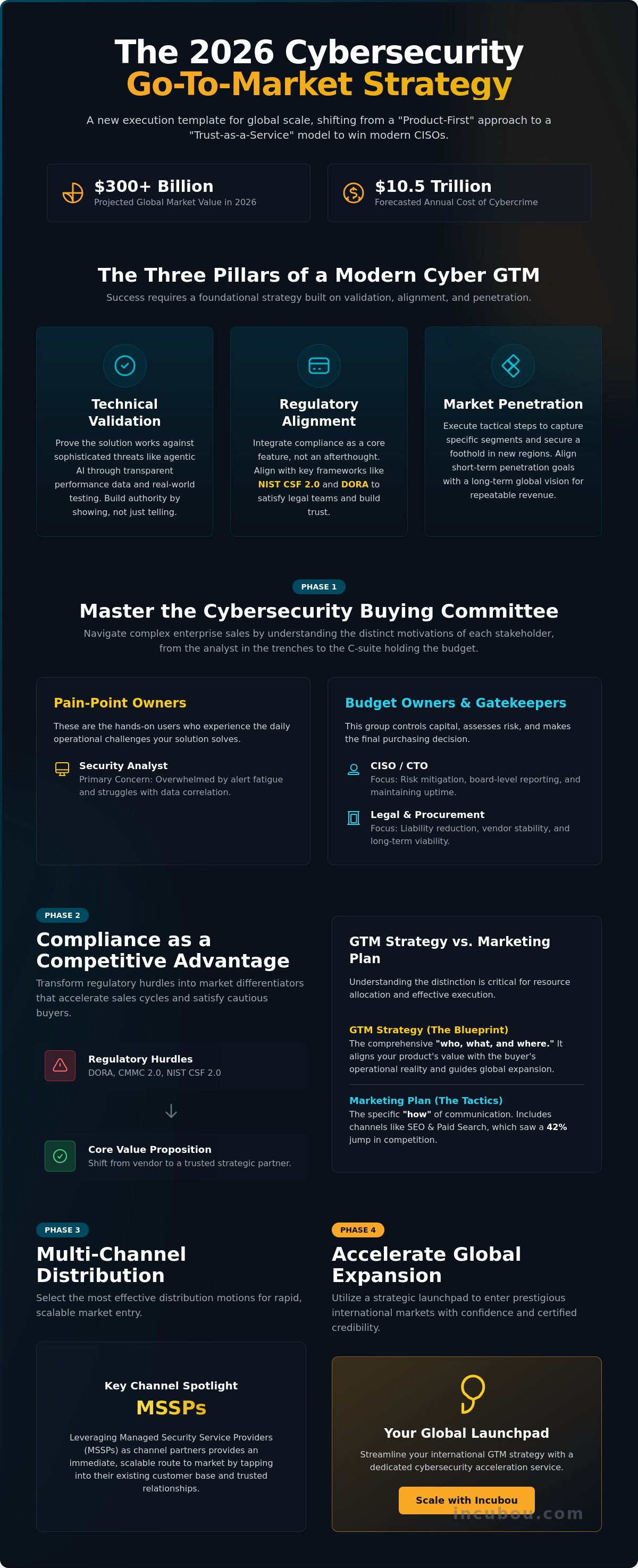
A go-to-market strategy in the security sector isn't a simple product launch checklist. It's a precise set of heuristics designed to generate revenue within exceptionally high-friction environments. In 2026, the global market is valued at over $300 billion, yet the barrier to entry has never been higher. You aren't just selling software; you're selling a promise of resilience in a world where the cost of cybercrime is forecasted to exceed $10.5 trillion. This reality demands a fundamental shift from "Product-First" to "Trust-First" positioning to inspire confidence in stakeholders and CISOs alike.
The three pillars of a modern cyber GTM include:
- Technical Validation: Proving the solution works against agentic AI and automated attacks through transparent performance data and real-world testing.
- Regulatory Alignment: Ensuring compliance with frameworks like NIST CSF 2.0 and DORA is a core feature, not a bureaucratic afterthought.
- Market Penetration: Executing the tactical steps to capture specific segments while maintaining a global vision for scale.
Don't confuse your marketing plan with your go-to-market strategy for cybersecurity. A marketing plan focuses on the "how" of communication, such as SEO or paid search, which saw a 42% jump in competition last year. A GTM strategy is the comprehensive "who, what, and where" that aligns your product's value with the buyer's operational reality. It serves as a steady hand, guiding your organization through the complexities of international expansion and ensuring every resource is used for rapid development and revenue generation.
The Trust Deficit in Modern Security Sales
The era of marketing built on fear, uncertainty, and doubt (FUD) has ended. Today's CISOs are skeptical of bold claims and aggressive sales tactics. They want technical transparency and third-party validation. You build authority by showing exactly how your tool handles data correlation or alert triage in milliseconds. Success depends on identifying a "Security Champion" within the prospect's organization. This person understands the technical nuances and can advocate for your solution during the long enterprise sales cycle, helping you overcome the inherent trust deficit.
GTM vs. Market Penetration: Knowing the Difference
Market penetration is a tactical subset of your broader GTM motion, focusing on increasing the usage of your product within an existing market. In the context of global expansion, market penetration is the focused effort to secure a foothold in a new geographic region by displacing incumbents or capturing untapped demand. Aligning these short-term penetration goals with long-term scaling objectives ensures your revenue engine remains repeatable. Utilizing sophisticated bridges like the Incubou accelerator can provide the strategic advantage needed to enter prestigious international markets with certified credibility.
Phase 1: The Cybersecurity ICP and Persona Matrix
Identifying your Ideal Customer Profile (ICP) is the foundation of any successful go-to-market strategy for cybersecurity. In 2026, you're not just targeting a single job title; you're navigating a complex committee. You must distinguish between "Pain-Point Owners," like the security analyst overwhelmed by alert fatigue, and "Budget Owners" who control the capital. Mapping this matrix allows you to address the specific anxieties of the CISO, the CTO's focus on uptime, and the legal department's obsession with liability. Procurement often acts as the final gatekeeper, looking for vendor stability and long-term viability in a crowded market.
Look for high-intent signals that indicate a state of transition. A recent change in a prospect's tech stack or a shift in the latest cybersecurity market trends often signals a window of opportunity. For example, the full enforcement of DORA in early 2025 has left many financial institutions scrambling for resilient solutions throughout 2026. Verticalization is essential here. A healthcare provider requires a messaging strategy built on patient data privacy, while critical infrastructure firms prioritize physical-digital convergence and uptime. You can't use a one-size-fits-all approach when the regulatory stakes differ so wildly between sectors.
The CISO Persona: What Keeps Them Up in 2026?
The modern CISO has evolved from a technical gatekeeper into a strategic business enabler. They don't want to hear about features; they want to hear about risk mitigation and board-level reporting. To avoid the trap of vendor fatigue, your pitch must demonstrate how you simplify their lives rather than adding another dashboard to their screen. Focus on operational efficiency and how your solution integrates into their existing ecosystem. Show them you understand the high-stakes nature of their role by providing clear, actionable data they can take to the board.
Technographic and Firmographic Segmentation
Precision is your ally. Use intent data to find companies with vulnerable or outdated stacks that can't keep up with agentic AI attacks. If you're eyeing US expansion, segmenting by compliance needs like FedRAMP is a powerful way to filter high-value prospects. This level of granular targeting ensures you're engaging with organizations at the right technology validation stage. It's about finding the intersection of technical need and financial readiness. If you need help refining this matrix for new regions, exploring cybersecurity acceleration can bridge the gap between your current ICP and global requirements.
Phase 2: Messaging and Compliance-as-a-Competitive-Advantage
Messaging in a go-to-market strategy for cybersecurity must transcend generic promises of "protection." To break through the noise of 2026, you must craft a Value Hypothesis that articulates a unique security outcome. This could be the ability to correlate disparate data streams in milliseconds or providing a unified view of your attack surface that maps directly to the NIST CSF 2.0 "Govern" function. Your narrative should position the product not as a standalone tool, but as a critical component of a Zero Trust framework. This architectural alignment is no longer optional; it's a mandatory requirement for public sector contracts and obtaining cyber insurance in a high-risk landscape.
Compliance serves as your strategic entry ticket. Integrating SOC2, ISO 27001, and GDPR into your core messaging transforms these bureaucratic hurdles into a competitive advantage. Achieving recognized compliance certifications directly reduces sales friction by pre-validating your security posture for the prospect's legal and procurement teams. By leading with these credentials, you remove the primary barriers that typically stall enterprise deals in the final stages. This proactive approach demonstrates a level of professional confidence that resonates with sophisticated buying committees.
The Regulatory Roadmap for Global Entry
Startups expanding from innovation hubs like Vila Nova de Gaia must navigate a complex web of requirements. For European firms eyeing the US market, prioritizing SOC2 and FedRAMP is essential for technical validation. Conversely, US companies entering the EU must address the strict mandates of GDPR and the Digital Operational Resilience Act (DORA), which became fully enforceable in early 2025. Using "Compliance Readiness" as a top-of-funnel lead magnet allows you to capture high-intent prospects who are actively seeking solutions to their regulatory burdens. This strategy positions your brand as an authoritative expert rather than just another service provider.
Technical Validation and Proof of Concept (PoC)
A successful GTM motion requires a frictionless PoC process. If the integration is too heavy, the deal will die before it begins. Design your validation phase to prove value within days, not weeks, focusing on tangible results like reduced alert noise or faster threat remediation. Utilizing anonymous case studies is a sophisticated way to build authority and show real-world results without compromising the security of your existing clients. These tactics are essential for effective Cybersecurity Market Penetration. By demonstrating technical excellence through a structured validation journey, you move beyond being a vendor to becoming a trusted strategic partner.
Phase 3: The Multi-Channel Distribution Template
Selecting the right revenue motion is the engine room of your go-to-market strategy for cybersecurity. You must align your distribution model with your Annual Contract Value (ACV) and the technical complexity of your offering. High-premium solutions typically require a Sales-Led Growth (SLG) approach to manage the multi-layered buying committees we identified earlier. Conversely, lower-friction tools can leverage Product-Led Growth (PLG) to drive user adoption, provided they maintain the "Trust-First" positioning essential for 2026. Success lies in building a hybrid model that respects the prospect's time while providing deep technical validation.
Adopt a "Channel First" mentality to achieve rapid market entry without the overhead of a massive internal sales force. Leveraging Managed Security Service Providers (MSSPs) and Value-Added Resellers (VARs) allows you to bypass the noise of a saturated market by tapping into established trust. These partners act as force multipliers, providing the local expertise and technical support required for international scaling. By positioning your product as a core component of an MSSP's service stack, you gain immediate access to a vetted pool of enterprise clients who are already looking for ways to satisfy DORA or NIST CSF 2.0 requirements.
Balance high-intent SEO with strategic Account-Based Marketing (ABM) to maximize your reach. With paid search competition jumping 42% recently, organic authority has become your most cost-effective asset. Data indicates that B2B SEO in the cybersecurity sector delivers a 748% ROI compared to paid channels. However, organic reach alone isn't enough for high-value enterprise deals. You need a targeted outbound motion that treats every account as a market of one. If you're ready to build this repeatable revenue engine on a global scale, explore how cybersecurity expansion services can streamline your international growth.
Engage with the security researcher and CISO community authentically to drive community-led growth. In 2026, peer recommendations carry more weight than any white paper. Participate in open-source projects, contribute to threat intelligence sharing, and support local security chapters. This organic involvement builds the professional confidence and prestige required to influence top-tier decision-makers. When you act as a contributor to the ecosystem rather than just a vendor, you remove the traditional barriers to entry that stall most startups.
The Security Channel Ecosystem
Build a partner program that prioritizes the success of Managed Security Service Providers (MSSPs) through robust APIs and co-marketing support. In 2026, marketplace listings on platforms like AWS, Azure, and Google Cloud are essential for simplifying the procurement process. Navigating the "Tier 1" vs "Tier 2" distribution model is critical for international scaling, as it determines how your product is warehoused, supported, and sold across different geographic regions. A well-structured channel ecosystem ensures your solution is available exactly where and when your customers want to buy.
Account-Based Marketing (ABM) for High-Value Targets
Create personalized security reports that analyze a prospect's public-facing attack surface as a high-value outbound hook. Use LinkedIn and exclusive executive events to reach the "unreachable" CISO, focusing on strategic value rather than technical jargon. This approach is vital for scaling revenue from Seed to Series A, as it allows you to focus your limited resources on the accounts most likely to convert. By delivering tailored insights that address specific pain points, you position your brand as a sophisticated mentor and a reliable partner in a complex market.
Phase 4: Accelerating Global Expansion with Incubou
Scaling a security firm beyond its domestic borders is a high-stakes endeavor that requires more than just a localized marketing plan. It needs a strategic bridge to overcome the bureaucratic, cultural, and technical hurdles of international trade. Vila Nova de Gaia has emerged as a premier launchpad for this growth, offering a sophisticated ecosystem where founders can refine their go-to-market strategy for cybersecurity. By positioning your operations in a certified innovation hub, you gain the credibility necessary to engage with prestigious global partners and CISOs who demand verified reliability.
Partnering with a cybersecurity acceleration service provides the technical and strategic validation required for 2026's high-trust environments. These services act as a sophisticated mentor, guiding you through the complexities of the US-EU bridge. Whether you're a European startup seeking SOC2 compliance for US entry or a US firm navigating the Digital Operational Resilience Act (DORA) in the EU, acceleration services remove traditional barriers. You'll access a network of industry experts who provide the granular feedback needed to stress-test your GTM before a full-scale launch, ensuring your revenue engine is primed for the global stage.
The Incubou Advantage: IAPMEI-Certified Growth
As an IAPMEI-certified institution, Incubou offers more than just consulting; it provides a global vision for scaling. Founders often make the mistake of underestimating local regulatory nuances or failing to adapt their messaging for different cultural contexts. Strategic support helps you avoid these common pitfalls by facilitating connections with budget owners and security champions. This collaborative atmosphere ensures your business model is not just refined but also sustainable for long-term international expansion. You move from simple business model refinement to a position of strategic advantage in a complex market.
Next Steps: Executing Your GTM Template
Executing your go-to-market strategy for cybersecurity requires disciplined momentum and a focus on tangible results. For the first 90 days of market entry, you should prioritize the following actions:
- Set Clear KPIs: Track the number of technical validation meetings and the average speed of your PoC cycle.
- Iterative Feedback Loops: Establish a direct line between sales and product teams to ensure your positioning stays aligned with buyer expectations.
- Market Validation: Use early wins to build the "Anonymous Case Studies" mentioned earlier, reinforcing your authority.
This structured journey transforms your vision into a repeatable revenue engine. If you're ready to take the next step and bypass the hurdles of international business, you can scale your cybersecurity firm globally with Incubou. Our program is designed to provide the steady hand and global connections your startup needs to thrive in a deafeningly loud market.
Secure Your Path to Global Scale
The blueprint for a successful go-to-market strategy for cybersecurity in 2026 is built on the pillars of technical validation and radical transparency. You've seen how shifting from feature-parity to trust-first positioning allows your brand to bypass market noise and resonate with skeptical CISOs. By integrating compliance frameworks directly into your value proposition and leveraging a multi-channel distribution model, you transform bureaucratic hurdles into powerful market differentiators.
Execution requires more than just a template; it demands a steady hand and a connected ecosystem. As an IAPMEI-certified cybersecurity incubator, we provide specialized US market entry support and access to an exclusive network of security founders and experts. This strategic foundation ensures your revenue engine is repeatable and your international expansion is grounded in professional confidence.
Don't leave your global growth to chance. Download our Cybersecurity GTM Execution Template to start refining your trajectory today. Your mission to secure the digital world deserves a partner that understands the high-stakes nature of this industry. We're ready to help you build that bridge.
Frequently Asked Questions
What is a go-to-market strategy for cybersecurity?
A go-to-market strategy for cybersecurity is a comprehensive roadmap that outlines how a security firm delivers its unique value proposition to a specific audience while overcoming high-friction sales cycles. It encompasses everything from technical validation and regulatory alignment to distribution motions. Unlike a standard marketing plan, it serves as a sophisticated set of heuristics for revenue generation in environments where trust is the primary currency.
How is a cybersecurity GTM strategy different from general SaaS GTM?
Cybersecurity GTM differs from general SaaS due to the extreme trust deficit and the complexity of buying committees that include CISOs, legal, and procurement teams. While standard SaaS might focus on user features and ease of use, security GTM prioritizes technical transparency and third-party validation. It requires navigating strict regulations like DORA or CMMC 2.0, making compliance a core component of the value hypothesis rather than an afterthought.
Should I use a product-led or sales-led GTM for my security startup?
Choosing between product-led and sales-led motions depends on your Annual Contract Value (ACV) and the friction of your integration process. High-premium enterprise solutions typically require a Sales-Led Growth approach to manage long validation cycles and complex stakeholder requirements. However, lower-friction tools can utilize Product-Led Growth to build initial user adoption, provided they maintain the professional confidence required to satisfy enterprise security standards.
How much does it cost to execute a cybersecurity GTM for the US market?
The cost of executing a GTM for the US market varies significantly based on your scaling objectives and the specific regulatory hurdles you face, such as FedRAMP or SOC2 certification. You should account for expenses related to technical validation, localized sales expertise, and marketing efforts in a highly competitive arena where paid search costs have risen. It's best to consult with a strategic partner to build a budget that reflects your specific technology validation stage.
What are the most effective marketing channels for cybersecurity in 2026?
High-intent SEO and strategic Account-Based Marketing (ABM) are the most effective channels in 2026 for reaching sophisticated security leaders. Data shows that B2B SEO in this sector delivers a 748% ROI compared to paid channels, which face increasing saturation. Combining these with community-led growth and marketplace listings on platforms like AWS or Azure ensures your solution is visible during the critical research phase of the buyer's journey.
How long does it take to see results from a new GTM strategy?
Seeing measurable results from a new GTM strategy typically takes six to twelve months; this timeline mirrors the standard enterprise sales cycle in the security sector. Initial indicators of success include a shortened Proof of Concept (PoC) duration and increased engagement from "Security Champions" within target accounts. Rapid development and iterative feedback loops during the first 90 days are essential for refining your positioning and accelerating long-term revenue growth.
Why do cybersecurity GTM strategies often fail?
Cybersecurity GTM strategies often fail because they rely on outdated fear-based marketing or ignore the specific regulatory needs of the target vertical. Many startups fail to distinguish between "Pain-Point Owners" and "Budget Owners," leading to stalled deals during the procurement phase. A lack of technical validation or a failure to align with architectural frameworks like Zero Trust can also result in a significant trust deficit that prevents successful market penetration.
How can an accelerator help with my go-to-market strategy?
A specialized accelerator acts as a global bridge-builder, providing the strategic consulting and industry connections needed to refine your market entry. It helps you navigate bureaucratic hurdles and legal barriers while offering access to a network of CISOs for initial validation. By acting as a sophisticated mentor, an accelerator ensures your go-to-market strategy for cybersecurity is grounded in practical realities, helping you move from business model refinement to sustainable international growth.


