

While the global cybersecurity market is projected to reach $248.28 billion in 2026, the total cost of cybercrime is forecasted to exceed a staggering $10.5 trillion. This massive gap represents more than just a threat; it signals a fundamental shift in how organizations must defend their digital borders. You likely recognize that the era of basic firewalls is over, yet finding clear cybersecurity market opportunities for startups feels increasingly difficult amidst high regulatory barriers and legacy market saturation.
We understand that your ambition is to build something transformative, not just another incremental tool. This article identifies the most lucrative niches and strategic entry points within the evolving landscape. You'll gain a strategic framework for navigating complex mandates like the EU's NIS2 directive and positioning your startup for successful US expansion. We'll explore how to capture growth in high-velocity sectors like healthcare, currently projected to see an 18.98% growth rate, while bypassing the oversaturated legacy markets. We're moving beyond the noise to focus on the high-growth niches where your innovation meets the most urgent enterprise demands of the next decade.
Key Takeaways
- Identify high-growth niches like Security for AI and decentralized identity to move beyond oversaturated legacy markets.
- Pinpoint specific cybersecurity market opportunities for startups by analyzing the divergent regulatory demands of the US and European landscapes.
- Overcome the hurdle of technical validation with enterprise clients using streamlined Proof of Concept (POC) frameworks designed for CISOs.
- Leverage specialized mentorship and acceleration models to bypass bureaucratic obstacles during international expansion.
- Navigate the $350 billion market landscape by shifting from reactive defense to proactive, AI-integrated security postures.
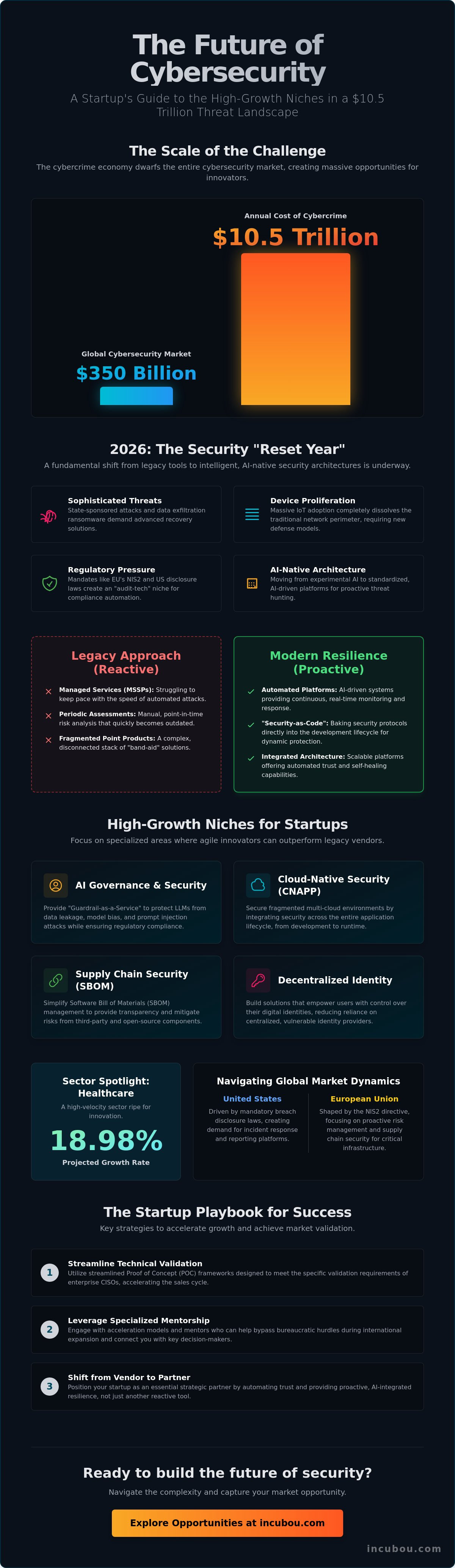
The 2026 Cybersecurity Market Landscape: A $350 Billion Frontier
The cybersecurity sector has reached a defining inflection point. With the global cybersecurity market landscape projected to hit a $350 billion valuation by 2026, the stakes for founders have never been higher. This isn't just an abstract figure. It's a clear signal that enterprise buyers are moving away from legacy "band-aid" solutions toward integrated, intelligent architectures. For innovators, this shift directly impacts startup valuations, as investors now prioritize platforms that offer scalable, AI-driven resilience over fragmented point products. We see this as a rare window where strategic positioning can yield exponential growth.
We're calling 2026 the "reset year" for security architecture. The first wave of AI adoption was experimental and often chaotic. Now, organizations are rebuilding their security foundations to handle the long-term reality of autonomous threats and the massive proliferation of IoT devices. This transition opens significant cybersecurity market opportunities for startups that can bridge the gap between legacy infrastructure and modern, proactive postures. Success in this era requires more than just technical skill; it demands a vision that aligns with the global shift toward automated, self-healing systems.
Key Market Drivers for the Current Year
Sophisticated state-sponsored actors and the explosion of connected devices are forcing a total rethink of perimeter defense. Ransomware has evolved too. It's no longer just about encryption; it's about deep data exfiltration and targeted extortion. This surge creates a massive need for specialized recovery solutions that go beyond simple backups. Additionally, mandatory disclosure laws in the US and the EU's NIS2 directive are making board-level accountability a legal requirement. This regulatory pressure is birthing a new "audit-tech" niche where startups can automate complex compliance reporting. The 2026 Cybersecurity Reset marks the transition from experimental AI implementation to the establishment of standardized, AI-native security architectures.
The Shift from Managed Services to Automated Resilience
Traditional Managed Security Service Providers (MSSPs) are struggling to keep pace with the speed of modern attacks. Enterprises are pivoting toward automated security platforms that offer "Security-as-Code." This model allows security protocols to be baked into the development lifecycle, making protection as dynamic as the software it defends. It's a prime area for cybersecurity market opportunities for startups to replace manual, periodic risk assessments with continuous, real-time monitoring. By providing a steady hand through this complexity, new ventures can position themselves as essential strategic partners rather than just another vendor in a crowded stack. To see how these principles are applied in practice, discover CyberOne and their specialized MXDR solutions for Microsoft ecosystems. We believe the future belongs to those who can automate trust at scale.
High-Growth Segments: Identifying Profitable Niches for New Entrants
Legacy vendors often struggle with the speed of modern technological shifts. This creates a unique advantage for agile founders. While established players dominate broad infrastructure, the most significant cybersecurity market opportunities for startups lie in specialized niches that require deep technical focus and rapid iteration. We see immense potential in Cloud-Native Application Protection Platforms (CNAPP) as enterprises struggle to secure fragmented multi-cloud environments. Similarly, the rising demand for Software Bill of Materials (SBOM) management offers a clear path for ventures that can simplify supply chain transparency and mitigate third-party risks.
AI Governance and Security
Enterprises are rapidly integrating Large Language Models (LLMs), yet they lack the tools to monitor data leakage or model bias in real-time. This gap has birthed a desperate need for "Guardrail-as-a-Service" solutions. Startups can lead this charge by building platforms that protect generative models from prompt injection while ensuring compliance with emerging AI regulations. Following cybersecurity guidance for startups helps you bake these protections into your product from day one. There is also a major opening for AI-driven threat hunting tools that can identify autonomous attackers before they penetrate the network.
Decentralized Identity and Zero Trust
The traditional password-based system is failing. We're witnessing a decisive transition toward passwordless, biometric-first models and verifiable credentials. Zero Trust Architecture (ZTA) is no longer a theoretical buzzword; it's a mandatory requirement for modern enterprise procurement. This evolution creates a massive startup opportunity in securing human-to-machine and machine-to-machine interfaces. By focusing on decentralized identity, you can remove the single point of failure inherent in legacy systems. If you're ready to scale these innovations, consider how targeted acceleration can streamline your path to market.
Strategic growth in 2026 isn't about competing head-on with incumbents. It's about securing the connective tissue of the modern tech stack. Whether it's protecting AI pipelines or automating supply chain trust, the goal is to solve the high-friction problems that CISOs face every day. Focus on these profitable niches to build a foundation for long-term commercial success. Your ability to move fast in these complex areas is your greatest competitive asset.
Navigating Geographic Shifts: US and European Market Dynamics
Geographic strategy often dictates the trajectory of a startup's first major funding round. While the global cybersecurity market size is surging, the path to revenue looks very different in Lisbon compared to San Francisco. These geographic shifts reveal unique cybersecurity market opportunities for startups that understand how to bridge different jurisdictions. Success in 2026 requires a dual-market presence. We see a growing trend of European founders using Portugal, specifically Vila Nova de Gaia, as a sophisticated launchpad. This region has emerged as a critical cybersecurity innovation hub, offering a unique blend of technical talent and strategic access to both the EU and North American markets. Building this "Global Bridge" isn't just about sales; it's a prerequisite for Series A readiness.
Market Entry Strategy for the United States
Entering the US market is a high-stakes sprint. You can't ignore the necessity of SOC2 compliance and strictly defined US-based data residency. These are the baseline requirements for any enterprise conversation. Startups must pivot from a technical-first narrative to an aggressive, value-driven sales pitch. The US is a commercial-first environment where speed to validation is everything. To gain initial traction, consider the following:
- Obtain SOC2 Type II certification early to satisfy enterprise risk assessments.
- Establish US-based data residency to meet local privacy expectations and procurement rules.
- Leverage channel partners and explore federal contract opportunities to scale beyond initial pilots.
The European Advantage: NIS2 and Beyond
In contrast, the European market is currently defined by regulatory momentum. The NIS2 Directive is no longer a future concern; it's actively forcing medium-sized firms to overhaul their security postures. This creates significant cybersecurity market opportunities for startups that can simplify compliance. Operating within a certified ecosystem, such as the IAPMEI-certified hubs in Portugal, provides immediate localized credibility. Mastering international scaling for tech startups allows firms to navigate these bureaucratic layers while maintaining technical excellence. We suggest focusing on these pillars:
- Leverage NIS2 mandates to target the underserved mid-market sector that requires rapid compliance tools.
- Utilize IAPMEI-certified hubs to access specialized mentorship and legal support.
- Implement a compliance-first product roadmap to reduce buyer friction within the EU.
Choosing where to plant your flag is a strategic decision that affects your entire cap table. By balancing the regulatory rigors of Europe with the commercial intensity of the US, you build a resilient business model. Use these geographic shifts to your advantage. Don't just follow the crowd; position your venture where the regulatory and commercial tides meet for maximum impact.
Strategic Market Entry: From Technical Validation to Commercial Scale
Building a superior technical solution is only half the battle. For most founders, the primary obstacle isn't the code; it's the "Trust Paradox." CISOs are notoriously risk-averse and often hesitate to partner with a venture that lacks a ten-year track record. To overcome this, you must shift your focus toward rigorous technical validation through frictionless Proof of Concept (POC) frameworks. These frameworks should be designed to demonstrate immediate value within 14 to 30 days without requiring deep infrastructure changes. By reducing the "cost of trying," you open up significant cybersecurity market opportunities for startups that larger, slower incumbents simply cannot match.
In the early stages, success depends on "Founder-Led Selling." This isn't just about closing deals; it's about building peer-to-peer relationships with security leaders. Your deep technical understanding allows you to speak the language of the CISO, addressing their specific pain points with a level of nuance that a standard sales representative lacks. Use this period to gather direct feedback and refine your value proposition before attempting to scale your sales team. Third-party validation, such as SOC2 reports or industry certifications, acts as the final bridge to overcome the trust gap and achieve commercial scale.
Refining the Cybersecurity Business Model
Your choice between a "Land and Expand" model and a "Platform-First" approach will define your capital efficiency. While landing with a specific feature is often easier, enterprises in 2026 are increasingly seeking integrated solutions to reduce vendor fatigue. Pricing is also evolving. We're seeing a decisive move away from per-user licenses toward consumption-based or value-based models that align with actual risk reduction. To ensure your commercial structure is sound, follow this checklist for cybersecurity business model refinement to avoid common scaling traps.
Overcoming Regulatory and Compliance Barriers
Don't view compliance as a bureaucratic hurdle; treat it as a competitive feature. By baking global standards into your product, you remove a major procurement blocker for your clients. Automated GRC (Governance, Risk, and Compliance) tools can help your startup maintain these standards without draining your engineering resources. Strategic partnerships are equally vital. Aligning with local legal experts or established security firms can help you navigate the specific requirements of new jurisdictions. If you're ready to bypass these hurdles and achieve rapid growth, our cybersecurity acceleration services provide the strategic roadmap you need to scale globally.
The transition from a validated prototype to a commercially viable enterprise platform requires a steady hand and a clear strategy. By focusing on low-friction entry points and aligning your business model with modern procurement trends, you position your startup for long-term dominance. Remember, in cybersecurity, technical excellence is the entry fee, but commercial strategy is what determines the winner.
Accelerating Growth: Positioning Your Startup for Global Success
Capturing the most significant cybersecurity market opportunities for startups requires more than technical ingenuity; it demands a sophisticated go-to-market strategy that aligns with global procurement standards. We've seen that an accelerator model acts as a vital catalyst for rapid market penetration, bridging the gap between a validated prototype and a commercial leader. By leveraging specialized mentorship, you can effectively remove the bureaucratic hurdles that often stall international expansion efforts. This strategic consulting transforms a technical tool into a comprehensive global business solution that enterprise buyers can trust. It's about moving from a "feature" mindset to a "strategic partner" mindset.
The Role of Specialized Cybersecurity Acceleration
Incubou provides the strategic guidance necessary to fast-track commercialization in a crowded landscape. We utilize a deep network of industry experts to refine your technology for specific enterprise use cases, ensuring your value proposition resonates with risk-averse security leaders. Generic accelerators often fail cybersecurity founders due to a lack of niche expertise in regulatory compliance and security-specific procurement cycles. They don't understand the nuances of a CISO's risk appetite or the technical validation required for a successful rollout. Our specialized approach ensures you're building a resilient organization capable of sustaining high-growth momentum while maintaining technical excellence.
Facilitating Global Market Penetration
Success in the global market requires a credible foundation. For European firms, obtaining IAPMEI certification within the Portuguese ecosystem provides a recognized mark of quality that resonates across the EU and beyond. This credibility is essential when preparing for the aggressive competitive environment of the United States. We help you outline a roadmap for sustainable growth, ensuring your transition into North American markets is backed by the necessary data residency and compliance frameworks discussed in our previous sections. Sustainable growth isn't accidental; it's the result of a methodical internationalization strategy that respects local legal requirements while pushing for global scale.
By anchoring your operations in an IAPMEI-certified hub, you signal to global investors that your venture meets the highest institutional standards. This level of validation simplifies the due diligence process and accelerates your path to Series A. We provide the specific support needed to navigate these shifts without losing operational speed or technical focus. Ready to scale? Explore our cybersecurity acceleration services to begin your journey toward global leadership.
The journey from an early-stage venture to a global security powerhouse is complex, but the rewards in a $350 billion market are substantial. By positioning your startup within a supportive, certified ecosystem, you gain the strategic advantage needed to dominate the 2026 landscape. Focus on your core innovation while we help you navigate the international business hurdles. Your path to global success starts with a clear vision and the right strategic partners to bridge the gap between innovation and impact.
Mastering the Global Cyber Frontier
The path to dominance in 2026 requires more than technical precision; it demands a strategic alignment with the world's most complex regulatory and commercial shifts. We've explored how identifying high-growth niches like AI governance and decentralized identity helps you bypass legacy competition. Success now hinges on your ability to bridge the gap between technical validation and global commercial scale. By leveraging the right geographic hubs and specialized mentorship, you turn cybersecurity market opportunities for startups into a sustainable, international reality.
You don't have to navigate these bureaucratic hurdles alone. As an IAPMEI-certified accelerator specializing in international market entry, we provide the steady hand and global CISO network you need to thrive. We're here to ensure your vision isn't just a tool, but a cornerstone of the global security infrastructure. Our mission is to empower founders to move quickly and securely into the world's most lucrative markets while maintaining the highest standards of technical excellence.
Apply for Cybersecurity Acceleration at Incubou today and start building your global legacy. The future of secure technology is waiting for your leadership.
Frequently Asked Questions
What are the fastest-growing cybersecurity market opportunities for startups in 2026?
AI governance and decentralized identity models lead the growth rankings. With the healthcare sector seeing a projected 18.98% growth rate, startups focusing on medical device security find a less crowded field. These cybersecurity market opportunities for startups allow new ventures to solve high-friction problems that legacy vendors ignore. Moving beyond basic protection toward proactive, AI-integrated resilience is the key to capturing this $248 billion market.
How can a European cybersecurity startup enter the US market effectively?
Effective entry requires obtaining SOC2 Type II certification and establishing localized data residency. European founders should leverage channel partners to navigate the aggressive US sales environment. Adapting your technical narrative to focus on commercial value and rapid ROI is essential for gaining traction. Building a dual-market presence early on ensures you're ready for Series A funding and global scalability.
Is the cybersecurity market too saturated for new startups?
No, the market is expanding to a projected $248.28 billion by 2026, though legacy segments like basic firewalls are crowded. The real opportunity lies in the "connective tissue" of security, such as bridging AI governance and decentralized identity. Startups that focus on automated resilience and self-healing systems find significantly lower competition than those building incremental tools for traditional perimeters.
What certifications do I need to sell cybersecurity solutions to enterprises?
You'll typically need SOC2 Type II for the US market and ISO 27001 for European enterprise clients. These certifications act as a baseline for trust during the procurement process. Additionally, demonstrating compliance with regional mandates like the EU's NIS2 directive is often a non-negotiable requirement for medium-sized and large firms. These credentials help you bypass the initial "Trust Paradox" often faced by younger companies.
Why should a cybersecurity founder join an accelerator program?
Specialized acceleration provides a strategic roadmap to bypass bureaucratic hurdles and technical validation delays. Founders gain direct access to global networks of CISOs and industry experts who refine their product for enterprise use. This support is vital for moving from a technical prototype to a commercially viable solution. Generic programs often lack the niche expertise required to handle complex security procurement cycles and regulatory demands.
What are the main challenges for cybersecurity startups scaling internationally?
Founders must navigate divergent regulatory landscapes while overcoming the difficulty of achieving technical validation with enterprise clients. Scaling internationally also requires managing high barriers to entry related to local data residency and mandatory disclosure laws. These challenges make strategic partnerships and specialized mentorship essential for maintaining momentum. Success depends on your ability to handle bureaucratic hurdles without losing your technical edge.
How does AI change the cybersecurity market landscape for new entrants?
AI creates an arms race that forces organizations to transition from reactive defense to AI-driven Security Operations Centers. This shift creates cybersecurity market opportunities for startups that can automate threat hunting and protect LLMs from prompt injection. Defenders must now handle the volume of autonomous threats, making automated resilience a mandatory requirement. New entrants that bake AI-native protection into their core architecture gain a significant competitive advantage.
What is the role of IAPMEI-certified accelerators in the Portuguese tech ecosystem?
These accelerators act as a bridge-builder, providing institutional credibility and strategic mentorship within the Portuguese tech hub. They help founders utilize Vila Nova de Gaia as a launchpad for both European and US expansion. By aligning with IAPMEI standards, startups signal to global investors that they meet rigorous institutional benchmarks. This certification simplifies the internationalization process and accelerates the path to commercial success.


