

In the first quarter of 2026, median pre-money valuations for early-stage cybersecurity deals reached a staggering $100.9 million. While the capital is available, understanding how to scale a cybersecurity company requires more than just a superior codebase. You've likely experienced the exhaustion of founder-led sales burnout or the frustration of rising customer acquisition costs in an increasingly crowded market. It's a common ceiling for technical leaders who find themselves bogged down by the complexities of CMMC compliance and the hunt for specialized sales talent.
We're here to help you break through that ceiling. You'll master the transition from a localized startup to a global security powerhouse with our comprehensive scaling framework. This guide reveals the shift from technical validation to strategic market dominance. We'll examine how to build a high-performing sales engine, navigate international regulatory hurdles, and position your organization as a steady hand in a complex global market.
Key Takeaways
- Escape the "Founder Trap" by transitioning from bespoke technical consulting to a scalable, product-led growth model that empowers your team.
- Optimize your revenue architecture by adopting value-based pricing and multi-tenant systems designed for friction-less enterprise integration.
- Learn how to scale a cybersecurity company by standardizing your sales engine to prioritize business risk mitigation over complex technical specifications.
- Accelerate international reach using a strategic "Bridgehead" approach to navigate the regulatory and operational hurdles of global expansion.
- Leverage specialized cybersecurity acceleration and certifications to secure European grants and establish high-level market credibility.
The Transition: Moving from Technical Innovation to Market Dominance
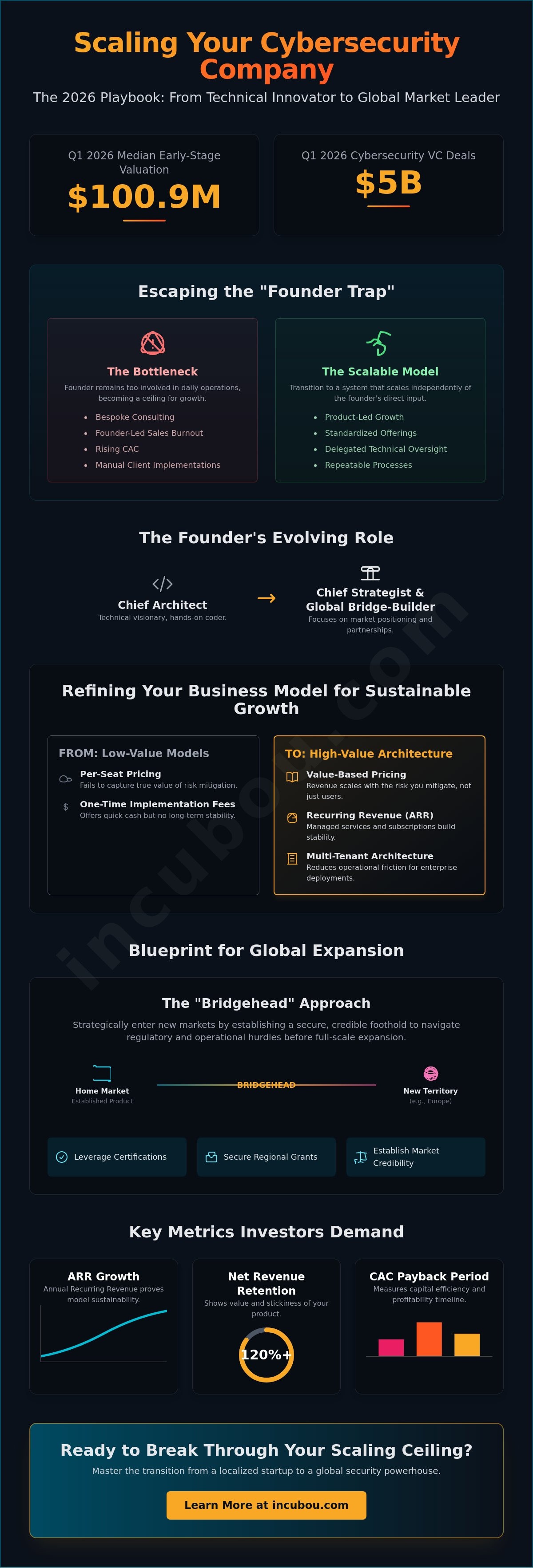
Scaling a cybersecurity firm requires a fundamental shift in perspective. Many founders build exceptional technology but struggle to build an exceptional business. The primary challenge in learning how to scale a cybersecurity company isn't just improving the code; it's about evolving from a technical innovator into a market leader. This evolution demands a rigorous move away from bespoke, consulting-heavy delivery toward a scalable, product-led growth model that functions independently of the founder's daily technical input.
The "Founder Trap" represents the most significant hurdle during this phase. It occurs when technical leads remain too deeply involved in daily operations, code reviews, or individual client implementations. While your technical expertise is the foundation of the company, it can become the bottleneck that prevents rapid expansion. To break free, you must standardize your offerings. Transitioning to a model where the product drives its own acquisition, onboarding, and expansion allows your organization to handle a higher volume of enterprise contracts without a linear increase in headcount.
In 2026, precision in your financial narrative is non-negotiable. With Q1 2026 venture capital deal values reaching approximately $5 billion and median early-stage valuations hitting $100.9 million, investors demand sophisticated metrics. You must prioritize Annual Recurring Revenue (ARR) growth alongside Net Revenue Retention (NRR) and aggressive CAC payback periods. These figures prove your business model is sustainable. Maintaining a security-first culture during this rapid growth ensures that trust, your most valuable currency, remains intact even as you expand your footprint.
The Founder’s Role in a Scaling Venture
Your role must shift from "Chief Architect" to "Chief Strategist" and "Global Bridge-Builder." This doesn't mean losing your product vision; it means delegating technical oversight to a leadership team that understands SaaS metrics as deeply as they understand zero-trust architecture. Focus on high-level strategic partnerships and international market positioning. By empowering a dedicated C-suite to manage the granular technical details, you gain the clarity needed to steer the company toward global dominance.
Validating Your Scalability Quotient
Before moving into new territories, assess whether your current infrastructure can handle a 10x increase in user load without performance degradation. Documentation is the backbone of this stage. Every support process and implementation step must be repeatable and clear enough for a new hire to execute without guidance. The Scalability Quotient is the ratio of revenue growth to operational overhead. Achieving a high quotient ensures that as you learn how to scale a cybersecurity company, your profit margins expand rather than shrink under the weight of new business; for instance, optimizing internal costs with LicenseIQ to identify wasted spend on Microsoft 365 licenses helps maintain a lean operational profile.
Refining Your Cybersecurity Business Model for Sustainable Growth
Reimagining your revenue structure is the next step after escaping the technical founder trap. Traditional per-seat pricing often fails to capture the true value of modern security solutions. With the average cost of a data breach reaching $9.44 million for US-based organizations, your pricing should reflect the risk mitigated rather than the number of employees protected. Transitioning to value-based or data-volume-based models ensures your revenue scales alongside the protection you provide. This shift is a core component of learning how to scale a cybersecurity company effectively while maintaining high margins.
Deploying multi-tenant architectures reduces the operational friction that typically plagues enterprise deployments. This structural efficiency allows you to onboard massive global contracts without manually configuring individual server environments for every new client. It streamlines updates and ensures that threat intelligence is shared across your entire ecosystem instantly. Success in this phase requires cybersecurity business model refinement to ensure your operational overhead doesn't erode your profitability as you grow. Focus on building "sticky" integrations with existing security stacks, such as SIEM or SOAR platforms, to increase switching costs and solidify your market position.
Optimizing for Recurring Revenue
Implementation fees provide quick cash but offer little long-term stability. Transform these one-time engagements into managed service contracts or tiered subscription levels that provide ongoing value. Use "Land and Expand" tactics by solving a specific, urgent pain point first, then layering on additional modules as the client's infrastructure grows. Automated renewals and clearly defined upsell paths are essential in the 2026 landscape to keep your Net Revenue Retention (NRR) above industry benchmarks. Founders looking to streamline this process often benefit from professional cybersecurity acceleration to validate their models before entering high-stakes markets.
Pricing Strategies for Global Markets
Global markets require a nuanced approach to pricing that accounts for varying regional priorities. While US enterprises might prioritize rapid AI integration and speed, European clients often value rigorous data sovereignty and compliance with regulations like GDPR. Adjust your pricing tiers to reflect these regional complexities. Avoid the race to the bottom by positioning your firm as a premium, certified solution. Bundling real-time threat intelligence with your core software increases perceived value and separates you from commodity vendors who only offer basic defensive tools.
Building a High-Velocity Cybersecurity Sales Engine
Word-of-mouth referrals might sustain a boutique consultancy, but they won't build a global powerhouse. Relying on organic growth is a strategic risk that limits your reach. To truly master how to scale a cybersecurity company, you must construct a predictable sales machine that functions independently of the founder's personal network. This requires a fundamental shift in communication. Stop leading with technical specifications and start leading with business risk mitigation. Your sales engine should focus on solving specific pain points for high-stakes verticals like FinTech and Healthcare, where the cost of failure is highest.
Multiplying your market reach doesn't always require a massive internal headcount. Leverage Managed Security Service Providers (MSSPs) and strategic channel partners to act as force multipliers. These partners already have the trust of your target clients; your job is to make it effortless for them to sell your solution. By integrating a sophisticated cybersecurity B2B sales strategy, you align your outreach with the 2026 buyer journey, which favors validation and rapid deployment over long, drawn-out procurement cycles.
The 5-Step Sales Standardization Process
Consistency is the backbone of velocity. Implement these five steps to ensure every member of your sales team performs at an elite level:
- Step 1: Define the Ideal Customer Profile (ICP) based on specific threat surfaces and regulatory pressures.
- Step 2: Create a repeatable discovery call script that prioritizes operational pain points over product features.
- Step 3: Automate the Proof of Concept (PoC) phase to reduce sales cycles and demonstrate immediate value.
- Step 4: Empower channel partners with specialized enablement kits that include co-branded collateral and technical guides.
- Step 5: Implement a CRM-driven feedback loop to ensure R&D is building features that sales can actually close.
Selling to the C-Suite in 2026
When you sit across from the Board, technical vulnerabilities are secondary to financial liability. Translate your security metrics into the language of ROI and risk. For US-based organizations, where the average cost of a data breach is $9.44 million, the conversation should focus on "breach costs avoided." Use your compliance certifications, such as CMMC or SOC2, as sales accelerators rather than just administrative checkboxes. These certifications provide the institutional credibility required to win enterprise-level global contracts while shortening the due diligence process for your prospects. This strategic positioning is essential as you learn how to scale a cybersecurity company in a market that demands both innovation and reliability.
Global Expansion: Navigating the US and International Territories
Scaling beyond your home market is the ultimate validation of your technology. It requires a clinical evaluation of your global expansion for cybersecurity firms readiness. Learning how to scale a cybersecurity company on a global stage means understanding that a "Bridgehead" strategy is superior to a scattered approach. Select a specific hub, like Northern Virginia for federal access or Austin for tech talent, to establish a localized presence that feels native to the market. This localized approach ensures you maintain your core values while speaking the specific language of your new customers.
Cracking the US Market
The US remains the gold standard for valuation and exit opportunities. In Q1 2026, cybersecurity deal values hit $5 billion, with early-stage investments surpassing late-stage funding for the first time since 2022. This influx of capital signifies a market hungry for innovation but demanding of scale. As you refine your approach to how to scale a cybersecurity company, remember that the US market rewards those who arrive with a clear, localized strategy. Shift from a cautious tone to an aggressive, results-oriented message that highlights immediate risk reduction. US buyers prioritize speed, efficacy, and proven reliability. Incorporating stateside requires more than a digital presence. You need local legal and tax counsel to manage the specific bureaucratic hurdles of each state. This foundation allows you to compete for large-scale enterprise contracts that demand domestic presence and local accountability.
To support this localized operational foundation, you can learn more about Beyer Bytes and their specialized IT and physical security solutions for businesses in the Panhandle and Front Range areas.
Navigating Regulatory Hurdles
Don't view regulations as barriers. View them as competitive moats. As of January 1, 2026, new CCPA regulations require annual cybersecurity audits for businesses exceeding specific revenue and data thresholds. By being the first to offer seamless compliance reporting, you become an indispensable partner for enterprise clients. The EU AI Act and the White House Executive Order from June 2, 2026, regarding "covered frontier models," are reshaping how security products are built. These frameworks demand transparency and safety assessments before public release. Similarly, the bipartisan "Great American Artificial Intelligence Act of 2026" draft released on June 4, 2026, signals a new era of binding development obligations for large-scale developers. Regulatory compliance is the new perimeter for scaling firms.
Navigating these complex international waters is a high-stakes endeavor. If you're ready to cross borders, our team specializes in global expansion for cybersecurity to ensure your transition is seamless and secure.
Leveraging Cybersecurity Acceleration for Rapid Scaling
General tech accelerators often fail specialized cybersecurity startups because they lack the deep domain expertise required to navigate high-stakes security markets. While a generalist might help with basic SaaS metrics, they rarely understand the nuances of zero-trust adoption or the friction of federal procurement. When you're determining how to scale a cybersecurity company, the right partnership provides more than just office space. It offers a bridge to international validation. The IAPMEI certification serves as a prestigious mark of credibility, opening doors to European grants and establishing the trust necessary to handle sensitive data across international borders.
Incubou provides the strategic guidance and industry-specific connections needed for rapid global penetration. We move beyond theoretical advice to offer practical roadmaps for Series A and B funding. By participating in a dedicated cybersecurity acceleration program, you ensure your firm is positioned as a strategic partner rather than a mere vendor. This shift is critical as median pre-money valuations for early-stage deals reached $100.9 million in early 2026, raising the bar for what investors expect from a scaling leadership team.
The Power of a Specialized Network
Accessing warm introductions to Fortune 500 CISOs and government procurement officers is the fastest way to bypass standard gatekeepers. A specialized network provides access to decision-makers who understand the gravity of the $11.88 trillion global cost of cybercrime projected for 2026. Peer-to-peer learning from founders who've already successfully crossed the Atlantic or entered the European market offers insights that no textbook can replicate. Specialized mentors help refine your technical roadmap, ensuring your development efforts align with actual market needs and emerging threats like AI-automated attacks.
Achieving Investment Readiness
VC due diligence in the security sector is notoriously rigorous. You must structure your data room to prove technical superiority, operational excellence, and regulatory foresight. Highlight your adherence to new frameworks, such as the White House Executive Order from June 2, 2026, or the proposed "Great American Artificial Intelligence Act" draft from June 4, 2026. These details show you're proactive and prepared for the first comprehensive federal AI governance regime. Your pitch must balance your unique intellectual property with a clear plan for market scalability. Ready to take your firm global? Discover how Incubou’s acceleration programs fast-track your growth.
Securing Your Position as a Global Market Leader
The journey from a technical startup to a global security powerhouse requires a disciplined shift from architectural oversight to strategic market dominance. You've identified the "Founder Trap," refined your revenue model for enterprise stability, and standardized a high-velocity sales engine. Mastering how to scale a cybersecurity company in 2026 demands this holistic evolution. It ensures your organization remains resilient against both emerging threats and the complexities of international expansion.
Success on the global stage is rarely a solo endeavor. As an IAPMEI-certified accelerator, we provide the specialized network of industry experts and the proven track record in US market entry that EU startups need to thrive. We understand the bureaucratic hurdles and technical nuances that define our sector. Apply for Incubou’s Cybersecurity Acceleration Program today to secure the strategic guidance your vision deserves. The future of global security is being built now; it's time to lead it with confidence.
Frequently Asked Questions
What is the biggest challenge when scaling a cybersecurity company?
The primary hurdle is overcoming the "Founder Trap" where the technical lead remains the sole driver of sales and product vision. Scaling requires a shift toward business risk mitigation and a standardized sales engine that functions independently. This transition allows your organization to secure enterprise-level contracts without relying on the founder's personal technical deep dives for every client implementation.
When is the right time to enter the US market for a European security startup?
Enter the US market once your European operations are stable and you've secured enough capital to support a localized "Bridgehead" strategy. The US is a high-stakes environment where buyers expect rapid results and domestic support. Securing early-stage funding, which reached a median of $100.9 million in early 2026, provides the necessary resources to compete in this aggressive business culture.
How much should a scaling cybersecurity firm spend on R&D vs. Sales?
Balancing these investments is critical for learning how to scale a cybersecurity company effectively. While R&D maintains your technical edge, rapid growth usually requires allocating 40% to 50% of revenue toward Sales and Marketing. This investment builds the robust lead generation pipeline necessary to win in a crowded market where high customer acquisition costs can otherwise stall your momentum.
Does my cybersecurity company need IAPMEI certification to scale in Europe?
IAPMEI certification isn't a legal requirement, but it acts as a prestigious validator for firms seeking European expansion. it provides access to specialized mentors and strategic grants that can significantly offset the costs of rapid development. This certification signals to global venture capitalists that your firm is credible and deeply connected to a sophisticated international ecosystem.
How do I protect my intellectual property while expanding globally?
Protection requires a combination of robust legal frameworks and technical safeguards. Work with localized counsel to navigate international data sovereignty laws and export controls effectively. Implementing multi-tenant architectures and strong encryption helps maintain control over your proprietary technology as you deploy solutions across different geographic regions with varying regulatory requirements.
What role do MSSPs play in a scaling cybersecurity business model?
Managed Security Service Providers act as essential force multipliers in your distribution network. They integrate your technology into their existing service offerings, providing instant access to their established client base. This partnership allows you to scale your market reach and increase revenue without the linear headcount growth typically required for direct sales and implementation teams.
Can a cybersecurity company scale effectively without venture capital?
Scaling without venture capital is possible but requires a highly efficient product-led growth model. Bootstrapped firms must prioritize high-margin recurring revenue and "sticky" features that increase switching costs for competitors. While venture capital provides speed, organic scaling ensures you maintain full control over your strategic vision and product roadmap during the expansion phase.
How do I find specialized cybersecurity sales talent for international markets?
Focus on candidates who possess a deep understanding of business risk and specific industry verticals like Healthcare or FinTech. General SaaS sales talent often struggles with the technical nuances of security procurement. Using professional acceleration networks helps you find individuals who can translate technical vulnerabilities into the financial risk language that global C-suite executives demand when learning how to scale a cybersecurity company.


