

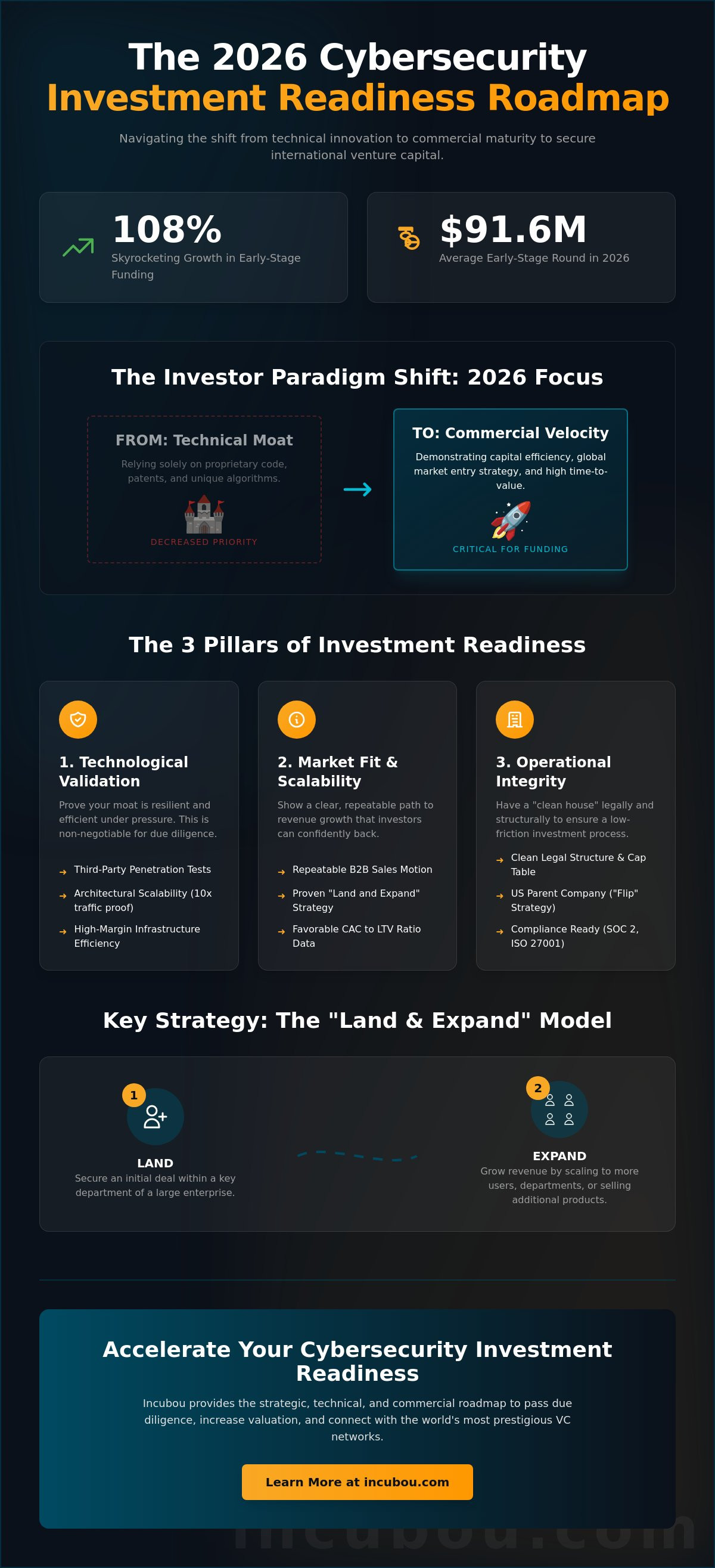
Cybersecurity funding rounds skyrocketed by 108% in early 2026, with the average early-stage round now reaching a staggering $91.6 million. While the capital is flowing, the criteria for selection have shifted from simple technical innovation to sophisticated commercial maturity. You've likely built a powerful solution, yet you still face the daunting gap between hitting technical milestones and meeting the rigid expectations of international investors. Achieving true cybersecurity investment readiness in this environment requires more than a "moat" of code; it demands a clear, high-velocity strategy for global market entry and regulatory compliance.
We recognize the frustration of proving market fit in a crowded sector while navigating the complexities of NIST 2.0 and new US compliance standards. This article promises to help you master the strategic, technical, and commercial benchmarks required to secure international venture capital in 2026. We'll provide a definitive roadmap to pass due diligence, increase your valuation through scalability, and connect with the world's most prestigious VC networks.
Key Takeaways
- Understand why 2026 venture capitalists prioritize capital efficiency and operational maturity over raw growth.
- Learn how to achieve cybersecurity investment readiness by aligning technical validation with commercial scalability and clean legal structures.
- Discover the mandatory technical benchmarks, including third-party penetration tests and architectural scalability, required to pass rigorous due diligence.
- Master the "Land and Expand" B2B sales model to demonstrate clear revenue growth potential within existing enterprise accounts.
- Identify when to execute a "Flip" strategy to establish a US parent company and streamline your path to international funding.
Defining Cybersecurity Investment Readiness in 2026
Founders often mistake a robust security posture for a fundable business model. While having a secure product is the baseline for entry, it doesn't equate to being investable in the eyes of a sophisticated partner. In the current environment, cybersecurity investment readiness is the strategic synthesis of a defensible product moat and high-velocity market entry. It's the precise alignment of technical validation, commercial scalability, and operational maturity that signals to the market that your startup is prepared for rapid, global expansion.
The 2026 investment climate has undergone a fundamental transformation. Investors have moved away from the "growth at all costs" mentality that defined previous cycles, choosing instead to prioritize capital efficiency. They look for teams that can generate significant value without burning through cash reserves at an unsustainable rate. Demonstrating that you can acquire enterprise customers effectively while maintaining high margins is now just as critical as the code itself. To secure venture capital today, you must prove that your organization is a finely tuned engine ready for international fuel.
The Shift from Technical Moats to Commercial Velocity
A unique algorithm or a novel detection method is no longer enough to secure a Series A round. Patents and proprietary tech provide a foundation, but they don't guarantee market dominance. Modern VCs focus on "time-to-value" for B2B security buyers. They want to see how quickly a Chief Information Security Officer (CISO) can deploy your solution and realize a return on their investment. If your implementation process is cumbersome or requires extensive manual configuration, your commercial velocity will stall. Readiness involves proving that your sales motion is repeatable and that your product can scale beyond your initial domestic market into complex regions like the US or the EU.
The Three Pillars of the Incubou Readiness Framework
We've identified three essential pillars that define a startup's maturity. Strengthening these areas ensures you aren't just "secure," but truly ready for the scrutiny of global due diligence.
- Technological Validation: This goes beyond internal testing. It requires proving that your architecture can handle a 10x increase in traffic and data volume without a corresponding 10x increase in operational costs.
- Market Fit: You must demonstrate a repeatable sales motion. This includes clear data on your Customer Acquisition Cost (CAC) and a proven "Land and Expand" strategy within enterprise accounts.
- Operational Integrity: This is the "clean house" factor. It involves having your legal structures, cap table, and compliance certifications like SOC 2 or ISO 27001 fully organized before the first meeting.
By focusing on these pillars, you move from being a technical project to a scalable enterprise. True cybersecurity investment readiness means your startup is a low-friction vehicle for growth, prepared to integrate into the global security ecosystem with confidence.
Technical Validation Checklist: Proving the Moat
Technical brilliance alone doesn't secure a term sheet. In the current market, investors look past your code to find evidence of resilience and scalability. They prioritize startups that have already stress-tested their assumptions through independent channels. You must prove that your "moat" isn't just a clever algorithm, but a sustainable technical advantage that survives the scrutiny of global due diligence. This level of technical validation is a cornerstone of cybersecurity investment readiness, transforming a promising tool into a bankable asset.
Third-party validation has become a non-negotiable requirement for funding in 2026. Founders often assume their internal testing is sufficient, yet investors analyze specific questions VCs will ask regarding independent penetration tests and vulnerability assessments. These reports provide the objective proof needed to verify your security claims. Beyond basic security, your architecture must demonstrate clear scalability benchmarks. Can your system handle 10x the traffic and data volume without a 10x increase in infrastructure costs? Investors look for architectural efficiency that allows for high-margin growth as you scale into larger enterprise environments.
The Proprietary Tech Audit
Documenting your "secret sauce" requires a delicate balance between transparency and security. You need to provide enough detail to prove your innovation is unique without exposing the core logic to unnecessary risk. This audit also involves a rigorous check of open-source components. Messy dependencies can create legal friction during a "flip" or an acquisition, so ensuring your IP is clean and fully owned is vital. If your product utilizes AI or machine learning, move beyond the marketing buzzwords. Be prepared to demonstrate functional utility, specifically how your models improve threat detection or response times in real-world scenarios.
Interoperability and API Maturity
The era of the "walled garden" is over. Modern security teams demand tools that integrate seamlessly with their existing stacks, particularly SIEM and SOAR platforms. If your tool doesn't play well with others, it's a liability, not an asset. Investors fear vendor lock-in that leads to high churn rates. Proving "frictionless deployment" means having mature API documentation and pre-built integrations ready for review. This interoperability ensures your solution can be adopted quickly by global enterprises with complex, multi-vendor environments. Refining these technical pillars is a core component of cybersecurity acceleration, ensuring your product is ready for the world stage.
Finally, protect the code that drives your valuation. Intellectual Property (IP) protection isn't just about filing patents; it's about establishing a culture of security within your development lifecycle. Showing that you've secured your own CI/CD pipelines and managed developer access effectively tells an investor that you understand the high-stakes nature of the industry you're trying to lead.
Commercial Scalability: The B2B Sales Strategy
Technical excellence provides the foundation, but commercial scalability determines your ultimate valuation. Investors in 2026 aren't just buying your code; they're investing in your ability to capture market share efficiently. Demonstrating cybersecurity investment readiness requires a deep understanding of the financial metrics that drive venture capital decisions. You must prove that your business model is as resilient and scalable as your software architecture.
The security niche is notorious for its complex procurement processes. Chief Information Security Officers (CISOs) are risk-averse, leading to a standard sales lag of 6 to 18 months. Transparency regarding this timeline is vital. Investors respect founders who acknowledge these realities rather than presenting overly optimistic projections. To justify high Customer Acquisition Costs (CAC), your Lifetime Value (LTV) must show significant upside. This is often achieved through a "Land and Expand" model, where you secure an initial footprint and grow revenue through additional modules or seat licenses. As highlighted in the Global Cybersecurity Outlook, the strategic importance of cyber-resilience is driving long-term enterprise commitments, making this expansion path more viable than ever.
Refining your cybersecurity B2B sales strategy is a core component of this pillar. It involves shifting from opportunistic sales to a methodical, repeatable process that produces predictable results. VCs look for a "money-in, growth-out" engine where every dollar of capital spent on sales and marketing yields a clear, measurable return.
Global Market Penetration Readiness
Success in a domestic market doesn't automatically translate to global dominance. You must identify a clear "beachhead" market, such as the US or the EU, and understand its specific requirements. Structuring your team to support international sales is essential, ensuring you have the localized expertise to handle different buying behaviors. Crucially, your compliance roadmap must align with your target region. Achieving SOC 2 Type 2 is a prerequisite for the US market, while GDPR remains the gold standard for European expansion. Proving you have these certifications in place or well underway removes significant friction from the due diligence process.
The Repeatable Revenue Engine
A major milestone in your growth journey is the transition from founder-led sales to a professional sales organization. Investors want to see that the product can sell without the CEO in the room. This maturity is proven through detailed case studies and low churn data, which validate your product-market fit. Forecasting accuracy is another critical metric. In the high-stakes world of venture capital, missing your quarterly numbers by more than 10% can be a major red flag. It suggests a lack of visibility into your pipeline or an unstable sales process. Building a reliable revenue engine demonstrates that your startup is ready for the professional management and scale that comes with a Series A or B round.
The "Clean House" Factor: Legal and Global Structure
Legal due diligence is frequently the stage where promising deals stall or fail entirely. Investors look for a "Global-First" architecture that simplifies international expansion and reduces future friction. For European startups, achieving cybersecurity investment readiness often involves executing a "Flip" strategy. This process involves establishing a US parent company, typically a Delaware C-Corp, to house your intellectual property and attract North American capital. This structure provides a familiar legal framework for global VCs and significantly streamlines the path to an international exit.
Cap Table hygiene is equally critical for institutional trust. Messy equity splits with inactive founders or poorly documented "friends and family" rounds can be a major deterrent during a Series A. Cleaning these up early demonstrates professional maturity and strategic foresight. Furthermore, being part of an IAPMEI-certified hub like Incubou adds a layer of institutional credibility. This certification signals to the market that your startup has already met rigorous national standards for excellence within the Portuguese and European ecosystems.
IP Ownership and Employment Contracts
Your valuation is tied directly to the code you've built. You must ensure that every line of code developed by contractors or third-party agencies is legally and exclusively owned by the company. Standardizing these agreements for a global workforce prevents costly disputes during an acquisition. Additionally, implementing a formal Employee Stock Option Plan (ESOP) is a strategic necessity. It's a vital tool for attracting and retaining the high-level cyber talent required to maintain your competitive advantage as you scale into new jurisdictions.
Compliance as a Competitive Advantage
In 2026, compliance isn't just a hurdle; it's a market differentiator. SOC 2 Type 2 has become the mandatory "entry ticket" for US venture capital. While a Type 1 audit for a midsize company might cost between $7,500 and $15,000, the more rigorous Type 2 is what proves operational consistency over a period of months. Mapping your internal security posture to the NIST CSF 2.0 framework ensures you align with the latest global standards for executive accountability and risk management. This alignment is a core component of cybersecurity investment readiness that most competitors overlook.
Regulatory gaps, such as failing to prepare for the EU Cyber Resilience Act or evolving US standards, can kill a deal in its final stages. Proactive compliance demonstrates that you understand the bureaucratic nuances of international business expansion. If you're ready to professionalize your legal and operational structure for the global stage, explore how our cybersecurity acceleration services can guide your journey.
Accelerating Readiness with Incubou
Navigating the journey to a successful Series A or B funding round shouldn't be a solitary effort. While the requirements for cybersecurity investment readiness are rigorous, they're not insurmountable when you have a strategic partner to guide your development. Incubou acts as that steady hand, providing the institutional structure and global connections necessary to move from a technical milestone to a commercial success. Our approach focuses on de-risking your startup, making it an attractive, high-velocity asset for the world's most demanding investors.
We provide more than just workspace; we offer a direct bridge to the international venture capital community. Our founders gain access to a curated network of global security investors who trust our vetting process and value our specialized focus. This access is complemented by a mentorship model where you learn directly from industry veterans who have successfully navigated the transition from seed to Series B. These insights help you avoid common pitfalls in scaling and ensure your operational integrity remains intact under the pressure of due diligence. By leveraging our cybersecurity acceleration services, you've already cleared many of the hurdles that cause other startups to stumble.
The US Market Entry Launchpad
Transatlantic scaling presents unique bureaucratic and cultural hurdles that can drain a startup's resources. We help you navigate these complexities by leveraging our hub in Vila Nova de Gaia as a strategic launchpad for both European validation and US market entry. Our experts provide granular guidance on reducing your time-to-market, ensuring your product and legal structures are optimized for a North American audience from day one. We'll help you tailor your pitch to resonate with the specific nuances of Silicon Valley investors, who often prioritize different scalability metrics than their European counterparts.
From Roadmap to Reality
Our "Pitch Prep" methodology goes beyond refining slides. We stress-test your entire business case against real-world investor objections, ensuring you can defend your valuation with data-driven confidence. As the first and only IAPMEI-certified cybersecurity incubator in Portugal, our endorsement acts as a powerful seal of quality for institutional investors. This certification signals that you've met the high standards required for global expansion and professional management. It transforms your roadmap from a collection of goals into a verifiable reality that VCs can get behind.
Don't leave your funding journey to chance in a competitive market. If you're ready to transform your technical innovation into a VC-ready enterprise, apply for our next acceleration cohort and join a community dedicated to global security leadership.
Secure Your Global Strategic Advantage
Securing international venture capital in 2026 requires a fundamental shift from technical focus to holistic business maturity. You've explored how technical validation, commercial scalability, and a clean legal structure form the essential pillars of success. Achieving true cybersecurity investment readiness means your organization is prepared for the rigorous scrutiny of global due diligence. It's about proving that your product isn't just a solution, but a scalable engine for international growth.
Incubou acts as your strategic partner in this high-stakes environment. As an IAPMEI-certified cybersecurity accelerator based in the strategic hub of Vila Nova de Gaia, Portugal, we provide the institutional credibility and specialized US market entry launchpad you need to scale. We help you navigate complex bureaucratic hurdles and connect with the right investor networks to ensure your vision reaches its full potential.
Download the Full Investment Readiness Checklist to begin stress-testing your strategy today. Your journey to global leadership starts with a single, structured step. We're here to ensure you take it with confidence.
Frequently Asked Questions
What is the most common reason cybersecurity startups fail due diligence?
Messy legal documentation and a lack of clear intellectual property ownership are the primary reasons cybersecurity deals fail during due diligence. Investors need absolute certainty that the code they're funding belongs entirely to the entity they're buying into. If contractor agreements are missing or employment contracts are non-standard, the risk becomes too high for institutional capital. Professionalizing these administrative foundations is a critical step in the journey toward cybersecurity investment readiness.
How much revenue do I need to be considered "Series A ready" in 2026?
While metrics vary, the 2026 benchmark for Series A often requires Annual Recurring Revenue between $1 million and $3 million. Investors now prioritize capital efficiency and a proven "Land and Expand" model over raw user growth. Demonstrating a repeatable sales motion that yields high margins is more important than hitting a specific revenue number without a sustainable path to profitability. Founders must show that their revenue is predictable and scalable.
Does my cybersecurity startup need a US entity to attract American VCs?
Yes, establishing a US parent company, typically a Delaware C-Corp, is almost always a requirement for securing lead investment from American venture capital firms. This "Flip" strategy provides US investors with a familiar legal and tax framework, reducing their perceived risk. It also simplifies the process of hiring North American talent and acquiring domestic customers, signaling that you're committed to a global-first growth strategy that accommodates international expansion.
How long does the cybersecurity investment readiness process usually take?
Preparing for investment readiness typically takes six to twelve months of focused effort. This timeline allows for the completion of necessary technical audits, such as SOC 2 Type 2, and the professionalization of internal sales and legal processes. Rushing this journey often leads to red flags during due diligence. Starting early is essential to ensure your startup is truly fundable and operationally mature when the market opportunity arises.
What technical certifications are most important for investment readiness?
SOC 2 Type 2 and ISO 27001 remain the most critical certifications for proving operational security to international investors. While SOC 2 is the standard for the North American market, ISO 27001 provides the global validation necessary for European and Asian expansion. Aligning your framework with NIST CSF 2.0 further demonstrates your commitment to executive-level accountability and modern risk management standards, which are highly valued during the cybersecurity investment readiness evaluation.
How does an accelerator like Incubou help with the "readiness" process?
Incubou streamlines the readiness process by providing a structured framework for technical validation and commercial scaling. We offer founders direct access to a curated network of global security investors and mentorship from professionals who have successfully navigated Series B exits. Our program de-risks your startup by ensuring your legal, technical, and sales foundations meet the high standards of international venture capital. We act as a strategic bridge to global markets.
Can a European cybersecurity startup realistically compete in the US market?
European cybersecurity startups can successfully compete in the US by leveraging their strong focus on data privacy and engineering excellence. The key to success is localized execution, which includes hiring a US-based sales team and achieving domestic compliance standards like SOC 2. By positioning European origin as a mark of quality and rigorous security standards, founders can win significant market share in the competitive American security landscape while maintaining their unique technical advantage.
What is the "IAPMEI certification" and why does it matter to investors?
IAPMEI certification is a prestigious seal of quality awarded by the Portuguese government to incubators that meet rigorous institutional standards. For investors, this certification acts as an external validation of the incubator's professional management and the quality of its supported startups. Being part of an IAPMEI-certified hub like Incubou provides founders with immediate credibility. It signals that their venture is part of a high-standard, verified ecosystem that understands the nuances of international business expansion.


