

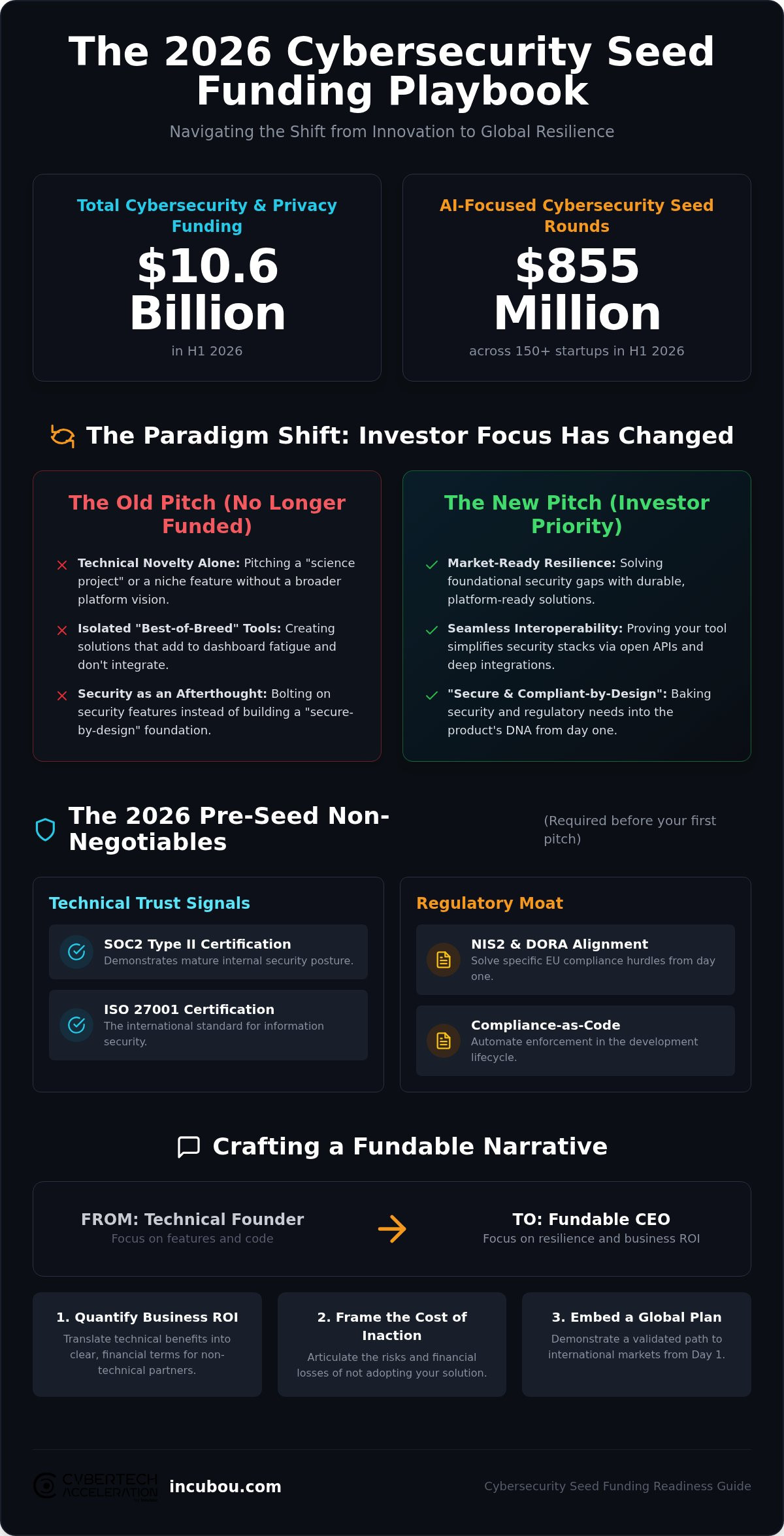
AI-focused cybersecurity startups secured $855 million across 150 seed rounds in just the first half of 2026. While capital is abundant, the barrier to entry has shifted significantly. When you're preparing for cybersecurity seed funding, you're no longer just pitching a tool; you're pitching a foundation for global resilience. Investors now demand more than technical brilliance. They want to see a validated path to international markets and a sophisticated understanding of the current regulatory environment.
You likely feel the pressure of market saturation and the struggle to translate deep technical ROI for non-technical partners. It's a high-stakes environment where a single regulatory oversight can stall your momentum before it begins. This guide provides a clear roadmap to investment readiness by detailing the 2026 "must-have" technical features and global expansion strategies. We'll explore how to bridge the gap between innovation and global venture capital, ensuring your startup is built for scale while meeting the rigorous demands of NIS2 and DORA compliance.
Key Takeaways
- Shift your focus from pure innovation to market-ready resilience, ensuring your product is built for platform integration and regulatory compliance from the start.
- Master the resilience narrative by quantifying business ROI and the cost of inaction to resonate with non-technical venture capital partners.
- Secure a strategic advantage when preparing for cybersecurity seed funding by embedding a "Day 1" global expansion plan into your initial roadmap.
- Transition from a technical founder to a fundable CEO by leveraging specialized acceleration to refine your business model for high-growth international markets.
The 2026 Cybersecurity Seed Landscape: Shifting from Innovation to Resilience
The era of the "science project" startup is over. In the 2026 market, cybersecurity seed funding is no longer awarded for technical novelty alone. While venture funding for cybersecurity and privacy startups reached $10.6 billion in the first half of 2026, the capital is increasingly concentrated. Investors have moved away from funding isolated "best-of-breed" tools. They now prioritize market-ready resilience. When you're preparing for cybersecurity seed funding, you must demonstrate that your solution isn't just a feature, but a durable component of a global security architecture.
The rise of the AI-driven threat landscape has fundamentally altered valuations. AI-focused cybersecurity startups raised $855 million across more than 150 seed-stage rounds in the first half of this year. This surge reflects a "cyber arms race" where defenders must leverage the same sophisticated automation as attackers. Consequently, seed-stage valuations now hinge on your ability to prove your technology is recession-proof. Investors look for solutions that reduce operational complexity and offer a clear path to long-term survival in a volatile economic climate. They favor OPEX-friendly models that allow enterprises to scale security costs alongside their business growth.
The Rise of Strategic Resilience
Strategic resilience is the new benchmark for early-stage ventures. Investors prioritize startups that solve foundational security gaps rather than niche vulnerabilities. Founders must align their roadmaps with the shifting priorities of organizations like the Cybersecurity and Infrastructure Security Agency (CISA), which emphasizes proactive risk management and secure-by-design principles. In 2026, "security-by-design" is an expectation for every seed-stage venture. You must prove that security is baked into your product's DNA, not bolted on as an afterthought. This shift demands a move from capital-intensive hardware solutions to flexible, software-defined security that fits modern, cloud-native workflows.
Investor Expectations: Consolidation vs. Innovation
The trend toward vendor consolidation is a critical factor in your seed-stage pitch. Chief Information Security Officers (CISOs) are exhausted by managing dozens of disconnected dashboards. To secure funding, your startup must prove it can coexist within existing security stacks. Interoperability has become a non-negotiable keyword. If your tool doesn't integrate seamlessly with major platforms or provide open APIs for data sharing, it's a liability. Investors want to see that your innovation simplifies the security environment rather than adding another layer of management overhead. Your pitch should highlight how you enable better outcomes through the consolidation of telemetry and the automation of response across the entire enterprise ecosystem.
Technical and Compliance Readiness: The 2026 Non-Negotiables
Secure your foundation before you step into the boardroom. In 2026, the threshold for technical maturity has moved upstream. Investors now view SOC2 Type II and ISO 27001 certification as pre-seed requirements rather than post-funding milestones. This shift stems from the reality that enterprise customers won't even entertain a pilot with a startup that lacks these basic trust signals. When you're preparing for cybersecurity seed funding, your internal security posture is as much a part of the product as the code itself. You must demonstrate a commitment to continuous security monitoring and automated compliance within your own tech stack to prove you can handle sensitive customer data.
The "NIS2 Effect" has fundamentally reshaped the European and global market. With the directive now in full effect across 18 critical sectors, startups must design their product roadmaps to solve specific regulatory hurdles from day one. Investors look for founders who understand these mandates deeply. They want to see that your solution helps entities meet stricter incident reporting and supply-chain due diligence requirements. If you can't articulate how your technology simplifies compliance for a CISO under NIS2 or DORA pressure, you're missing a primary value driver for 2026 capital.
Building a Regulatory Moat
Transform compliance from a checkbox into a competitive differentiator. Modern investors favor startups that implement "Compliance-as-Code," which is the practice of codifying regulatory requirements into the development lifecycle to ensure automated, continuous enforcement. This approach ensures your product remains "compliant by design" as you scale. In the era of generative AI, data privacy by design is equally critical. You must prove that your AI models respect data sovereignty and maintain strict isolation, especially when targeting highly regulated industries. Demonstrating this level of foresight during due diligence positions your startup as a sophisticated, low-risk investment.
Validation via Pilot Programs
Distinguish your progress by moving beyond the traditional MVP. A "trial" is a passive test; a "strategic pilot" is a structured validation of business value. To impress seed investors, you need high-fidelity data from real-world environments. Document how your product performs under stress, its impact on mean time to detect (MTTD), and its integration ease with existing stacks. This level of evidence is essential for proving cybersecurity product market fit. Founders who present detailed pilot results demonstrate they aren't just building tech; they're solving enterprise-scale problems. If you need help refining these results for a global audience, exploring cybersecurity acceleration services can provide the strategic edge needed to close your round.
Crafting the Investment Narrative: From Features to Business ROI
Stop relying on fear as a sales tactic. While threat statistics once dominated pitch decks, the 2026 investor is looking for business enablement and operational resilience. When you're preparing for cybersecurity seed funding, your narrative must shift from "what could go wrong" to "how we ensure things go right." This transition requires you to quantify the cost of inaction for your target customers. If a prospect doesn't adopt your solution, what is the measurable impact on their uptime, their regulatory standing, or their brand equity? Investors want to see that you understand the economic drivers of the C-suite, not just the technical anxieties of the SOC.
Deep-tech expertise remains the primary trust signal in this sector. Founder-market fit is scrutinized more heavily in cybersecurity than in almost any other industry because the stakes are uniquely high. You must demonstrate that your team possesses the technical pedigree to outpace sophisticated adversaries while maintaining the business acumen to scale a global organization. To facilitate rapid technical due diligence, your data room should be structured for efficiency. Include clear architectural diagrams, third-party penetration test results, and documented code review processes. A well-organized data room signals to VCs that you're a disciplined operator ready for institutional capital.
Communicating ROI in a Saturated Market
Translate your technical wins into financial outcomes. In a crowded market, claiming "fewer false positives" isn't enough. Instead, show how those improvements lead to hundreds of saved analyst hours and a significant reduction in talent churn. You can also leverage the "insurance angle" by demonstrating how your technology directly reduces cyber insurance premiums for your clients. Using a structured approach to funding for cybersecurity startups can help you refine this narrative, ensuring your value proposition aligns with the specific mandates of 2026 venture partners.
The 2026 Pitch Deck Framework
Your seed round deck should be a lean, 10-slide masterclass in strategic clarity. Address the "Why Now?" question by highlighting the convergence of AI-driven threats and new regulatory mandates like NIS2. In a post-AI-hype environment, VCs are skeptical of "AI-powered" labels without substance. Pitch your technology as "Defensible AI" by clearly explaining how your proprietary data loops and secure model training create a moat that generic, off-the-shelf large language models simply cannot replicate. Focus on the durability of your competitive advantage and your clear vision for global market capture.
Global Scalability: The Cross-Border Advantage
Investors in 2026 rarely fund a "local" cybersecurity solution. Because cyber threats ignore national borders, your growth strategy must do the same. When you're preparing for cybersecurity seed funding, presenting a "Day 1" global expansion plan is no longer optional. It's a fundamental requirement for securing high-tier venture capital. VCs look for startups that can bridge the gap between regional innovation and the world's largest security spends, specifically in the United States, where the government and public sector market alone is projected to reach $84.61 billion this year.
European founders have a unique advantage when they leverage strategic hubs. Using an established pipeline from Vila Nova de Gaia to Silicon Valley allows you to build a product under rigorous European standards while eyeing the rapid scaling opportunities of the US market. This cross-border approach is essential when preparing for cybersecurity seed funding because it proves your solution can handle diverse regulatory environments and varied customer expectations from its inception. It transforms your startup from a regional player into a global contender.
The Strategic Advantage of Portugal’s Cyber Ecosystem
Positioning your venture within the Portugal cybersecurity startup hub provides immediate credibility. Being based in a certified innovation hub like Vila Nova de Gaia offers access to a dense network of industry-specific mentors and R&D grants that aren't available to isolated startups. IAPMEI certification acts as a prestigious seal of approval. It signals to international investors that your business meets high standards of operational excellence and strategic vision. This regional support helps you refine your tech before the high-pressure demands of global competition begin.
Preparing for US Market Entry
Success in the United States requires more than just a flight to San Francisco. You must understand the fundamental differences between EU and US security buying cycles. US cycles are often faster but demand higher levels of immediate technical proof and aggressive sales motions. Localizing your global expansion for cybersecurity firms strategy involves more than just translating marketing materials. It means building a US-based advisory board before your seed round even closes. This provides the local market intelligence and network access needed to penetrate the world's most competitive security landscape. To accelerate this journey, partner with a specialized cybersecurity accelerator that understands the nuances of international scaling.
Maximizing Seed Success via Strategic Acceleration
Acceleration acts as the final catalyst that transforms a technical vision into a fundable enterprise. While the previous sections of this guide detailed the technical and narrative requirements for your round, the actual execution often requires a specialized partner to navigate the final hurdles. When you're preparing for cybersecurity seed funding, the quality of your network determines the speed of your close. A specialized accelerator provides more than just advice. It offers a structural framework to refine your business model for the 2026 investment environment, ensuring you transition from a technical founder into a fundable CEO who can command a boardroom.
Warm introductions to sector-specific venture capitalists are the lifeblood of a successful seed round. Cold outreach rarely works in the high-stakes world of security tech. By leveraging cybersecurity acceleration services, you gain access to a curated network of investors who already understand the nuances of the cyber market. This strategic alignment reduces the time spent explaining basic technical ROI and allows you to focus on the sophisticated "Resilience Narrative" discussed earlier. Post-funding support is equally vital, as a strategic partner helps you maintain momentum while scaling from Seed to Series A.
The Incubou Framework: Beyond Mentorship
Incubou provides a sophisticated platform for growth that goes far beyond traditional mentorship. As an IAPMEI-certified accelerator, we offer business scaling services that act as a powerful trust signal for international investors. This certification validates your operational excellence before you even begin due diligence. Based in the certified innovation hub of Vila Nova de Gaia, Incubou facilitates global market penetration by acting as a bridge between European innovation and global venture capital. Our founders benefit from a dedicated peer network of security innovators, creating a collaborative environment where technical hurdles and regulatory challenges like NIS2 are solved collectively.
Next Steps for Founders
Determining if your startup is ready for a high-intensity program requires an honest assessment of your current trajectory. When preparing for cybersecurity seed funding, you should have a validated MVP and initial customer feedback at a minimum. Use this checklist to evaluate your readiness for the Incubou program:
- Technical Validation: Do you have data from at least one high-fidelity pilot program?
- Regulatory Awareness: Is your roadmap aligned with NIS2 or DORA requirements?
- Global Ambition: Are you ready to execute a "Day 1" US market entry strategy?
- Founder Commitment: Is your team prepared to transition from engineering to strategic leadership?
If you're ready to scale your innovation and secure your place in the 2026 investment landscape, it's time to take the next step. Apply for Incubou’s Cybersecurity Acceleration Program today and begin your journey toward global market leadership.
Secure Your Global Future in 2026
Securing a seed round in the current landscape requires a precise synthesis of technical validation and strategic foresight. Founders must move beyond isolated features to build interoperable, resilient platforms that meet the rigorous demands of NIS2 and DORA. Success hinges on your ability to prove global scalability from the very first pitch, especially when targeting the high-growth US market. When you're preparing for cybersecurity seed funding, every technical decision and compliance milestone becomes a critical signal of your readiness for institutional capital.
Partnering with a strategic mentor bridges the gap between European innovation and international venture capital. Incubou provides a steady hand through IAPMEI-certified acceleration and specialized US market entry support. By joining our innovation hub in Vila Nova de Gaia, you gain the network and credibility needed to scale rapidly. Accelerate your cybersecurity startup’s global growth with Incubou and turn your technical vision into a market-leading reality. The global security landscape is waiting for your solution, and you don't have to navigate it alone.
Frequently Asked Questions
What is the average seed round size for cybersecurity startups in 2026?
The median seed round for cybersecurity startups in 2026 typically falls between $3 million and $4 million. While total venture funding for the sector reached $10.6 billion in the first half of the year, investors are concentrating capital into fewer, higher-quality deals. You'll find that successful founders are those who demonstrate significant technical validation and a clear path to international scalability before entering the boardroom.
How much revenue do I need to raise a cybersecurity seed round?
You don't necessarily need high annual recurring revenue (ARR), but you must prove a validated path to it. In the 2026 landscape, investors prioritize "market-ready resilience" over pure innovation. Having one or two high-fidelity pilot programs with enterprise-level entities often serves as a more powerful trust signal than fragmented, low-value revenue. Focus on showing deep engagement with customers who face high regulatory pressure.
Do I need a patent to get seed funding for my security tech?
Patents aren't strictly mandatory, but you must demonstrate a defensible technical moat. In a post-AI-hype environment, venture capitalists scrutinize whether your technology is easily replicable by larger incumbents. While a patent provides legal protection, showing proprietary data loops or unique architectural integrations often carries more weight during technical due diligence. You must prove your solution is "Defensible AI" rather than a generic wrapper.
What are the most active cybersecurity VCs for seed stage in Europe?
European cybersecurity VCs are increasingly focused on startups that align with NIS2 and DORA mandates. The most active firms are those with a dedicated security portfolio, as they understand the long enterprise sales cycles and high-stakes nature of the sector. These specialized investors are often more valuable than generalist firms because they provide the specific network needed to navigate the complex European and US regulatory environments.
How does NIS2 compliance affect my startup’s ability to get funded?
Compliance with NIS2 is now a prerequisite for funding rather than a secondary goal. Because your future enterprise customers must comply with stricter incident reporting and supply-chain rules, they won't purchase from non-compliant startups. When you're preparing for cybersecurity seed funding, showing that your product is "compliant by design" significantly de-risks the investment. It proves you can immediately enter the $84.61 billion government and public sector market.
Can I raise a seed round if my cybersecurity startup is based in Portugal?
Yes, raising a round from Portugal is a strategic advantage when you leverage the country's specialized innovation hubs. Being based in an IAPMEI-certified ecosystem like Vila Nova de Gaia provides the credibility needed to attract global capital. This location acts as a bridge, allowing you to build under rigorous European standards while preparing for cybersecurity seed funding and eventual expansion into the world's largest security markets.
What is the difference between a general accelerator and a cybersecurity-specific one?
A cybersecurity-specific accelerator provides specialized mentors and a network that understands the technical nuances of the security stack. Unlike generalist programs, a cyber-focused partner like Incubou helps you navigate complex regulations and specific US market entry hurdles. This specialization is vital for refining your business model to meet the unique demands of global security buyers who prioritize resilience over generic software features.
How do I prove my AI-driven security tool isn't just a wrapper for LLMs?
To prove your AI tool has substance, you must showcase your proprietary data sets and the specific security outcomes your models achieve. Investors in 2026 are skeptical of generic wrappers that lack original architecture. Focus your pitch on your unique training loops and secure model isolation. Demonstrating how your AI handles sensitive data while remaining compliant with DORA standards will distinguish your startup as a durable, deep-tech venture.


