

In 2026, treating your European distribution strategy as a simple sales exercise is a fast track to failure. To scale effectively, you must view european cybersecurity channel partners as essential trust-proxies that bridge the gap between your technology and stringent local demands. You likely already feel the pressure of high direct entry costs and the overwhelming complexity of navigating regional compliance like NIS2. Building a presence from scratch in fragmented markets often leads to friction, especially when local customers demand immediate technical support and established reputations.
This strategic guide empowers you to master the European landscape by building a scalable indirect sales model. We'll show you how to identify and recruit partners who offer more than just a customer list; they provide the regional validation and regulatory ease required for sustainable revenue. You'll learn to leverage these local networks to reduce market entry friction and secure a competitive advantage. We'll break down the specific criteria for selecting partners who act as a bridge to your global vision, ensuring your expansion is both rapid and secure. It's time to transform these regional hurdles into your primary growth engine.
Key Takeaways
- Understand why 2026 requires channel partners to serve as essential trust-proxies that bridge the gap between your innovation and local market demands.
- Distinguish between the influence of VARs, SIs, and the emerging Super-MSSP to recruit the most effective european cybersecurity channel partners for your niche.
- Simplify regional regulatory compliance by aligning with partners who possess deep expertise in NIS2 milestones and GDPR standards.
- Architect a scalable indirect sales model by moving beyond simple margins toward high-impact incentives like Market Development Funds.
- Accelerate your market entry by utilizing IAPMEI-certified acceleration programs that provide a direct gateway to the broader European channel ecosystem.
The Critical Role of Channel Partners in European Cybersecurity
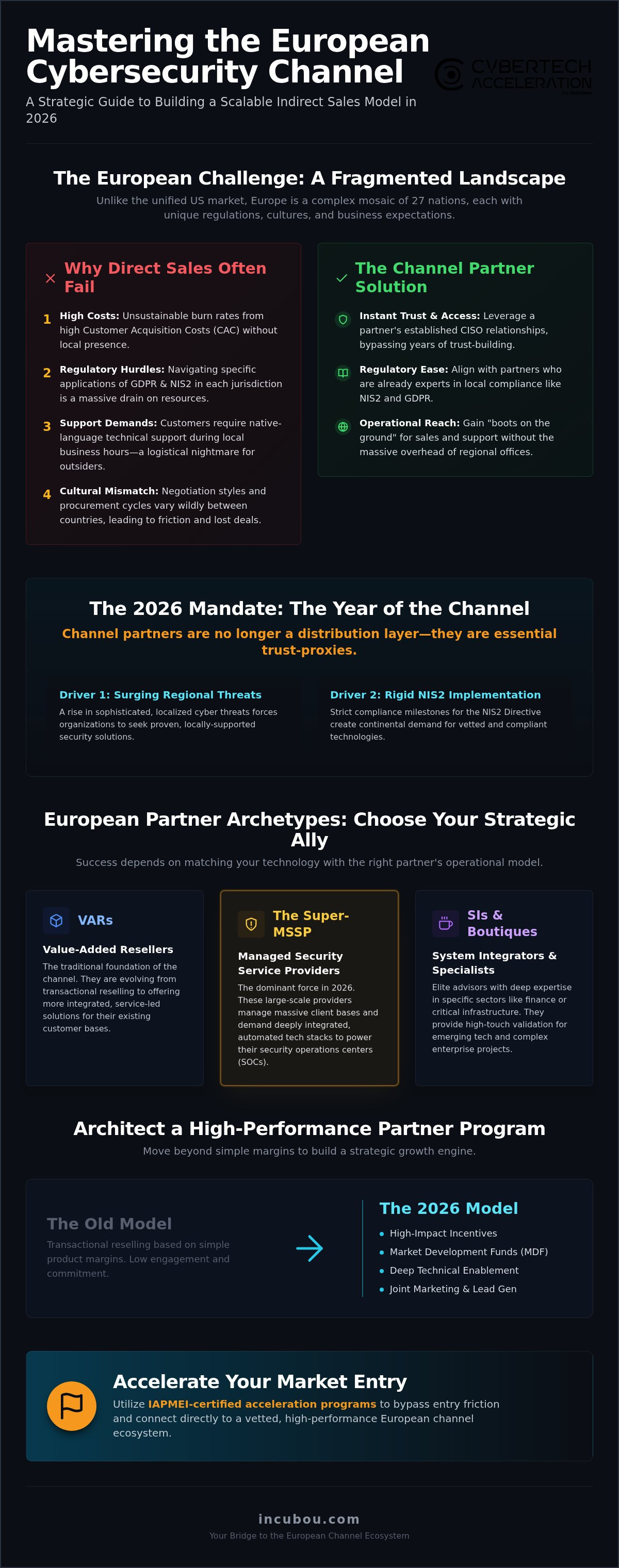
The European market isn't a monolith; it's a complex mosaic of 27 nations, each with unique legal frameworks and cultural nuances. For a growing security firm, european cybersecurity channel partners act as the indispensable bridge between your core innovation and these localized markets. They don't just sell software. They translate your value proposition into the specific language of regional risk. These partners provide the operational boots on the ground that your startup likely lacks, offering a sophisticated path to revenue that bypasses the need for expensive regional offices.
As we move through 2026, the industry is entering what many call the 'Year of the Channel.' This shift is driven by a surge in sophisticated regional threats and the rigid implementation milestones of the NIS2 Directive. Organizations across the continent are desperate for compliant solutions, yet they rarely buy from unknown entities. By leveraging a partner's existing relationship with local CISOs, you bypass the years of trust-building usually required to close enterprise deals. Trust is the primary currency in European business. If a trusted local integrator vouches for your tech, the path to a signed contract shortens significantly. Scaling your revenue through european cybersecurity channel partners allows you to achieve massive reach without the massive overhead of establishing legal entities in dozens of different countries.
Why Direct Sales Often Fail in the European Market
Attempting a direct sales model in regions like DACH or Southern Europe often leads to an unsustainable burn rate. The barrier isn't just the language; it's the deeply ingrained preference for local trust and historical reliability. High customer acquisition costs (CAC) plague foreign brands that lack a physical presence or a recognizable name in the local ecosystem. Common barriers include:
- Regulatory Nuance: Local partners understand the specific application of GDPR and NIS2 in their specific jurisdiction.
- Technical Support: Buyers demand support in their native language and within local business hours.
- Cultural Alignment: Negotiation styles and procurement cycles vary wildly between Paris, Berlin, and Madrid.
Without a local partner to provide this high-touch service, even the most advanced security tools struggle to gain traction. You aren't just selling a product; you're selling a promise of security that requires local hands to maintain.
European Channel Ecosystem vs. US Market Dynamics
The US market often allows for a unified, centralized sales strategy. Europe demands the opposite. You must manage fragmented regional expectations where a strategy that works in Sweden might fail in Italy. This is where the Value-Added Distributor (VAD) becomes a vital ally. Unlike simple logistics providers, European VADs provide the market intelligence and technical enablement needed to scale. We're seeing a definitive shift from transactional reselling to long-term, service-led partnerships. In 2026, your success depends on your ability to treat these partners as a strategic growth engine rather than a mere distribution layer. They are the gatekeepers to the enterprise, and your expansion depends on how well you empower them.
Evaluating European Partner Types: VARs, MSSPs, and SIs
Identifying the right european cybersecurity channel partners requires a granular understanding of how service delivery has evolved. By 2026, the lines between traditional roles have blurred, yet the influence of specific entities has intensified. We're seeing the dominance of the 'Super-MSSP'—large-scale providers that demand deeply integrated, automated tech stacks to manage their massive client bases. Your success depends on matching your technology's maturity with the operational capacity of your chosen partner. This alignment ensures that your solution becomes a core part of their service delivery rather than a shelf-ware burden.
For innovators with highly specialized or high-end solutions, boutique security partners offer an alternative path. These firms may have a smaller geographic footprint, but their deep expertise in specific sectors like finance or critical infrastructure is unmatched. They act as elite advisors, providing the high-touch validation that enterprise clients require for emerging tech. Finding these specialized players is a core part of a successful cybersecurity expansion strategy that prioritizes quality over raw volume.
Managed Security Service Providers (MSSPs): The 2026 Powerhouse
MSSPs have become the primary engine for recurring revenue across the continent. They've shifted focus toward comprehensive SOC-as-a-Service models to address the talent shortage facing European enterprises. To win here, your technology must fit their existing SOC workflows seamlessly. They prioritize tools that offer robust multi-tenancy and extensive API support. When you evaluate an MSSP, look beyond their marketing materials. Scrutinize their technical depth and engineering talent. A partner with high marketing reach but low technical capability will likely fail to operationalize your product effectively, leading to high churn rates.
Value-Added Resellers (VARs) and System Integrators (SIs)
VARs remain the fastest route for established product categories that need rapid market penetration. They excel at high-volume sales through existing procurement vehicles and established customer lists. They're your best bet if your product is easy to deploy and solves a well-understood problem. System Integrators (SIs), however, are critical for complex, enterprise-grade security deployments. These projects often require customized architecture and integration with legacy systems. We're seeing more partners adopt a hybrid model, acting as both integrators and strategic advisors. These firms are particularly valuable because they own the long-term security roadmap for the CISO, positioning your tech as a permanent fixture in the client's defense strategy.
Navigating Regional Barriers: Compliance, Localization, and Trust
Building a successful presence in Europe requires more than a translated website or a local phone number. By 2026, european cybersecurity channel partners have become hyper-selective, prioritizing vendors that actively alleviate their regulatory burdens. The NIS2 Directive has fundamentally altered the vetting process. Partners now scrutinize your supply chain security and incident reporting capabilities before they even consider a partnership. To win their trust, you must embed "Privacy by Design" into your core architecture, ensuring your solution aligns with the strictest interpretations of GDPR and data sovereignty. Adopting a "European-First" brand identity signals that you respect regional legal norms and procurement cycles, which vary significantly from the rapid-fire US model.
Trust isn't just a soft metric; it's a hard requirement for market entry. In regions like DACH (Germany, Austria, Switzerland) and France, the demand for local data residency and "Souveraineté Numérique" (Digital Sovereignty) is non-negotiable. If your solution cannot guarantee that data remains within specific borders or cloud environments, you'll find most doors closed. Establishing a physical presence in strategic hubs like Vila Nova de Gaia allows you to build the face-to-face rapport necessary for long-term success. These hubs act as a bridge, helping you navigate the complex legal requirements and cultural expectations that define the European landscape.
The NIS2 Opportunity for Cybersecurity Startups
The 2026 NIS2 implementation milestones have created a massive opening for agile security firms. European partners are desperately seeking solutions that simplify compliance for their end-customers. They don't want another tool to manage; they want a compliance enabler. Position your technology as a way for partners to automate reporting or verify security postures across their client base. This approach turns a regulatory hurdle into your strongest recruitment hook, attracting top-tier partners who need to solve these specific compliance pains quickly and effectively.
Cultural Nuances in European Partner Recruitment
Recruitment strategies must adapt to the regional rhythm. In Northern Europe, partners often prioritize technical efficiency and direct, transparent communication. In Southern Europe, relationship-building and long-term trust are paramount. Navigating the 'sovereign cloud' requirements in France and Germany is particularly critical; you must demonstrate how your tech integrates with local infrastructure. Utilizing a gateway like Vila Nova de Gaia provides the expert mentorship needed to refine these regional approaches, ensuring you don't waste resources on a one-size-fits-all strategy that fails to resonate with local stakeholders.
Architecting a High-Performance European Partner Program
A world-class program for european cybersecurity channel partners requires a shift from transactional thinking to strategic alignment. You can't simply sign a contract and expect revenue to flow. You must architect a framework that rewards high-performance while providing the technical foundation for scale. This starts with tiering your program to balance broad inclusivity with high-touch elite partnerships. While entry-level tiers provide market visibility, your top-tier categories should focus on partners willing to invest in deep technical certification and joint business planning. This structure ensures that your most dedicated allies receive the resources they need to win complex enterprise accounts.
Incentive structures in 2026 have moved far beyond simple percentage-based margins. High-performing european cybersecurity channel partners now prioritize Market Development Funds (MDF) that allow them to execute localized campaigns and events. These funds empower partners to act as your regional marketing arm, reducing your internal overhead while increasing local relevance. Additionally, your technical integration must be seamless. If your tech doesn't plug easily into their existing service stack through robust APIs, they'll deprioritize it in favor of more "channel-friendly" competitors. Simplicity in integration is often the deciding factor for an MSSP or SI when choosing a long-term vendor.
Partner Enablement and Training Strategies
Enablement is the lifeblood of a scalable channel. You need to move beyond one-off webinars and create a robust, self-service partner portal that provides 24/7 access to technical documentation, sales playbooks, and competitive battlecards. Certifications play a dual role: they validate the partner's expertise to the end-customer and build a sense of loyalty to your brand. When a partner invests hours into mastering your platform, they're far less likely to churn. Effective co-branding is also essential. Providing white-label assets allows your partners to maintain their status as trusted advisors while leveraging your technological innovation.
Measuring Channel Success: 2026 KPIs
Success in the European channel is measured by more than just the bottom line. You must track the distinction between 'partner-originated' and 'partner-fulfilled' deals to understand where the true value lies. If your partners are merely fulfilling deals you found yourself, your program isn't truly scaling your reach. Key metrics to monitor include:
- Time-to-first-deal: This measures the efficiency of your onboarding and enablement process.
- Partner-led growth rate: The percentage of new revenue generated without direct intervention from your internal sales team.
- Technical proficiency: The number of certified engineers within the partner's organization, which correlates with lower support tickets.
Underperforming relationships carry a high hidden cost in management time and support resources. Regularly auditing your partner base allows you to refocus energy on the high-potential partners who drive the majority of your indirect revenue. To refine your strategy and build a resilient network, you can access expert expansion advisory tailored to the nuances of the European market.
Accelerating Market Entry: How Incubou Connects You to the Channel
Vila Nova de Gaia has rapidly emerged as a premier European hub for cybersecurity innovation, offering a sophisticated entry point for firms looking to scale. While previous sections outlined the necessity of high-performance partnerships, the actual recruitment of european cybersecurity channel partners remains the most significant hurdle for international founders. Incubou removes this friction by providing a pre-vetted network of industry experts and strategic connections. Our IAPMEI-certified programs don't just offer advice; they actively refine your cybersecurity business scaling roadmap to align with the specific demands of the 2026 market.
Bypassing the 'cold outreach' phase is vital for rapid growth. Through our accelerator networks, you gain direct access to elite regional VADs and MSSPs who are already looking for compliant, innovative solutions. This isn't just about distribution; it's about strategic alignment. We provide the expert global expansion for cybersecurity firms that addresses the cultural and legal nuances discussed earlier. This ensures your brand resonates across different borders, turning the complexity of the European landscape into a structured growth engine.
The Power of a Certified Cybersecurity Accelerator
Validation is the cornerstone of European business. Being part of an IAPMEI-certified incubator provides instant credibility, signaling to potential partners that your technology has been vetted by a recognized institution. This prestige facilitates mentored introductions that would otherwise take years of networking to secure. We work closely with you to refine your cybersecurity product market fit, tailoring your technical value proposition to the specific compliance and integration needs of high-end European buyers. This focused approach ensures your solution isn't just another tool, but a necessary component of a partner's security stack.
Next Steps: Scaling from Portugal to the Rest of Europe
Portugal serves as the ideal launchpad for the EMEA region, combining a pro-innovation environment with deep ties to the broader network of european cybersecurity channel partners. By applying for our cybersecurity acceleration services, you fast-track your channel strategy and secure your position in a competitive landscape. We provide the steady hand and global vision needed to navigate bureaucratic hurdles and technical integration challenges. Don't leave your expansion to chance. Join the Incubou ecosystem today to empower your growth and secure your future in the European market.
Secure Your European Competitive Advantage
Scaling your security firm across Europe requires a departure from direct sales and a total embrace of strategic alliances. You've seen how european cybersecurity channel partners serve as the ultimate trust-proxies, navigating the rigid compliance milestones of 2026 while providing the local validation your brand needs. Success depends on architecting a program that prioritizes partner enablement and seamless technical integration. This ensures your solution becomes a core component of the regional defense stack. By leveraging established networks, you bypass the friction of fragmented markets and the excessive burn rates associated with direct entry.
Now is the time to transform these regional regulatory hurdles into your primary growth engine. Scale your cybersecurity firm into the European market with Incubou's expert acceleration. Our IAPMEI-certified acceleration program, based in the strategic innovation hub of Vila Nova de Gaia, Portugal, provides a proven roadmap for global expansion. We provide the mentorship and connections needed to turn your global vision into a localized reality. Let's build your international presence together and lead the next wave of cybersecurity innovation.
Frequently Asked Questions
What is the difference between a VAR and an MSSP in Europe?
A VAR focuses on high-volume product sales with additional technical services, while an MSSP provides continuous, managed security operations. European enterprises increasingly favor the MSSP model to address internal resource shortages. MSSPs integrate your tech into their long-term service contracts, providing more stable, recurring revenue. VARs are often better for rapid, transactional market entry with established product categories. This distinction is critical when defining your ideal partner profile.
How do I find cybersecurity channel partners in specific European countries?
Identify partners by engaging with regional innovation hubs and specialized industry events. Hubs like Vila Nova de Gaia provide a concentrated network of european cybersecurity channel partners and local experts. You can also leverage Value-Added Distributors (VADs) who specialize in specific territories like DACH or the Nordics. These distributors possess deep market intelligence and can introduce you to pre-vetted integrators within their network, saving months of manual research.
What margins do European channel partners typically expect in 2026?
Partners expect incentive structures that go beyond simple percentage margins to include market development funds (MDF). While specific margins vary by product category and region, competitive programs in 2026 prioritize high-performance tiers and co-marketing support. Focusing on the partner's total profitability, including service revenue and renewals, is more effective than competing on raw margin alone. This approach builds long-term loyalty and ensures your product remains a top priority in their portfolio.
How does the NIS2 Directive affect cybersecurity channel partnerships?
The NIS2 Directive mandates stricter supply chain security and incident reporting for all entities involved in critical infrastructure. This regulation forces european cybersecurity channel partners to conduct deeper due diligence on their vendors. Your technology must act as a compliance enabler, simplifying the reporting burden for the partner's end-customers. Partners are now actively seeking vendors who can prove their alignment with these new European standards, turning compliance into a powerful recruitment tool.
Why should a cybersecurity startup use an accelerator for market entry?
An accelerator provides instant validation through recognized certifications like IAPMEI, which is essential for building trust with European integrators. Startups benefit from pre-vetted networks and mentored introductions that bypass the slow 'cold outreach' phase. By using an accelerator, you gain a refined strategic roadmap that addresses regional nuances. This structured support significantly reduces the cost and time required to achieve meaningful market penetration, allowing you to focus on product innovation rather than bureaucracy.
Is it better to have one large distributor or multiple regional partners in Europe?
Utilizing multiple regional partners is generally more effective than relying on a single large distributor due to Europe's fragmented nature. Local partners possess the specific language skills, cultural understanding, and existing relationships needed to close deals in their territory. While a single distributor might seem simpler, it often lacks the granular reach required for complex security sales. A multi-partner strategy allows you to adapt to regional market dynamics more efficiently and avoids over-reliance on one entity.
How can I protect my brand reputation when selling through a channel?
Protect your brand by implementing rigorous enablement programs and clear technical certifications for every partner. Ensuring that partners can support your product at the same level as your internal team prevents poor implementations from damaging your reputation. Regularly audit partner performance and provide white-label marketing assets to maintain a consistent message. Robust Service Level Agreements (SLAs) help define expectations and ensure a high-quality experience for the end-user, which is vital for long-term customer retention.
What are the common mistakes when building a European partner program?
The most common mistake is applying a 'one-size-fits-all' strategy to the entire continent without accounting for regional differences. Neglecting local compliance requirements or failing to provide technical support in local time zones will quickly alienate potential partners. Another error is treating partnerships as purely transactional sales channels rather than strategic growth engines. Successful programs focus on long-term enablement and mutual value, ensuring that partners are fully equipped to represent your brand with technical authority and confidence.


