

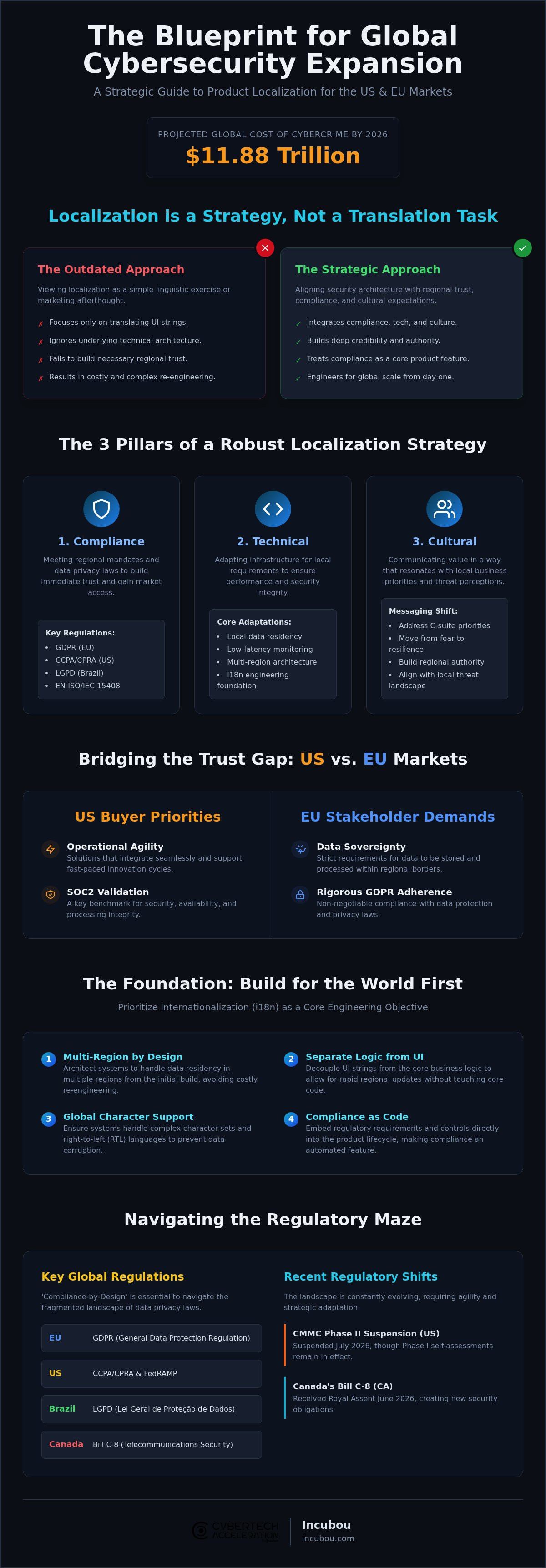
With the global cost of cybercrime projected to hit $11.88 trillion in 2026, expanding your security solution into new territories is no longer just a growth play; it's a high-stakes mission where regional trust is the only currency. You likely feel the pressure of navigating conflicting regulations while fearing that a single mistranslated technical document could compromise your credibility. Developing a sophisticated cybersecurity product localization strategy is the only way to bridge the gap between European innovation and the rigorous demands of the US market.
We understand that the high cost of re-engineering for local data residency and the maze of certification requirements can feel like insurmountable barriers to entry. It's a complex journey, but you don't have to navigate it alone. This guide provides a clear roadmap to master these complexities, ensuring your technology remains compliant and respected across borders. We'll examine the impact of the July 2026 CMMC Phase II suspension, the new ISO/IEC 15408 standards, and the strategic steps required for successful US and EU market penetration.
Key Takeaways
- Learn why an effective cybersecurity product localization strategy requires engineering-level internationalization rather than simple text translation to maintain core system integrity.
- Discover how to implement a 'Compliance-by-Design' framework to navigate the increasing fragmentation of global data privacy laws like GDPR, CCPA, and LGPD.
- Identify the critical technical adjustments needed for real-time monitoring and threat intelligence feeds to ensure regional relevance and low latency across global dashboards.
- Master the cultural shift from fear-based to resilience-based marketing to build authentic authority and trust in diverse international security markets.
- Understand how leveraging a specialized accelerator like Incubou can fast-track your US market entry by connecting you with a deep network of industry-specific mentors and validation experts.
Beyond Translation: Defining Cybersecurity Product Localization in 2026
Stop viewing localization as a linguistic exercise. In the high-stakes environment of 2026, a robust cybersecurity product localization strategy separates global leaders from regional footnotes. While traditional SaaS might focus on translating menus, security technology demands a deeper alignment of the underlying architecture. We define cybersecurity localization as the process of aligning security architecture with regional trust expectations. It's a holistic mission where simple 'string translation' is the least critical component of your roadmap.
Your strategy must rest on three non-negotiable pillars to succeed in a fragmented global market:
- Compliance: Meeting regional mandates like the updated EN ISO/IEC 15408:2026 standards or Canada's Bill C-8 requirements.
- Technical: Adapting infrastructure for local data residency and low-latency monitoring across hybrid environments.
- Cultural: Communicating risk and resilience in a way that resonates with local C-suite priorities and threat perceptions.
The Trust Gap in Cross-Border Security
Trust is not a static concept. US buyers often prioritize operational agility and SOC2 validation, looking for partners who mirror their fast-paced innovation. In contrast, European stakeholders demand rigorous data sovereignty and GDPR adherence, viewing any oversight as a lack of professionalism. A poorly localized interface signals more than just a language barrier; it suggests your product might be equally careless with local privacy laws. Building authority requires deep mentorship and a network of local experts who can validate your business model against these specific regional expectations. When you align with local standards, you transform from a foreign vendor into a trusted strategic partner.
Engineering for Internationalization (i18n) First
Build for the world before you launch for a specific region. Prioritize internationalization (i18n) to ensure your codebase supports global deployment without friction. This involves Defining Cybersecurity Product Localization as a core engineering objective rather than a marketing afterthought. You must prepare systems to handle multi-region data residency from the initial build to avoid the high cost of later re-engineering. Separate business logic from UI strings to allow for rapid regional updates without touching the core code. This technical foresight is essential for managing right-to-left (RTL) languages and ensuring that complex character sets in system logs don't disrupt your threat intelligence feeds. Engineering for i18n first creates the flexible foundation required for secure, high-speed international expansion.
Navigating the Regulatory Landscape: Compliance as a Product Feature
Position compliance as a core value proposition rather than a bureaucratic hurdle. A successful cybersecurity product localization strategy treats regulatory alignment as a competitive advantage that builds immediate trust with regional stakeholders. Startups entering the US market must adopt a 'Compliance-by-Design' framework, embedding specific legal requirements into the product lifecycle from the initial architecture phase. This involves mapping the distinct nuances of GDPR in Europe, CCPA/CPRA in the US, and LGPD in Brazil to ensure your solution respects local digital sovereignty.
Recent regulatory shifts underscore the importance of staying agile. For instance, the US Department of War suspended CMMC Phase II requirements on July 13, 2026, though Phase I self-assessments remain in effect. Meanwhile, Canada's Bill C-8 received Royal Assent on June 15, 2026, introducing new telecommunications security obligations that international providers must address. Adapting your End User License Agreement (EULA) and Privacy Policy isn't just a translation task; it's a strategic necessity to protect your brand and your users. If you're targeting US government contracts, FedRAMP certification becomes a non-negotiable gateway that requires specific localized controls.
Data Sovereignty and Residency Requirements
Meeting data sovereignty laws requires sophisticated technical strategies for regional data siloing. You must ensure sensitive information remains within specified borders to comply with local laws. The 'Schrems II' legacy continues to shape EU-to-US data transfers in 2026, making it vital to select cloud providers with robust local availability zones. Navigating the complexities of Global Security Infrastructure involves balancing these residency mandates with the need for global system visibility. Choosing the right infrastructure partners ensures you meet compliance without sacrificing performance.
Local Security Standards and Audits
While ISO 27001 serves as a global benchmark, entering the US market often necessitates a transition to SOC 2 Type II. This shift demonstrates a commitment to the specific operational controls and security principles US enterprises expect. Engaging local penetration testing partners also adds a layer of regional credibility that foreign audits might lack. By refining your cybersecurity product market fit, you ensure your security controls align perfectly with the expectations of local CISOs. Refining these business models for international expansion is a core pillar of our mission. If you're looking to bridge the gap between European innovation and US regulatory demands, partnering with a certified accelerator can streamline your path to global compliance.
Technical Adaptations for Global Security Infrastructure
High-performance security requires local presence. A robust cybersecurity product localization strategy ensures that real-time monitoring remains truly real-time, regardless of where your users sit. When management consoles sit thousands of miles from the end user, the resulting latency doesn't just frustrate IT teams; it compromises the speed of incident response. Dashboards must respond instantly. Achieving this requires a decentralized approach to data processing that balances centralized threat intelligence with regional execution.
Your technical roadmap must prioritize four critical areas of adaptation:
- Identity Integration: Support local identity providers (IdPs) and regional SSO standards beyond the standard global players to ensure seamless user access.
- Threat Intel Relevance: Adapt threat intelligence feeds to prioritize regional actors and deliver alerts in the local language, ensuring context isn't lost in translation.
- Regional Encryption: Implement localized encryption standards and address specific government access requirements without compromising your core security integrity.
- Automated Playbooks: Localize incident response playbooks to reflect regional IT team structures and reporting hierarchies.
Latency and Edge Computing in Localization
Security products often fail when the distance between the user and the management console grows too large. We recommend using edge computing to process security events locally. This strategy reduces latency for global dashboards and keeps sensitive data within the required sovereign borders. By processing metadata at the edge and only sending critical alerts to a central hub, you maintain a high-velocity defense. This technical foresight is essential for managing the AI-driven threats of 2026, where every millisecond counts in preventing a breach.
Adapting UI/UX for Security-Conscious Users
User experience in security is deeply cultural. US-based security analysts often prefer clean, high-level visualizations that highlight actionable insights quickly. In contrast, many European IT professionals favor data-dense dashboards that provide granular visibility into system logs. You must also master 'Security Slang.' Technical terms carry different weights across borders; a 'critical' alert in one region might be perceived as a 'high' priority in another. Ensuring your interface reflects these nuances builds immediate credibility with local teams. It demonstrates that your product wasn't just translated; it was built for their specific operational environment. This level of technical empathy is a hallmark of a sophisticated global expansion.
The Cultural Nuances of 'Security': Building Regional Authority
Security is a culture, not just a set of protocols. While your code might be universal, the way you communicate risk and resilience must be deeply regional. A successful cybersecurity product localization strategy recognizes that a 'steady hand' approach resonates differently across borders. In the US, security marketing often highlights strategic ambition and the empowerment of the innovator persona. European audiences, however, frequently prioritize risk mitigation and the reliability of a certified institution. You must tailor your 'enemy' narrative by identifying local threat actors that keep regional CISOs awake at night, ensuring your product feels like a local solution rather than a foreign import.
Building authority also requires a commitment to the human element of security. The World Economic Forum reports that 95% of all cybersecurity breaches involve human error, making a human-centric security culture a critical defense layer. Your localization efforts should extend to customer support, offering local language technical expertise that understands the specific operational hurdles of the region. This builds the prestigious and supportive atmosphere necessary for long-term retention. Validating your product through local industry associations and community hubs further cements your position as a trusted strategic partner.
Communication Styles and Market Penetration
Directness in security reporting varies significantly across the globe. Refining your cybersecurity B2B sales strategy means adapting to these cultural norms. While US buyers might appreciate punchy, results-oriented reporting, European stakeholders often require more descriptive, balanced documentation that mirrors their methodical approach to governance. Your content strategy should address specific regional fears, such as the reputational damage of a public breach in the US versus the severe regulatory penalties associated with GDPR in the EU. This localized approach ensures your message isn't just heard; it's trusted.
Leveraging Regional Ecosystems
Market entry is rarely a solo mission. Successful expansion often relies on strong alliances with local channel partners and Managed Security Service Providers (MSSPs) who already hold regional trust. Use local case studies to prove your efficacy within the specific legal and technical constraints of the target market. Participating in regional innovation centers, such as the Portugal cybersecurity startup hub, provides access to a network of experts who can help refine your business model. These ecosystems act as a global bridge, connecting your innovation with the validation required for rapid scaling. If you are ready to navigate these cultural complexities and scale your security solution in the US or EU, apply for our cybersecurity acceleration program to gain the strategic advantage you need.
Accelerating Localization with Incubou’s Global Strategy
Execute your cybersecurity product localization strategy with the precision and speed required to win in the 2026 global market. Localization cycles often stall under the weight of bureaucratic inertia and fragmented regulatory research. At Incubou, we act as the steady hand for founders navigating this complexity. Our acceleration services fast-track the localization lifecycle by compressing months of market validation into a structured, high-momentum journey. We provide direct access to a deep network of US and EU security experts who validate your product against real-world regional requirements before you commit significant capital.
Vila Nova de Gaia has emerged as a critical innovation hub where European ingenuity meets global ambition. We help you refine your business model for international scalability, ensuring your solution is market-ready for diverse territories. Navigating the bureaucratic hurdles of US market entry becomes a manageable process with our strategic mentorship. This support covers everything from initial compliance audits to localized industry networking, allowing you to focus on core innovation while we handle the complexities of expansion.
Incubou: Your Bridge to the US Security Market
We offer tailored programs designed specifically for global expansion for cybersecurity firms. Our IAPMEI certification provides a layer of institutional credibility that resonates with international investors and corporate partners alike. This certification signals that your startup has been vetted by a recognized authority, easing the path for capital injection and strategic alliances. We provide a structured roadmap that guides you from our headquarters in Vila Nova de Gaia directly into the heart of the US security ecosystem, removing traditional barriers to entry through proven frameworks.
Strategic Advisory for High-Growth Founders
Win the market by leveraging expert insights that go beyond standard consulting. Our one-on-one mentorship sessions focus on refining your technical and regulatory roadmaps, ensuring you don't waste resources on misaligned features. You gain access to industry connections that matter, from potential channel partners to local CISOs who provide invaluable product feedback. We understand the high-stakes nature of the security sector and provide the nurturing yet professional environment needed to scale safely. We invite ambitious founders to join the Incubou ecosystem to de-risk their international expansion and secure a dominant position in the global security market.
Secure Your Global Future: The Path to International Trust
Mastering a comprehensive cybersecurity product localization strategy is the definitive factor for scaling in a fragmented 2026 landscape. We've explored how technical internationalization and compliance-by-design form the foundation of digital sovereignty. You now understand that building regional authority requires more than just code; it demands cultural empathy and localized technical support. As you bridge the gap between European innovation and the rigorous demands of the US market, remember that speed and validation are your greatest assets.
Our IAPMEI-certified accelerator provides the specialized US market entry support needed to navigate these bureaucratic and technical hurdles with confidence. From our strategic hub in Vila Nova de Gaia, we offer the mentorship and expert network required to refine your business model for global success. Don't let regional barriers stall your mission. Scale your cybersecurity startup globally with Incubou and transform your international vision into a secure, validated reality. The global market is waiting for your innovation.
Frequently Asked Questions
What is the difference between translation and localization for security products?
Translation focuses on language; localization is a comprehensive engineering and regulatory alignment. It adapts your technical architecture to meet specific regional laws and user expectations. While translation changes words, localization modifies the product experience to feel native to the target market. This includes adjusting data handling, compliance features, and UI density. A robust cybersecurity product localization strategy ensures your solution respects local sovereignty while remaining functional and trusted.
Which regional security certifications are most important for US market entry?
SOC 2 Type II is the gold standard for US enterprise entry, while FedRAMP is required for government contracts. For defense contractors, CMMC Phase I self-assessments remain mandatory as of July 2026. These certifications provide the validation US buyers expect before trusting a foreign vendor. Achieving these standards early demonstrates your commitment to US security principles and helps you bypass the trust gap common in international expansion.
How does data residency affect cybersecurity product localization?
Data residency mandates that sensitive user data remains within the physical borders of a specific country. This requires localized data siloing and the use of cloud providers with regional availability zones. Failure to comply with residency laws can lead to severe fines and loss of market access. Your localization strategy must account for these technical silos to ensure global system visibility doesn't violate local sovereignty requirements.
Do I need to change my product’s architecture for different countries?
Architecture changes are often necessary to support regional encryption standards and decentralized data processing. A modular approach allows you to adapt to local laws without a total system rebuild. This flexibility is essential for handling varied character sets in logs or integrating with regional identity providers. Designing for internationalization from the start makes these technical adaptations significantly more efficient as you enter new territories.
How can a cybersecurity accelerator help with localization strategy?
A cybersecurity accelerator provides a structured roadmap and a network of industry experts to de-risk your expansion. They offer mentorship for refining your business model and navigating the complex bureaucratic hurdles of new markets. By connecting you with local stakeholders, an accelerator fast-tracks your validation process. This support is critical for executing a cybersecurity product localization strategy that aligns with both technical and commercial goals.
What are the biggest mistakes startups make when localizing for the US market?
The biggest mistake is treating the US market as a simple extension of the EU rather than a distinct regulatory landscape. Many startups delay SOC 2 audits or fail to establish US-based technical expertise early enough. Another common error is using fear-based marketing in regions that prefer resilience-based narratives. These missteps signal a lack of regional commitment and can alienate sophisticated enterprise buyers who value local authority.
How do I maintain a single codebase while supporting multiple regional regulations?
Maintaining a single codebase is possible through a modular architecture and the use of feature flags. This 'Compliance-by-Design' approach allows you to toggle regional settings while keeping the core logic unified. By separating UI strings from business logic, you can push updates quickly across different markets. This strategy reduces the technical debt associated with managing multiple product versions and ensures consistent security across all global deployments.
Why is cultural context important in cybersecurity threat reporting?
Cultural context defines how risk is communicated and perceived by local IT teams. A 'critical' alert in one region might not carry the same weight elsewhere, requiring you to adapt your threat intelligence terminology. Understanding regional threat actors allows you to tailor your narrative to local fears. This alignment builds trust and ensures your reporting resonates with the specific operational priorities of regional CISOs and security analysts.


