

Most cybersecurity startups don't fail because their code is broken. They fail because their business model lacks the structural integrity to scale across borders. You've likely poured years into perfecting your product and achieving technical validation, yet you still find that penetrating the US market from Europe feels like hitting a brick wall. It's exhausting to watch your burn rate accelerate while your sales pipeline remains stubbornly thin. You know your technology works, but you're realizing that technical brilliance doesn't automatically translate to commercial dominance.
This guide focuses on avoiding cybersecurity startup failure by identifying the critical strategic missteps that sink promising ventures before they reach maturity. We'll move beyond the code to examine the non-technical failure points that often catch founders off guard. You'll gain a clear roadmap for global expansion and the tools to validate your business model for the 2026 landscape. We'll show you how to transform your innovation into a scalable, globally-compliant enterprise that commands international respect and secures a lasting market position.
Key Takeaways
- Distinguish between technical validation and commercial traction to ensure your innovation survives the 2026 market landscape.
- Identify the signs of "false" product-market fit to prevent premature scaling that drains capital without securing long-term growth.
- Master the cybersecurity distribution ecosystem by moving beyond cold outreach to leverage trusted advisors and strategic channel partners.
- Navigate the complex legal and bureaucratic hurdles of US market entry to bridge the gap between European roots and global scale.
- Leverage specialized acceleration and expert mentorship to de-risk your venture while avoiding cybersecurity startup failure through strategic business architecture.
Why Cybersecurity Startups Fail: The 2026 Landscape
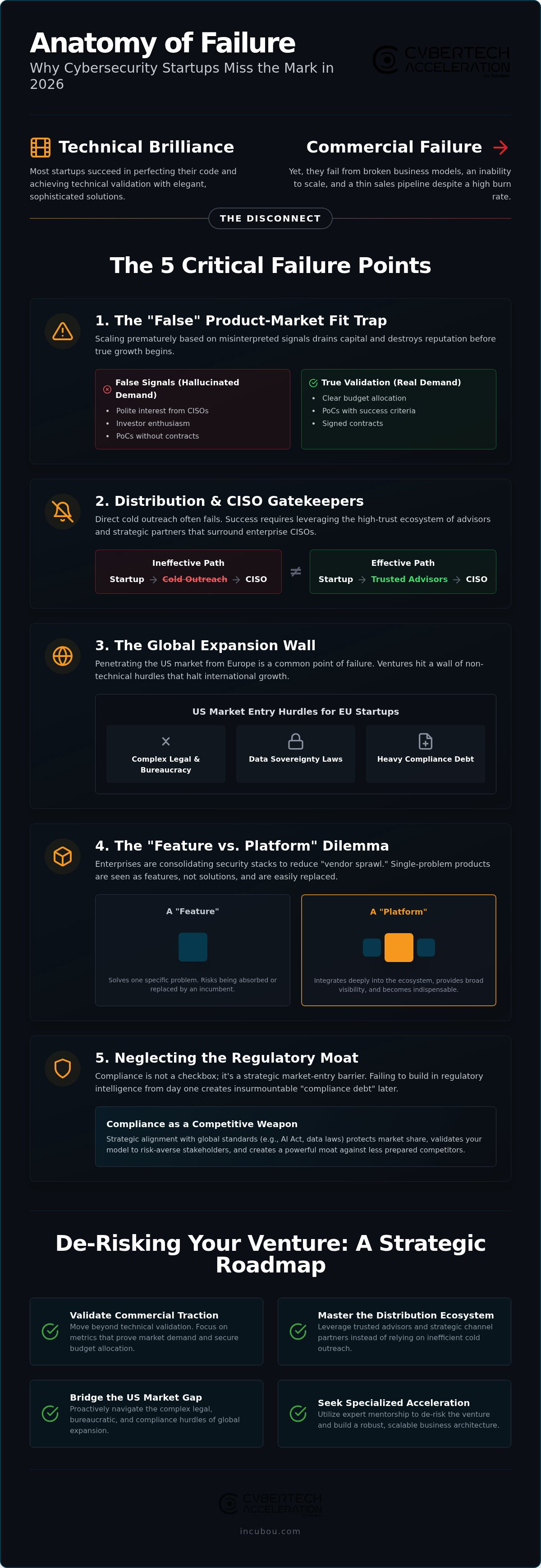
In the 2026 security environment, failure is rarely defined by a broken algorithm or a bypassed firewall. Instead, it manifests as the inability to achieve sustainable, global commercial traction. You might have the most sophisticated encryption on the market, but if you can't navigate the complex path to international scaling, your venture is effectively stagnant. Avoiding cybersecurity startup failure requires a fundamental shift in how you view your company. You aren't just building a tool; you're constructing a business architecture that must survive the scrutiny of global enterprise buyers and aggressive venture capital expectations.
The contrast between tech-first failure and market-first failure has never been sharper. Tech-first founders often build elegant solutions for problems that enterprises don't prioritize. Market-first founders identify a burning need but fail to provide the technical depth required to withstand a sophisticated threat landscape. Both paths lead to a lack of momentum. Because security is built on a foundation of high trust, recovering from an early commercial stumble is exceptionally difficult. Once a CISO labels your startup as "not enterprise-ready," that reputation persists across the industry, making future sales cycles exponentially harder to close.
The 'Feature vs. Platform' Dilemma
Enterprise buyers in 2026 are exhausted. They're actively consolidating their security stacks to reduce complexity and mitigate vendor sprawl; they want fewer, more powerful relationships. If your product solves only one specific problem, you risk being viewed as an unfunded feature in a larger vendor's roadmap. You must transition from a technical solve to a business-critical solution. Defensible platforms integrate deeply into the existing ecosystem and provide broad visibility. Startups that fail to make this jump often find themselves replaced by a "good enough" feature from an incumbent provider during the next budget cycle.
Understanding the 2026 Regulatory Moat
Regulatory alignment is no longer a checkbox; it's a market entry barrier. Failing to anticipate global compliance standards, such as the evolving AI Act or regional data sovereignty laws, kills early-stage startups before they can even pitch to US or Asian markets. This creates compliance debt. It's a heavy financial and technical burden that makes late-stage international expansion nearly impossible. You need to build regulatory intelligence into your product from day one. Strategic alignment with these frameworks acts as a powerful moat, protecting your market share from less prepared competitors and validating your business model to risk-averse stakeholders.
The Product-Market Fit Trap: Scaling Too Early
Scaling is a double-edged sword. For many founders, a few successful pilots feel like the signal to hire a dozen account executives and ramp up marketing spend. This is often where the decline begins. Avoiding cybersecurity startup failure often comes down to resisting the urge to hire a massive sales team before the product can actually deliver on its promises at scale. In the high-stakes world of enterprise security, "moving fast and breaking things" doesn't just damage your software; it destroys your reputation with the very CISOs you need to win over.
The security sector is particularly prone to the "Single Pane of Glass" fallacy. Founders try to build a platform that does everything, from endpoint protection to identity management, before they've mastered a single domain. By trying to solve every problem at once, you end up solving none of them particularly well. This lack of focus makes it impossible to achieve the deep integration required for modern security stacks. For a more detailed breakdown of this journey, explore our guide on achieving cybersecurity product market fit to ensure your foundation is secure before you build upward.
Validation vs. Hallucinated Demand
Don't confuse "polite interest" with actual budget allocation. CISOs are often happy to take a meeting to see what's new in the market, but that interest doesn't always translate into a purchase order. Technical founders frequently misinterpret investor enthusiasm as market demand. Investors bet on potential; CISOs buy solutions for today's fires. True validation occurs when a Proof of Concept (PoC) has clearly defined success criteria that tie directly to a business outcome. If your PoC doesn't have a path to a signed contract, it's just a free trial that drains your engineering resources.
Sustainable Growth Metrics for 2026
In the current venture landscape, raw customer count is a vanity metric. You must prioritize Net Revenue Retention (NRR) and Time to Value (TTV). If it takes six months for a customer to see the benefit of your tool, your churn risk is astronomical. Modern procurement teams look for solutions that integrate in days and show defensive value in weeks. The "Magic Number" for cybersecurity sales efficiency is defined as the ratio of new annualized revenue to the sales and marketing spend of the previous quarter, with a healthy target typically sitting above 0.75. If you're looking for a steady hand to help refine these metrics, partnering with a specialized accelerator can provide the strategic clarity needed to avoid premature scaling.
Distribution Pitfalls: Navigating the CISO's Gatekeepers
Traditional B2B sales playbooks are often the primary cause of friction for early-stage ventures. In most software sectors, volume-based cold outreach is a viable strategy; in cybersecurity, it's a fast track to being blacklisted. CISOs and security directors are the most bombarded executives in the enterprise. They don't respond to generic LinkedIn sequences or unsolicited emails. They rely on a "Trusted Advisor" network to filter the noise. If you lack a presence within this ecosystem, your technical brilliance remains invisible to the people holding the budgets.
Success in 2026 requires understanding the nuanced influence of VC-CISO networks. Many top-tier venture firms have established formal councils of security leaders who provide feedback and, occasionally, early procurement opportunities. While these networks are powerful, they can create a false sense of security. Founders often mistake "network-driven sales" for a scalable distribution model. Avoiding cybersecurity startup failure means recognizing that while these high-level introductions get you in the door, they don't replace the need for a robust, repeatable sales process that can survive outside the venture bubble.
The Power of the Channel Ecosystem
Enterprises rarely buy security tools in isolation. They buy through Managed Security Service Providers (MSSPs) and Value-Added Resellers (VARs) who act as the primary architects of their security stacks. If your product isn't "channel-ready" from day one, you're ignoring the most effective distribution engine in the industry. This means prioritizing multi-tenancy, robust APIs, and clear margin structures for partners. Additionally, cloud marketplaces like AWS and Azure have become primary procurement vehicles. Failing to list your solution where your customers already spend their budget is a strategic oversight that often leads to stalled growth.
Selling to Investors vs. Selling to Customers
The narrative that wins a Seed or Series A round rarely wins a contract in the trenches. Investors are bought into the "vision" of your product, often focusing on hype-driven trends like autonomous threat hunting or generative AI defense. CISOs, however, are focused on practical realities: staff shortages, integration friction, and alert fatigue. If your sales deck mirrors your pitch deck, you're likely missing the buyer's actual pain points. You must craft a separate, outcome-focused narrative that addresses the CISO's need for efficiency and risk reduction rather than just chasing the latest industry buzzwords to satisfy your board members.
The Global Expansion Wall: Failing the US Market Entry
European startups often dominate their local markets only to find their momentum evaporating when they reach the Atlantic. This "Global Expansion Wall" is a primary reason for stagnation. Avoiding cybersecurity startup failure during this transition requires more than just a US sales hire. It demands a total recalibration of your legal, technical, and cultural frameworks. While European buyers might value long-term stability and granular privacy details, US enterprises prioritize speed, immediate ROI, and seamless integration into a pre-existing federal or commercial ecosystem.
The legal and bureaucratic hurdles are particularly steep. Navigating international trade regulations and security certifications like FedRAMP or the updated CMMC requirements in 2026 can drain your capital before you even close your first major deal. Failing to account for these costs is a common strategic error. For a comprehensive look at these dynamics, read our analysis on global expansion for cybersecurity firms to align your strategy with current market demands.
Cultural translation also plays a significant role. European sales messaging often focuses on technical robustness and compliance. In North America, the narrative must pivot toward business resilience and the reduction of operational friction. If your pitch doesn't immediately answer how you save a CISO time and money, you'll struggle to gain traction in the competitive US landscape.
The US Market Entry Roadmap
Timing your US launch is as critical as the product itself. Entering too early leads to high burn without traction; entering too late allows incumbents to solidify their hold. You need a local presence. US-based support is often a hard requirement for federal contracts and large-scale enterprise deals. Many successful founders use specialized accelerators to bridge this gap, providing the local network and regulatory expertise needed to bypass traditional entry barriers. This approach transforms a high-risk gamble into a structured, predictable expansion.
Avoiding the 'Internationalization' Burn
Don't attempt to conquer three continents at once. Over-extending into too many markets simultaneously scatters your focus and depletes your cash reserves. Instead, prioritize markets based on regulatory similarity and the specific threat landscape your product addresses. A successful global scale-up relies on a disciplined beachhead strategy, where you win decisively in one territory before expanding into the next. If you are ready to scale, securing support for US market entry can provide the steady hand necessary to navigate these international complexities.
De-risking the Venture: The Role of Cybersecurity Acceleration
Specialized acceleration acts as a structural audit for your business. Most founders operate within a vacuum of technical enthusiasm, which often masks the commercial and regulatory gaps we discussed in previous sections. Avoiding cybersecurity startup failure requires a peer-reviewed strategy that goes beyond your internal executive team. By engaging with an accelerator that understands the specific nuances of the 2026 security landscape, you gain a defensive layer against the strategic missteps that sink even the most innovative ventures. You move from a state of reactive troubleshooting to proactive, global scaling.
Incubou serves as this strategic partner, offering more than just generic business advice. We provide the steady hand necessary for navigating international complexity. Our focus is on helping you build a defensible cybersecurity business scaling roadmap that aligns your technical milestones with global market demands. This ensures that when you finally approach the US market or engage with major channel partners, your business architecture is already optimized for their specific requirements. We act as a bridge-builder, connecting your European innovation to the global stage with precision and authority.
The IAPMEI Advantage in Vila Nova de Gaia
Being part of a certified hub increases investor confidence significantly. As an IAPMEI-certified cybersecurity incubator located in the Vila Nova de Gaia innovation hub, Incubou provides founders with immediate credibility. This certification isn't just a badge; it's a validation of our operational standards and our ability to support high-growth ventures. You gain access to a vetted network of industry-specific mentors who have navigated the same bureaucratic and technical hurdles you currently face. Scaling from a European tech hub with this level of institutional support allows you to maintain a lean burn rate while accessing world-class strategic resources.
Next Steps for Founders
Your immediate priority should be conducting a "Failure Audit" on your current business model. Look honestly at your burn rate, your Time to Value (TTV), and your actual budget allocation from customers versus polite interest. Identify the gaps in your global expansion strategy before they become terminal. If you find that your technical validation isn't translating to sales or that your US entry plan lacks local support, it's time to seek specialized intervention. You can learn how to apply for cybersecurity acceleration services at Incubou to begin de-risking your path to international dominance. Secure your venture's future by choosing a partner that understands the high stakes of the 2026 security environment.
Securing Your Global Growth Path
Building a resilient security venture in 2026 demands a shift from technical obsession to strategic business architecture. You've seen that success isn't just about code; it's about mastering the channel ecosystem, timing your international expansion, and aligning with global regulatory moats. Avoiding cybersecurity startup failure is a deliberate process of de-risking every commercial touchpoint before you scale. By prioritizing sustainable growth metrics and navigating the CISO's gatekeepers with precision, you position your venture for long-term dominance rather than a brief technical pilot.
Incubou provides the steady hand you need to bridge the gap between European innovation and global markets. As an IAPMEI-certified accelerator based in the Vila Nova de Gaia innovation hub, we specialize in the complexities of US market entry and international scaling. We help you transform your technical vision into a scalable, high-trust enterprise that's ready for the scrutiny of global buyers and sophisticated investors.
Apply for Incubou’s Cybersecurity Acceleration Program to secure your strategic advantage and join a network of mentors dedicated to your global success. Your innovation deserves a foundation that can withstand the pressures of the international stage. We're ready to help you build it.
Frequently Asked Questions
What is the most common reason cybersecurity startups fail?
The most common cause is failing to translate technical innovation into a scalable business model. Many founders focus on solving a specific technical problem but overlook the complex distribution and procurement cycles inherent in the security sector. This leads to high burn rates without the corresponding market traction needed to sustain operations beyond initial funding rounds.
How can a technical founder avoid the 'Product vs. Company' trap?
You avoid this trap by building a defensible platform rather than a single-use tool. While a product solves a niche problem; a company provides a business-critical solution that integrates into the wider enterprise ecosystem. Focus on creating long-term value through robust APIs, multi-tenancy, and compliance alignment rather than just adding new technical features.
When is the right time for a European cybersecurity startup to enter the US market?
The ideal time is after achieving technical validation in your home market but before your growth plateaus. You need enough capital to support a local US presence and the capacity to handle specific federal or commercial certifications. Timing is critical; entering too early drains resources, while entering too late allows established competitors to capture your target beachhead.
Does having a superior technology guarantee success in the cybersecurity market?
Superior technology is a prerequisite, not a guarantee. Success depends heavily on your ability to navigate the CISO's trusted advisor network and secure a spot in the channel ecosystem. In 2026, buyers often choose "good enough" solutions from established vendors over superior tech from a startup that lacks a clear roadmap for global support and integration.
How does an IAPMEI-certified accelerator help in avoiding startup failure?
An IAPMEI-certified accelerator provides a structured environment for avoiding cybersecurity startup failure by auditing your business model and expansion strategy. It offers access to a vetted network of industry-specific mentors who identify blind spots in your commercial architecture. This certification also increases investor confidence, signaling that your venture meets high institutional standards for growth and reliability.
What are the key metrics for cybersecurity startup success in 2026?
Focus on Net Revenue Retention (NRR) and Time to Value (TTV) rather than simple customer counts. Modern procurement teams prioritize tools that show defensive value in weeks, not months. Additionally, maintaining a "Magic Number" for sales efficiency above 0.75 ensures that your marketing spend is actually driving sustainable annualized revenue growth.
How do I know if my cybersecurity product has true market fit?
True market fit is confirmed when you see actual budget allocation rather than just polite interest from CISOs. If your Proof of Concept (PoC) consistently converts into a signed contract within a predictable timeframe, you've likely found a burning need. Repeatability is the key; if your sales process depends on one-off introductions, you haven't yet reached true market fit.
Can a cybersecurity startup succeed without a venture capital network?
It's possible but requires a heavy reliance on a robust channel partner ecosystem. While VCs provide introductions to CISO networks, a strong partnership with MSSPs and VARs can drive significant mid-market penetration. Success without VC backing demands extreme capital efficiency and a product that is "channel-ready" from day one to ensure organic distribution.


