

Why do some technical founders effortlessly navigate complex procurement cycles while others struggle to justify their presence to a skeptical CFO? In 2026, the distinction between a specialized security tool and a scalable global enterprise is rarely about the quality of the code; it's about the strategic logic of the business behind it. You likely feel the mounting pressure of rising customer acquisition costs and the increasing difficulty of proving tangible ROI in a market crowded with fragmented solutions. It's a high-stakes environment where technical superiority alone no longer guarantees a seat at the table in the competitive US market.
This article provides the essential roadmap for cybersecurity business model refinement, guiding you through the art of pivoting from a niche point solution to a scalable, investor-ready global security platform. We'll explore how to lower your CAC through strategic channel alignment and prepare your venture for seamless international expansion. By the end of this guide, you'll have a clear framework for transitioning to platform-based revenue and improving your readiness for the next stage of global growth.
Key Takeaways
- Adapt your strategy to the 2026 shift toward proactive, AI-integrated resilience instead of traditional reactive defense.
- Design revenue architectures that monetize reliability through sophisticated usage-based models and tiered subscription structures.
- Combat vendor consolidation fatigue by pivoting from a standalone point solution to an essential, API-first security platform.
- Apply a rigorous cybersecurity business model refinement checklist to ensure your value proposition addresses top-tier board risks.
- Leverage global acceleration networks to validate your business model and secure a foothold in competitive international markets.
What is Cybersecurity Business Model Refinement?
In the high-stakes technology sector, technical brilliance is merely the entry fee. Cybersecurity business model refinement is the iterative process of aligning your security technology with market demand, pricing elasticity, and the mechanics of scalable delivery. It's the bridge between a clever piece of code and a valuable, investor-ready enterprise. While a product addresses a specific technical vulnerability, a business model provides the structural logic for how your solution creates and captures value over the long term.
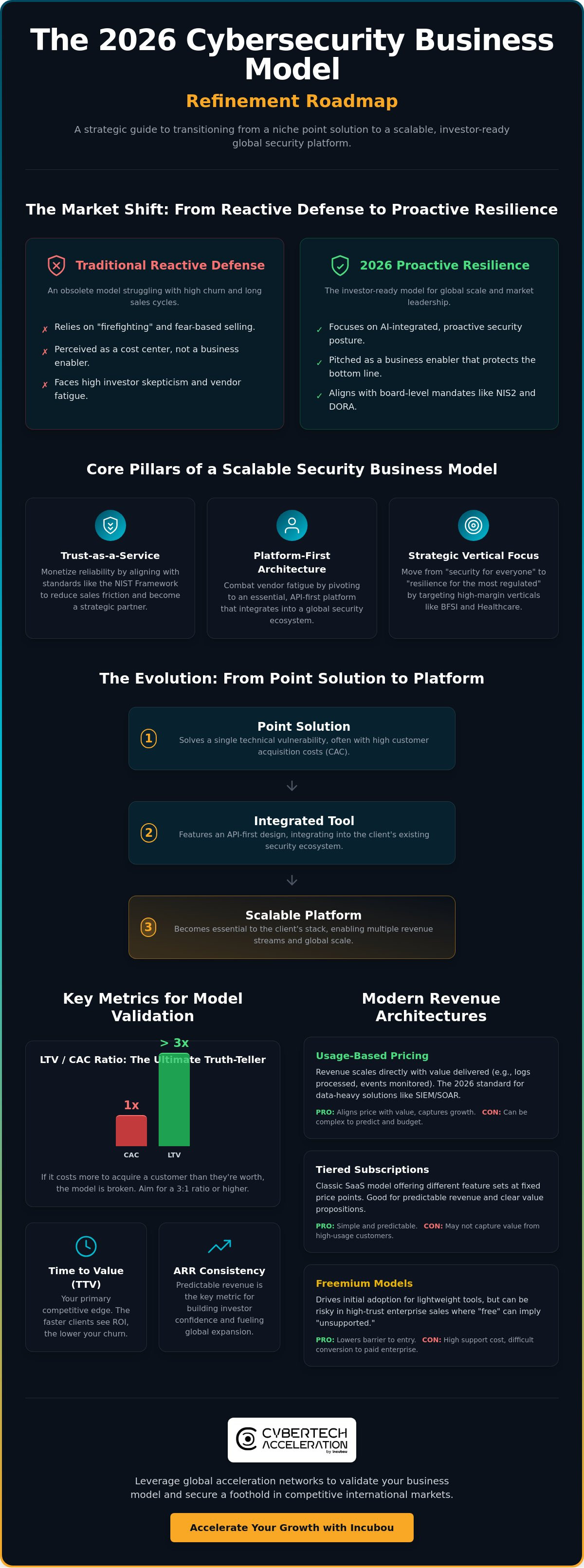
The year 2026 marks a definitive turning point for security startups. We've moved past the era of reactive defense. Today's market demands proactive, AI-integrated resilience. If your model still relies on firefighting narratives, you're likely seeing the warning signs of obsolescence. High churn rates, sales cycles stretching beyond twelve months, and investor skepticism are clear indicators that your current approach needs a strategic overhaul. Investors aren't funding just another tool; they're looking for platforms that integrate into a global ecosystem.
The Evolution of Security Value Propositions
Stop selling fear. In 2026, the most successful founders have shifted from scare tactics to business enablement. Your messaging must prove that your security solution helps a company move faster, not just stay safe. This shift is heavily influenced by regulations like NIS2 and DORA, which have transformed resilience into a board-level mandate. To win, you must refine your pitch for two distinct audiences. The CISO cares about technical efficacy and integration ease, but the CFO demands to see how your tool protects the bottom line and ensures regulatory compliance. If you can't speak both languages, your growth will stall.
Key Metrics for Model Validation
Validation requires hard data, not just founder intuition. In high-trust security sales, your LTV/CAC ratio is the ultimate truth-teller. If it costs more to acquire a customer than they're worth over three years, your model is fundamentally broken. Focus on Time to Value as your primary competitive edge. In an era of vendor fatigue, the faster a client sees a reduction in risk or an improvement in compliance, the more likely they are to renew. Finally, prioritize ARR consistency. For 2026 venture scaling, predictable revenue is the only metric that truly builds long-term investor confidence and supports global expansion.
The Core Pillars of a Scalable Security Business Model
Standard business frameworks often fail in the security sector because they ignore the fundamental currency of our industry: trust. Successful cybersecurity business model refinement requires building a "Trust-as-a-Service" layer. You aren't just selling a license; you're monetizing long-term reliability and compliance. By aligning your platform with established standards like the NIST Cybersecurity Framework, you transform from a vendor into a strategic partner that simplifies the complex regulatory burden for your clients. This alignment reduces friction during procurement and positions your tool as a necessity rather than an optional add-on.
Scaling globally demands a shift in revenue architecture. Moving beyond simple tiered SaaS models allows you to capture value more effectively as your customers grow. For instance, high-value verticals like Banking, Financial Services, and Insurance (BFSI) or Healthcare require deep integration and demonstrable resilience. Refining your focus to these specific segments allows for higher margins and more specialized, defensible value propositions. It's about moving from "security for everyone" to "resilience for the most regulated."
Refining Your Revenue Streams
Choosing the right pricing strategy is a delicate balancing act. While freemium models can drive initial adoption for lightweight tools, they often struggle with high-end enterprise security where "free" can imply "unreliable" or "unsupported." For data-heavy solutions like SIEM or SOAR, usage-based pricing is becoming the 2026 standard. This ensures your revenue scales directly with the volume of logs or events processed, aligning your costs with the value delivered. For a deeper dive into optimizing these financial structures and maximizing your ARR, see our guide on how to scale a cybersecurity company.
The Role of Indirect Sales Channels
You cannot achieve global scale through direct sales alone. Managed Security Service Providers (MSSPs) and Value-Added Resellers (VARs) are the essential backbone of international expansion. Refine your model to support white-labeling or co-managed services. This allows partners to wrap their own expertise around your technology, creating a "force multiplier" effect for your brand. This "channel-first" approach is particularly vital when entering the competitive US market, where established reseller alliances provide the localized credibility needed to bypass long gatekeeper cycles. If you're looking to accelerate this transition and validate your model with global experts, exploring a cybersecurity acceleration program can provide the necessary strategic bridge to these critical networks.
Transitioning from Point Solution to Platform
CISOs in 2026 are exhausted. They're managing dozens of disconnected security tools, leading to a phenomenon known as "vendor consolidation" fatigue. If your tool sits in a silo, it's a prime candidate for the chopping block during the next budget review. Successful cybersecurity business model refinement now requires a transition from a standalone point solution to an integrated platform. This shift isn't just about adding features; it's about becoming an essential, interoperable component of the client's broader security architecture.
Adopting an "API-First" strategy is no longer optional. Your solution must facilitate seamless data exchange across the stack to remain relevant. This reflects a broader Service-as-Software paradigm shift, where AI-driven automation and outcome-based results take precedence over manual tool management. By building an ecosystem rather than a standalone tool, you increase your "stickiness." Top-tier firms that successfully refined their models for the US market did so by ensuring their tech could be easily consumed through existing enterprise workflows, often acting as the connective tissue between legacy systems and modern cloud environments.
Building for Integration and Interoperability
Alignment with the NIST Cybersecurity Framework (CSF) v2 is the baseline for 2026 interoperability. Your model should prioritize "Marketplace" availability on platforms like AWS, Azure, or Google Cloud to reduce procurement friction. Platformization is the move from a single-use tool to a multi-stakeholder ecosystem that creates value for users, partners, and third-party developers alike. This approach allows you to capture a larger share of the security budget by solving multiple, interconnected problems simultaneously.
Point Solution vs. Security Platform: Comparison
The strategic choice between remaining a point solution or pivoting to a platform has significant financial implications. While point solutions often boast faster initial sales velocity due to their narrow focus, they suffer from significantly higher churn as larger platforms absorb their functionality. In contrast, security platforms command valuation multiples 2x to 3x higher than their standalone counterparts in 2026. You're ready for the platform pivot when your core technology becomes the primary data source or control point for adjacent security functions. Transitioning at this stage ensures you lead the consolidation trend rather than falling victim to it.
The 2026 Cybersecurity Business Model Refinement Checklist
Execution is where strategy meets reality. To ensure your cybersecurity business model refinement isn't just a theoretical exercise, you must pressure-test your operations against the specific demands of the 2026 market. This isn't about minor tweaks. It's about ensuring every facet of your organization is built for global, friction-free growth. If your value proposition doesn't solve one of the "top three" risks on a board-level agenda, you're fighting an uphill battle for budget. Boards are no longer interested in granular technical metrics; they want to know how you protect their enterprise value and ensure business continuity.
Your pricing strategy must also evolve to meet modern procurement trends. In 2026, outcome-based pricing is the gold standard. Clients want to pay for results, not just access. Can you prove your tool reduces the mean time to detect (MTTD)? Can you demonstrate a tangible reduction in compliance overhead? If your model still relies on legacy per-seat licensing, it's time to pivot. Additionally, your model must be "Series A ready." This means having clear, defensible unit economics and a path to scalability that doesn't require 24/7 manual intervention. If you can't deploy in the US market without a team of engineers holding the customer's hand, you aren't ready for global expansion.
Phase 1: Market and Value Alignment
Start with a brutal audit of your current customer feedback. Does what you're selling actually match what they're using? Refine your Ideal Customer Profile (ICP) specifically for international expansion, as a European healthcare client has vastly different needs than a US financial firm. Before you commit significant capital to a new market, validate your refined value proposition with at least five international CISOs. Their feedback is the "strategic mirror" you need to ensure your model resonates across borders. This validation ensures your compliance model inherently supports global standards like ISO, SOC2, or HIPAA from day one.
Phase 2: Operational and Financial Scaling
Operational maturity is the difference between a startup and a scale-up. Review our cybersecurity business scaling roadmap to ensure your infrastructure aligns with your growth ambitions. You must formalize your reseller margin and incentive structure early; partners won't push your product if the financial reward isn't clear and competitive. Finally, automate your onboarding process. Reducing the "Time to Value" (TTV) is the fastest way to lower churn and prove your platform's worth. If you're ready to stress-test your strategy with a global network of experts, consider joining a cybersecurity acceleration program to refine your path to market.
Accelerating Refinement with Incubou’s Global Network
Refining a business model in isolation is a dangerous game for cybersecurity founders. You need more than internal intuition; you need a "strategic mirror" that reflects the harsh realities of the global market. Incubou provides this perspective through our specialized hub in Vila Nova de Gaia. By leveraging our IAPMEI-certified mentorship, you can navigate the complex bureaucratic hurdles of international business while ensuring your technology remains focused on high-stakes market needs. We provide the validation required to turn a technical solution into a sophisticated, investor-ready enterprise.
Our network isn't just a collection of contacts. It's a direct pipeline to cybersecurity-specific venture capitalists who understand the nuances of 2026 funding rounds. These investors look for more than just growth; they look for the structural integrity that only comes from rigorous cybersecurity business model refinement. We help you bridge the gap between European innovation and global capital, ensuring your unit economics and platform strategy align with the expectations of top-tier Series A and B firms. This access transforms your scaling journey from a series of guesses into a methodical, validated expansion.
From Portugal to the US: A Strategic Bridge
The transition from a domestic market to the US is often where promising startups stall. Our cybersecurity acceleration services are designed to stress-test your business model before you commit to expensive international boots on the ground. By utilizing the "Portugal Hub," you can maintain cost-effective R&D operations while focusing your capital on aggressive, localized sales strategies in North America. This dual-presence model allows for rapid iteration based on US customer feedback without the overhead of relocating your entire engineering core. It's a balanced approach to global scaling that prioritizes both efficiency and market impact.
The Incubou Advantage: Why Founders Choose Us
Founders choose Incubou because we offer access to specialized security advisors who've navigated these exact waters before. Our mentors have built, scaled, and exited firms in the security space, providing "been there, done that" insights that generalist accelerators simply can't match. Being part of a certified, prestigious innovation ecosystem adds immediate credibility to your brand when speaking with global CISOs and procurement teams. It signals that your business has been vetted by an institution committed to the highest standards of technological excellence. Refine your model, validate your vision, and secure your place in the global security ecosystem by partnering with a steady hand in a complex market.
Building the Future of Global Security Resilience
The transition toward platform-based revenue and proactive resilience represents a fundamental shift in how security value is delivered. Success in 2026 requires more than technical excellence; it demands a rigorous approach to cybersecurity business model refinement that aligns your technology with global procurement trends and board-level priorities. By moving beyond isolated tools and embracing interoperable ecosystems, you position your venture for sustainable growth and significantly higher valuation multiples.
Navigating this complex transition alone is a high-risk endeavor. As an IAPMEI-certified accelerator, Incubou provides the strategic bridge you need to enter international markets with total confidence. We offer specialized US market entry support and direct access to a network of 50+ cybersecurity mentors who've successfully scaled global security firms. Don't let technical debt or market silos stall your progress. Whether you're refining your pricing structure or auditing your value prop for a new vertical, the right partnership makes the difference.
Refine your model and scale globally with Incubou today. The global security landscape is ready for your innovation, and we're here to ensure you have the steady hand needed to lead it.
Frequently Asked Questions
What is the most common mistake in cybersecurity business models?
The most frequent error is focusing exclusively on technical features rather than business outcomes. Founders often build superior detection engines but fail to align them with a CFO’s requirement for ROI or a board’s need for risk mitigation. This misalignment leads to stagnating growth and high churn when the tool is viewed as a luxury rather than a strategic necessity for business enablement.
How often should a cybersecurity startup refine its business model?
Refinement should be an ongoing habit, but you must conduct a formal strategic review at least every six months. The 2026 threat landscape and regulatory environment shift with incredible speed. Frequent cybersecurity business model refinement ensures your pricing and delivery stay ahead of AI-driven attacks and new mandates like the CMMC final rule or updated NIST frameworks.
Is a SaaS model always better for cybersecurity companies?
Not necessarily, as many high-security enterprise environments still demand hybrid or on-premise deployments for strict data sovereignty. While SaaS provides predictable ARR, 2026 trends indicate a move toward outcome-based and usage-based pricing. These models often outperform generic subscription tiers in highly regulated segments like BFSI or healthcare where value is measured by resilience, not just seat count.
How does US market entry affect my business model refinement?
Entering the US market forces you to localize your pricing, compliance, and channel strategies. You'll likely need to pivot from direct sales to a channel-first approach involving established US resellers and MSSPs. This transition requires a more robust operational structure to handle different procurement expectations and the faster sales velocity typical of the North American security ecosystem.
What role does IAPMEI certification play for Portuguese startups?
IAPMEI certification acts as a critical badge of institutional credibility and provides access to essential European funding and tax incentives. For startups within our Vila Nova de Gaia hub, this certification simplifies the bureaucratic path to internationalization. It signals to global venture capitalists that your business meets rigorous operational standards and is backed by a recognized, prestigious innovation ecosystem.
Can I refine my business model without changing my core technology?
Yes, because cybersecurity business model refinement often centers on how you package, price, and deliver your existing intellectual property. You can shift from a legacy per-user license to a modern usage-based model or repackage a point solution as an API-first platform component. These strategic pivots change how you capture value without requiring a total rewrite of your underlying detection engine.
How do investors evaluate a cybersecurity business model in 2026?
Investors prioritize unit economics, ARR consistency, and platform "stickiness." In 2026, they specifically look for evidence that your solution is an essential part of an integrated security stack. They evaluate your LTV/CAC ratio and your ability to prove ROI to non-technical stakeholders, ensuring the business is ready for the median $53.5 million Series A rounds currently seen in the sector.
What is the difference between a point solution and a security platform?
A point solution solves a single, narrow problem, while a platform acts as a multi-stakeholder ecosystem that integrates across the security stack. Platforms command valuation multiples 2x to 3x higher than standalone tools. They're much harder for a CISO to displace during budget consolidation because they provide broader visibility and act as the connective tissue for an organization's entire security architecture.


