

What if the primary driver of market dominance in 2026 isn't actually your code? Most founders spend years perfecting a technical solution, only to find themselves drowned out by the noise at major conferences or trapped in 18-month enterprise sales cycles. It's frustrating to watch competitors with inferior tech gain traction while you struggle to secure the third-party validation you need. Understanding the true cybersecurity startup success factors requires looking beyond the dashboard and into the strength of your strategic network.
We're here to pull back the curtain on the hidden drivers that separate global leaders from the rest of the pack. You'll discover why superior technology is rarely the deciding factor in scaling and how to master the complex path to international growth. This guide provides a clear framework for achieving product-market fit, leveraging strategic ecosystems for funding, and building a reliable roadmap for entry into the US and international markets. We'll help you transform from a technical innovator into a strategic global powerhouse with the validation and connections required to win.
Key Takeaways
- Move from a feature-first mentality to a solution-first strategy to overcome the "Cybersecurity Success Paradox" that often stalls innovative founders.
- Master the five non-negotiable cybersecurity startup success factors, including technical validation and regulatory alignment, to secure critical CISO buy-in.
- Discover why early global expansion is the only way to escape the "local stealth" trap and how to effectively leverage US market entry for rapid scaling.
- Learn to attract "Smart Money" by utilizing IAPMEI certification and ecosystem alignment to prove your investment readiness to top-tier VCs.
- See how the Incubou framework provides the specific technical validation and network access required to dominate the global cybersecurity market.
Myth vs. Reality: Why "Superior Tech" Fails in the 2026 Cybersecurity Market
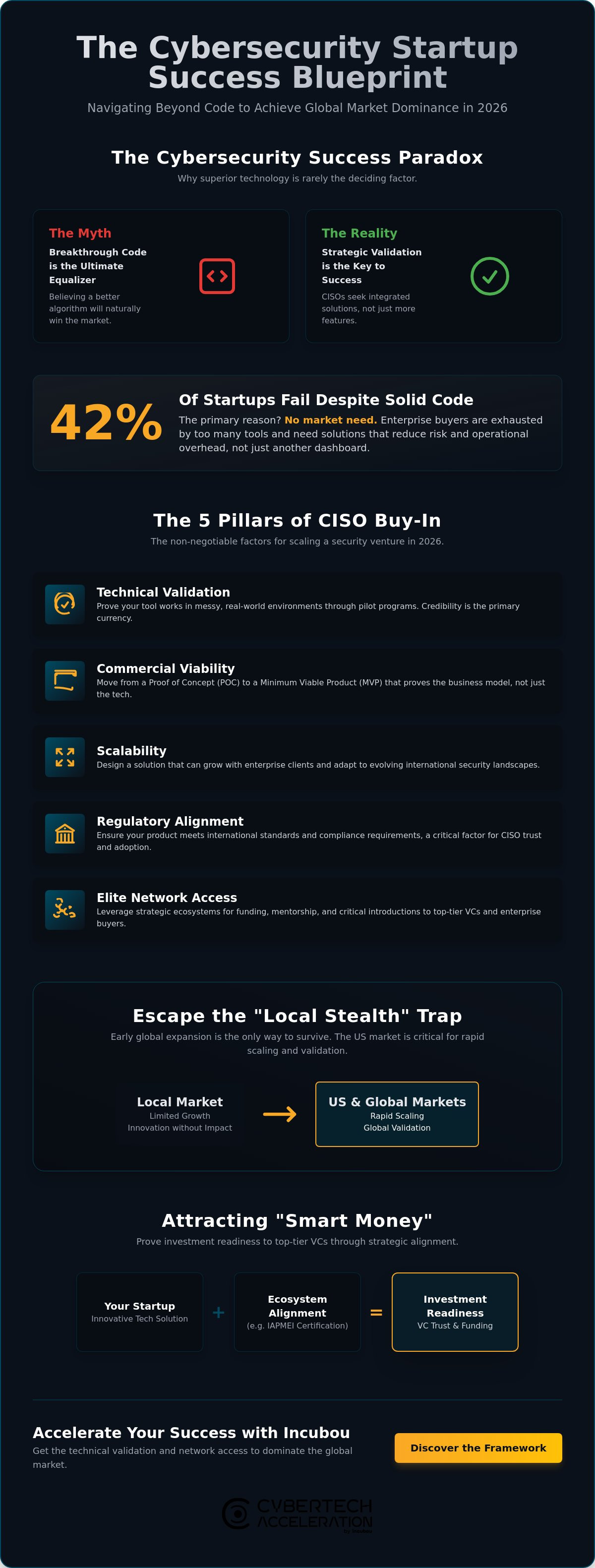
The cybersecurity industry suffers from a recurring phenomenon known as the "Cybersecurity Success Paradox." Founders often believe that breakthrough code is the ultimate equalizer. They assume that if they build a faster encryption algorithm or a more accurate threat detection engine, the market will naturally gravitate toward them. In reality, the most innovative tools frequently remain in perpetual stealth mode. With over 3,000 vendors vying for attention at major global conferences like RSA and Black Hat, even the most sophisticated code becomes invisible background noise.
Success in this saturated environment isn't about having the most features; it's about achieving strategic validation. While a foundational understanding of what is a startup highlights the importance of innovation, the 2026 market demands more. CISOs are no longer buying "better" versions of existing tools. They're looking for solutions that integrate seamlessly into a complex, resilient ecosystem. Shifting from a feature-first mentality to a solution-first reality is one of the most critical cybersecurity startup success factors.
The Fallacy of the "Uber for Firewalls"
Generic analogies are the fastest way to lose a sophisticated buyer's interest. Pitching your product as the "Uber for firewalls" or the "Airbnb of threat intelligence" fails because it ignores the high-stakes nature of enterprise security. Modern CISOs have moved away from broad, monolithic security suites in favor of hyper-niche, interoperable modules that solve specific problems. Market Relevance is the precise alignment between a specific threat vector and a defined budget line item.
Why 42% of Startups Fail Despite Solid Code
Data from CB Insights suggests that 42% of startups fail because there's simply no market need for what they've built. In the security sector, this is often compounded by "Security Fatigue." Enterprise buyers are exhausted by the sheer volume of alerts and the overhead of managing too many disparate tools. They don't need another dashboard; they need reduced risk and operational efficiency. Implementing cybersecurity business model refinement early on ensures that your technical solution solves a pain point intense enough to warrant a purchase. Identifying these cybersecurity startup success factors early prevents the premature death that claims nearly half of all new ventures.
Critical Success Factors: Achieving Product-Market Fit and CISO Buy-In
Scaling a security venture requires more than just breakthrough code. It demands a holistic approach to the market that transcends technical specifications. In the 2026 landscape, we identify five non-negotiable cybersecurity startup success factors: technical validation, commercial viability, scalability, regulatory alignment, and elite network access. Neglecting any of these pillars often leads to the "stealth trap" where innovation exists without impact. You must prove that your solution isn't just a clever algorithm but a robust business capable of surviving enterprise scrutiny.
Product-market fit in the security sector isn't about utility; it's about relief. You aren't selling a tool. You're selling the removal of a critical operational burden. Research on globalization for cybersecurity startups suggests that early alignment with international standards and pain points is vital for survival. Credibility is the primary currency in this industry. Pilot programs serve as the essential bridge between "interesting" and "indispensable," providing the telemetry needed to prove your tool works in messy, real-world environments. To cross this bridge, founders must deploy a cybersecurity B2B sales strategy that targets the right stakeholders, from the technical leads to the legal officers who gatekeep the budget.
Moving from Technical POC to Commercial MVP
A Proof of Concept (POC) proves the technology works; a Minimum Viable Product (MVP) proves the business model works. In a high-stakes security environment, your MVP must demonstrate "Commercial Readiness" from day one. This includes having mature API documentation, a clear pricing structure, and a defined support model. Use feedback from early adopters to pivot your interface or delivery method without compromising your core IP. Success depends on your ability to iterate quickly based on how enterprise teams actually use your software in their daily workflows.
The CISO Perspective: Solving Pain, Not Adding Noise
Chief Information Security Officers are currently overwhelmed by "Security Fatigue." They don't want another dashboard to monitor. They want to know how your product reduces their risk profile and legal liability. Position your startup as a "Risk Reducer" rather than a "Tool Provider." Ensure your solution offers deep interoperability with existing security stacks. If your product doesn't integrate with their current SIEM or XDR platforms, it's just more noise they can't afford to manage. Partnering with a specialized cybersecurity accelerator can help you refine this positioning before you approach enterprise buyers, ensuring your pitch resonates with the strategic goals of a modern CISO.
The Global Expansion Factor: Scaling Beyond Local Borders
Remaining confined to a local market is the new stealth mode. In the high-stakes world of digital defense, if your solution isn't visible on a global scale, it effectively doesn't exist to the enterprise buyers who matter most. High-growth firms recognize that internationalization isn't a secondary phase; it's a core day-one strategy. Adopting this global mindset early is one of the most critical cybersecurity startup success factors. While local markets provide a safe testing ground, they rarely offer the scale or the rigorous validation required to become a category leader.
The US market stands as the ultimate validator for security technology. It isn't just about the size of the budgets, though those are significant. It's about the complexity and the sheer volume of threats that US enterprises face daily. Successfully penetrating this market sends a powerful signal to the rest of the world that your technology is battle-tested. Many founders find success by utilizing a "Global Bridge" model. This strategy involves keeping specialized technical talent in cost-effective European hubs while aggressively pursuing US market entry for European startups to drive revenue and brand authority.
Navigating Regulatory and Compliance Hurdles Internationally
Don't view GDPR, CCPA, or the emerging 2026 AI security regulations as mere bureaucratic roadblocks. Sophisticated founders treat compliance as a "Sales Feature" rather than a legal burden. When you lead with a product that is already aligned with the world's strictest privacy and security standards, you remove a massive layer of friction for risk-averse CISOs. This proactive approach builds immediate trust and shortens the long enterprise sales cycles mentioned earlier. Leveraging specialized support for global expansion for cybersecurity firms allows you to shortcut the legal discovery process, ensuring your documentation is ready for international scrutiny from the first pitch.
The Vila Nova de Gaia Advantage
Portugal has rapidly transformed into a strategic springboard for the EMEA market and beyond. Specifically, Vila Nova de Gaia offers a unique ecosystem where startups can build elite technical teams with a level of cost-efficiency that is impossible to find in Silicon Valley or London. This geographical advantage allows you to maintain a high development velocity while preserving capital for global marketing and sales expansion. There are specific cybersecurity market opportunities for startups within the Portuguese ecosystem that provide the necessary infrastructure for rapid international growth. By basing operations in a certified hub, you gain the institutional credibility needed to bridge the gap between European innovation and global market dominance.
Strategic Funding and Ecosystem Alignment: The Role of IAPMEI Certification
Securing capital in the 2026 market requires more than a visionary pitch. It demands a strategic alignment with investors who understand the technical nuances and long-term cycles inherent in digital defense. In this high-stakes environment, "Smart Money" consistently outperforms "Fast Money." Strategic investors provide the industry connections and technical validation that simple capital cannot replace. Identifying these sophisticated partners is among the most vital cybersecurity startup success factors for those aiming to scale beyond their first seed round.
Ecosystem alignment accelerates the funding cycle by providing a pre-validated environment for venture capitalists. When a startup operates within a network of mentors, partners, and peers, it demonstrates a level of maturity that solo ventures lack. Government-backed certifications serve as a critical trust signal in this process. They act as a seal of approval, indicating that the startup has undergone rigorous scrutiny by institutional experts. This institutional backing significantly lowers the perceived risk for international venture capital firms looking for reliable entries into the European market.
Leveraging IAPMEI-Certified Accelerators for Credibility
IAPMEI certification is a prestigious designation by the Portuguese government that signals a startup's operational reliability and potential for innovation. For an emerging security firm, being part of an IAPMEI-certified program provides an immediate pedigree. It reduces the "Risk Profile" for international investors who may be unfamiliar with the local landscape. Beyond credibility, these hubs offer tangible advantages, including specific tax incentives and access to innovation grants that extend your runway. This financial efficiency allows you to focus resources on product development and market penetration rather than administrative survival.
Investment Readiness: Beyond the Pitch Deck
Investors in 2026 look for hard evidence of sustainability. A polished deck is no longer enough to close a Series A. You must demonstrate cybersecurity investment readiness through verified recurring revenue, low churn rates, and clean technical debt audits. Accelerators play a pivotal role here by helping founders refine their "Equity Story" to match the specific expectations of global VCs. They facilitate the warm introductions that often make the difference between a signed term sheet and a ghosted inbox. If you're ready to move from technical innovation to investor-ready powerhouse, consider joining a specialized cybersecurity acceleration program to bridge that gap.
Accelerating Your Success: The Incubou Framework for Security Founders
Incubou functions as a high-octane engine for founders ready to move beyond the experimental phase. We recognize that generalist incubators often lack the technical depth required to validate a complex security solution. Our framework systematically addresses the core cybersecurity startup success factors we've explored: technical validation, commercial viability, scalability, regulatory alignment, and elite network access. We don't just provide office space; we provide a structured path to global dominance by refining your product and business model in parallel.
Our "Global Market Entry" program is specifically engineered for European firms eyeing US expansion. We understand that the leap from a local hub to a global stage is the most dangerous period in a startup's lifecycle. By leveraging our deep-rooted connections in the North American market, we help you bypass the typical 18-month entry cycle. We transform your innovation into a market-ready asset that carries the weight of institutional credibility. It's time to move from simply "building" to aggressively "scaling" with a partner that speaks the language of security.
Tailored Mentorship for Security Innovators
Access to a deep network of industry experts and former CISOs is a cornerstone of our framework. These mentors provide the brutal, honest feedback that only comes from years of defending enterprise perimeters. Our cybersecurity acceleration services are designed to stress-test your technology against real-world threat scenarios while simultaneously hardening your commercial strategy. Within our security-only cohorts, peer-to-peer learning becomes a force multiplier. You'll share battle-tested tactics with other founders who are solving similar technical and regulatory challenges, creating a community of elite innovators.
Accessing Global Networks from Vila Nova de Gaia
Basing our operations in Vila Nova de Gaia provides a unique geographical and economic advantage. This strategic hub allows you to maintain high development velocity while staying connected to the major financial centers of Europe and the US. Through our strategic partners, we offer a direct path to international market penetration that few other programs can match. We bridge the gap between your technical vision and the global enterprises waiting for a solution that actually works. If you're ready to secure your place in the global market, the next step is clear. Apply to the Incubou acceleration program today and start your journey toward becoming a category leader in the 2026 cybersecurity landscape.
Securing Your Position in the Global Market
The shift from a feature-led approach to a solution-centric global strategy is no longer optional. It's the baseline for survival. To dominate the 2026 landscape, you must prioritize technical validation and early international market penetration over technical isolation. Leveraging government-backed credibility and elite mentorship allows you to bypass the bureaucratic hurdles that stall most innovators. Mastering these cybersecurity startup success factors transforms a promising tool into a market-leading enterprise.
We provide the steady hand you need to navigate these complex waters. As an IAPMEI-certified accelerator, we offer a specialized focus on global US market entry and direct access to a premier network of international security experts. Ready to scale your security innovation? Apply to the Incubou Cybersecurity Acceleration Program today. Your vision deserves a global stage, and we're here to ensure you reach it with confidence.
Frequently Asked Questions
What are the most important cybersecurity startup success factors in 2026?
The most critical cybersecurity startup success factors in 2026 include technical validation, commercial viability, scalability, regulatory alignment, and elite network access. These five pillars ensure your solution isn't just a technical novelty but a robust business capable of surviving enterprise scrutiny. Focusing on these areas helps you move past the "stealth trap" and achieve genuine market relevance in a crowded field.
How does an IAPMEI-certified accelerator help a cybersecurity company scale?
An IAPMEI-certified accelerator provides a seal of institutional reliability that significantly lowers the perceived risk for international investors. It grants startups access to specialized tax incentives and innovation grants while positioning them within a prestigious ecosystem. This certification acts as a pedigree, signaling that your venture has undergone rigorous scrutiny by government-backed experts and is ready for global expansion.
Why do so many cybersecurity startups fail to achieve product-market fit?
Most startups fail to achieve product-market fit because they prioritize "Better Tech" over "Better Solutions." They often build tools that add to "Security Fatigue" rather than reducing a CISO's operational burden. If your product doesn't solve a budget-aligned pain point or integrate with existing stacks, it'll struggle to gain traction regardless of its technical superiority.
Is US market entry necessary for a European cybersecurity startup to succeed?
While not strictly mandatory for survival, US market entry is necessary for global market dominance. The US serves as the ultimate validator because of its high threat volume and massive enterprise budgets. Successfully scaling there signals to the rest of the world that your technology is battle-tested and ready for the highest stakes in digital defense.
What do cybersecurity investors look for during a Series A funding round?
Investors during a Series A round look for hard evidence of a sustainable business model rather than just a vision. This includes verified recurring revenue, low churn rates, and clean technical debt audits. They also evaluate your "Equity Story" and your ability to leverage strategic networks for rapid international expansion and long-term commercial growth.
Can a cybersecurity startup succeed without a founder who has a security background?
Success is possible without a security background if the founder focuses on solving specific business pain points and leverages a specialized network. Surrounding yourself with former CISOs and industry mentors can bridge the technical knowledge gap. The key is shifting from a "Feature-First" mindset to a "Solution-First" approach that resonates with enterprise buyers.
How long does it typically take to scale a cybersecurity company globally?
Scaling a security company globally typically takes three to five years to achieve significant market penetration. Using a specialized framework can shorten this timeline by bypassing the common 18-month discovery cycles in international markets. Velocity depends on how quickly you can achieve technical validation and secure "Smart Money" funding from the right partners.
What role does Vila Nova de Gaia play in the Portuguese cybersecurity ecosystem?
Vila Nova de Gaia serves as a strategic entry point for the EMEA market and a cost-effective springboard to the US. It offers a unique concentration of technical talent and institutional support within the Portuguese ecosystem. Startups based here maintain high development velocity while leveraging the hub's credibility to attract global partners and international venture capital.


