

Most cybersecurity founders leave Lisbon with a digital stack of business cards and a calendar full of vague promises, yet only a handful will ever turn that noise into a successful Series A. It's easy to mistake a crowded booth for market validation, but without a rigorous filter, event buzz is just a distraction from real growth. You've likely felt the weight of lead fatigue after processing thousands of non-qualified contacts while searching for the specialized mentorship your technical product demands.
We understand that translating high-energy networking into investor-ready metrics is a daunting task. This guide delivers a tactical post-websummit strategy for cybersecurity startups designed to transform those raw connections into a structured international scaling plan for 2026. We'll walk you through a proven framework to identify high-intent partners, align your business model with the latest EU Cyber Resilience Act requirements, and execute a precise roadmap for US market expansion. By shifting your focus from social metrics to technical validation, you can secure the strategic advantage needed to lead the next wave of global resilience tech.
Key Takeaways
- Categorize your event contacts into high-intent buckets like strategic partners and technical validators to bypass lead fatigue and focus on high-fidelity growth.
- Develop a tactical post-websummit strategy for cybersecurity startups that prioritizes technical validation over social metrics to ensure a successful 2026 execution.
- Refine your business model by analyzing real-world feedback from your booth interactions to close critical gaps in international pricing and licensing.
- Map out a clear roadmap for US market expansion while navigating the complex regulatory landscape and data transfer requirements of North American security niches.
- Leverage IAPMEI-certified acceleration to gain the institutional credibility and expert network required to attract sophisticated global VC funding.
The Post-Web Summit Hangover: Moving from Networking to Execution
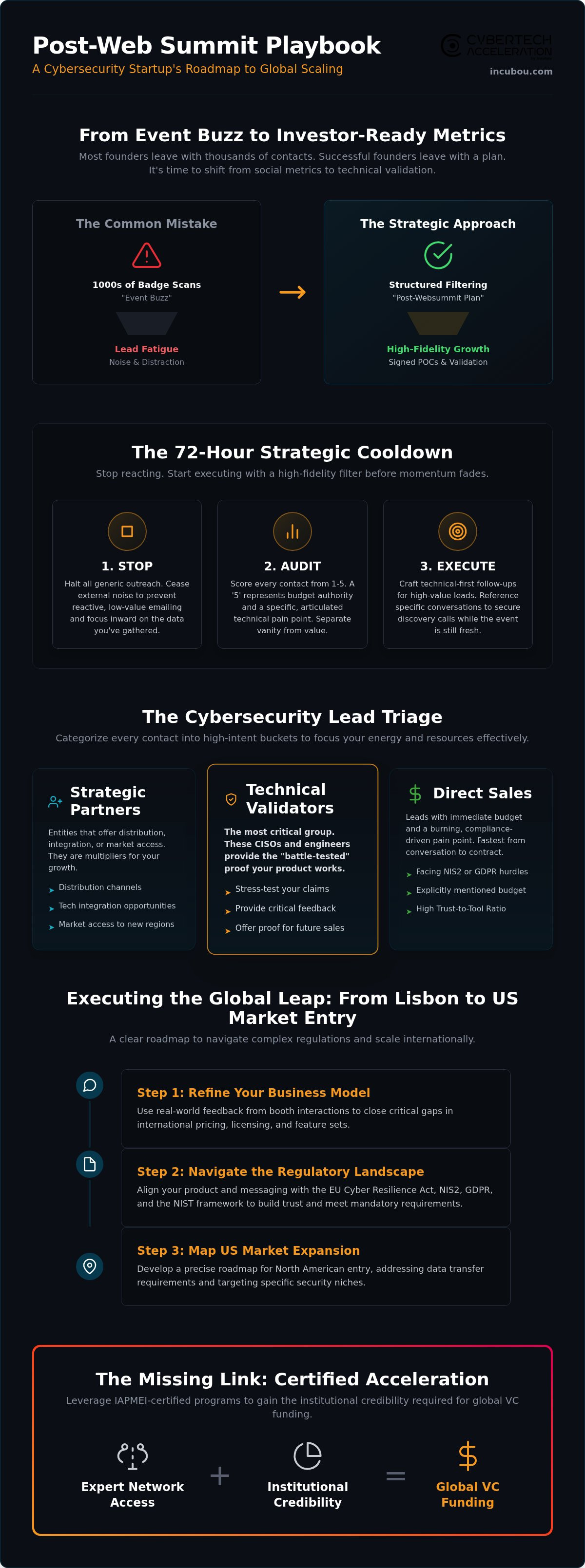
The silence following the final day of Web Summit can be deafening. After four days of relentless pitching and networking in Lisbon, most founders collapse into a cycle of reactive emailing, essentially wasting the momentum they spent thousands of euros to build. Real growth doesn't happen on the pavilion floor; it happens in the clinical execution of your post-websummit strategy for cybersecurity startups. While a successful event is often measured in badge scans and LinkedIn connections, a successful quarter is measured in signed Proof of Concepts (POCs) and technical validation. You must pivot from "event mode" to "scaling mode" before the exhaustion sets in.
Enter the Strategic Cooldown. This is a non-negotiable 72-hour window where you stop the external noise to audit your gathered data. It's during this phase that many founders realize they need the structured support found in business incubator programs to refine their next steps. Instead of rushing to email every contact in your CRM, you're building a high-fidelity filter. This process ensures your efforts align with a strategic cybersecurity business scaling roadmap rather than just chasing low-intent leads that will never convert.
Auditing Your Summit Data
Don't treat every contact equally. Implement a 1-5 scoring system where a "5" represents a lead with budget authority and a specific technical pain point. You must separate vanity connections from strategic assets. Evaluate if the interest you received aligns with 2026's core market trends, specifically AI-driven threat detection and the "resilience tech" shift. If an investor was merely curious about your AI story without digging into your Software Bill of Materials (SBOM) or compliance with the EU Cyber Resilience Act, they aren't a priority for your immediate funding round.
The 72-Hour Follow-Up Rule for High-Value Leads
Speed is essential, but precision is your real weapon. Generic templates are the fastest way to get ignored by a busy CISO. Your outreach must be technical-first. Lead with a specific value proposition that references a detail from your conversation in Lisbon. If you discussed supply chain security, mention how your tool handles the latest ENISA reporting requirements. Set immediate discovery calls to maintain the "Lisbon buzz" momentum before it fades into the background of their daily operations. Move quickly to secure these slots while your solution is still fresh in their minds.
The Cybersecurity Lead Triage: Filtering for Trust and Technical Fit
Cybersecurity sales cycles aren't like standard SaaS. You aren't just selling a productivity tool; you're selling a promise of resilience in an era of escalating threats. A generic post-websummit strategy for cybersecurity startups often fails because it treats every badge scan like a potential customer. In reality, security leaders have a high barrier to entry. They require proof of technical maturity and alignment with frameworks like the NIST Cybersecurity Framework before even considering a pilot. You must move past the "event buzz" and start the rigorous process of technical validation.
To move effectively, categorize your Lisbon leads into three distinct buckets. First, Strategic Partners are those who can offer distribution, integration, or market access. Second, Technical Validators are the CISOs and engineers who will stress-test your claims and provide the "battle-tested" stamp of approval. Finally, Direct Sales leads are those with immediate budget and a burning pain point. Prioritize any contact that explicitly mentioned regulatory hurdles like NIS2, GDPR, or the latest EU-US data transfer uncertainties. These compliance-driven leads are often the fastest to move from conversation to contract because their need is mandated by law.
Apply the Trust-to-Tool ratio to your triage. This metric evaluates whether a lead trusts your team's expertise as much as they like your software's features. In the security world, the person behind the product is often as important as the code itself. If the trust isn't there, no amount of technical flash will close the deal. Building this institutional trust early is why many founders seek specialized cybersecurity acceleration to validate their market approach and refine their pitch for global stakeholders.
Identifying Strategic Design Partners
A Design Partner acts as a vital bridge between your MVP and a market-ready solution. Look for mid-market firms that are innovation-hungry but resource-constrained. These companies often have the flexibility to provide deep technical feedback in exchange for early access to your stack. They help you build the "Security by Design" features that institutional clients eventually demand. Focus on leads who asked about your Software Bill of Materials (SBOM) or vulnerability management processes, as these indicate a high level of technical readiness.
Qualifying Investor Interest Post-Event
Don't waste time on "tourist investors" who are just following the general AI hype. You need specialized cybersecurity VCs who understand the nuances of threat vectors, defense-in-depth, and the shifting regulatory landscape. Check their current portfolio for synergy. If they already back non-competing security tech, they likely have a network of CISOs ready for introductions. Use our funding for cybersecurity startups guide to refine your pitch for these high-level discussions and ensure your metrics are investor-ready.
Refining Your Business Model Based on Global Market Feedback
Analyze the raw data from your booth interactions to expose the hidden friction points in your current model. Every objection heard during a Web Summit pitch is a diagnostic tool. If multiple prospects questioned your international pricing or found your licensing tiers opaque, your post-websummit strategy for cybersecurity startups must prioritize a commercial overhaul. High-growth environments don't tolerate ambiguity. You need a model that scales as effortlessly in San Francisco as it does in Berlin.
Pay close attention to how your elevator pitch resonated across different demographics. US-based attendees in 2026 often prioritize rapid ROI and seamless integration into existing SOC stacks. Conversely, European stakeholders frequently focus on the granular reporting requirements of the Cyber Resilience Act. The Rapid Growth of Cybersecurity Firms is largely driven by these diverging regulatory and operational pressures. Understanding these nuances allows you to tailor your value proposition to the specific market you're targeting next.
The Pivot vs. Persevere Audit
Determine if your core offering still aligns with the shifting demands of the 2026 landscape. We're seeing a massive shift toward "Resilience-as-a-Service," where the focus is on business continuity during a breach rather than just perimeter defense. If your Lisbon feedback suggests that "Defense-as-a-Service" is becoming a commodity, it's time to audit your product's direction. Use our guide on achieving cybersecurity product market fit to validate whether you should stay the course or pivot toward more lucrative, resilience-focused niches.
Updating the 2026 Technical Roadmap
Incorporate the insights from Web Summit's technical stages directly into your Q1 dev sprint. If technical leads in Lisbon expressed concern about ICT supply chain security, prioritize features that simplify SBOM management. Your tech stack must be ready for the intense scalability demands of global market entry. Don't build in a vacuum. Consult with a cybersecurity acceleration service to ensure your roadmap isn't just a reaction to noise, but a calculated move toward international dominance. This strategic alignment ensures your development resources are spent on features that institutional investors actually value.
Executing the Global Leap: From Lisbon to US Market Entry
Transforming Lisbon handshakes into North American contracts requires a decisive shift in your post-websummit strategy for cybersecurity startups. Web Summit 2026 served as a high-density meeting ground, but the US market demands a specific level of operational commitment that goes beyond digital follow-ups. You can't lead a global expansion from a distance; you must leverage the international connections made in Lisbon to anchor your entry. Whether you're targeting the tech hubs of Silicon Valley or the regulatory corridors of D.C., your strategy must move from networking to physical execution within weeks of the event closing.
Establish a presence in a strategic hub to build the local trust necessary for high-stakes security deals. While virtual offices offer a starting point, the median cost to start a business in the US is approximately $12,000, making it a calculated but essential investment. Note that US LLC filing fees in 2026 range from $40 in Kentucky to $500 in Massachusetts, so choose your jurisdiction based on proximity to your target enterprise clients. Use our global expansion for cybersecurity firms guide to map your step-by-step entry and avoid common administrative pitfalls.
Navigating US Compliance and Regulations
Compliance acts as the primary gatekeeper for US market entry. You must understand the immediate impact of CMMC, HIPAA, or SOC2 on your timeline before pitching to federal or healthcare-adjacent clients. The June 29, 2026, US Supreme Court decision regarding the FTC's structure has introduced fresh uncertainty into EU-US data transfer agreements, potentially complicating how European firms handle American data. Secure legal partners who specialize in cross-border cybersecurity intellectual property to protect your stack as you cross the Atlantic. Prepare your technical documentation to meet these rigorous standards to ensure you don't stall during the procurement phase.
Building a US-Centric Sales Engine
Localize your marketing collateral to speak to the specific threat landscapes facing North American enterprises. US buyers prioritize rapid ROI and "Security by Design" that integrates seamlessly with their existing SOC stacks. Hire or contract "boots on the ground" to manage North American time zones and maintain a consistent sales cadence. Schedule follow-up meetings with the US-based investors and partners you met in Lisbon within a strict 14-day window. The "Lisbon buzz" has a short shelf life in the fast-paced US ecosystem, and delays suggest a lack of readiness. If you're prepared to bypass the bureaucratic hurdles and scale your cybersecurity startup globally, specialized acceleration provides the necessary bridge to reach these milestones faster.
Why IAPMEI-Certified Acceleration is the Missing Link
Your post-websummit strategy for cybersecurity startups shouldn't end when you leave the Altice Arena; it should transition to a focused environment where technical validation takes center stage. While Lisbon provides the volume, Vila Nova de Gaia provides the velocity. Positioned as a strategic "after-party" hub for focused scaling, this region offers a sophisticated ecosystem designed to strip away the noise of general tech and focus entirely on security resilience. Transitioning from the chaos of a 70,000-person event to a specialized accelerator allows you to process your findings with the precision that the cybersecurity sector demands.
IAPMEI certification serves as a powerful signal to international venture capitalists. In the high-stakes world of security funding, where AI-focused startups raised $855 million in the first half of 2026 alone, institutional validation is a prerequisite for serious investment. Being part of a certified program proves that your business model has undergone rigorous scrutiny regarding its innovation and economic potential. It transforms your startup from an unverified "event lead" into a credible, investment-ready asset that understands the complexities of the EU Cyber Resilience Act and the shifting US regulatory landscape.
Incubou provides a distinct advantage through a network of specialized mentors who only speak cybersecurity. We don't offer generic business advice. Our support focuses on the technical nuances of threat detection, Software Bill of Materials (SBOM) management, and the bureaucratic hurdles of international expansion. We act as a global market entry engine, helping you refine your product for the technical scrutiny of US-based CISOs and European compliance officers. This isn't about learning the basics; it's about executing a high-fidelity strategy that secures your position in the global market.
Accessing the Portugal Cybersecurity Startup Hub
Leverage local industry connections to test your technology in a controlled, high-trust environment. By joining a community of founders who are also scaling a cybersecurity startup in Portugal, you gain access to shared intelligence on everything from ENISA reporting requirements to US market entry costs. Vila Nova de Gaia’s strategic position allows you to maintain a foothold in the European market while simultaneously preparing for Atlantic expansion. This proximity to Lisbon’s talent and Porto’s industrial base creates a unique launchpad for security firms targeting global dominance.
Next Steps: Applying for the 2026 Cohort
Applying for Incubou’s cybersecurity acceleration program is the final step in turning your Web Summit connections into a structured business. We look for projects that demonstrate the potential to reach an annual turnover or asset value of over €325,000 within a five-year period, as per IAPMEI standards. Our selection process focuses on "Investment Readiness" milestones that prepare you for the next scaling phase. We invite founders to schedule a post-Summit strategy audit with our experts to evaluate their current trajectory. Let's move beyond the buzz and start building the metrics that define a global leader in cybersecurity.
Securing Your Global Position in the 2026 Landscape
The window to capitalize on Web Summit momentum is narrow. Success in the 2026 cybersecurity market requires a decisive shift from gathering contacts to executing a high-fidelity roadmap. By implementing a rigorous lead triage and refining your business model for resilience, you transform event buzz into a scalable international asset. Navigating the complex US regulatory environment and leveraging certified acceleration are no longer optional; they're the foundations of global leadership.
Your post-websummit strategy for cybersecurity startups finds its home at the intersection of technical expertise and institutional credibility. As an IAPMEI-certified strategic partner, Incubou provides specialized US market entry support and exclusive access to the Vila Nova de Gaia cybersecurity hub. We don't just offer mentorship; we provide the bridge to your next funding round and international expansion.
The path from Lisbon to global dominance is ready for those with the discipline to take it. Apply for Incubou's 2026 Cybersecurity Acceleration Program today and secure your startup's future in the international arena. We're ready to build that bridge with you.
Frequently Asked Questions
What are the first three things a cybersecurity founder should do after Web Summit?
Perform a 72-hour audit of all gathered data to separate vanity connections from strategic assets immediately. Next, implement a scoring system from 1 to 5 based on technical fit and budget authority to prioritize your energy. Finally, draft personalized, technical-first outreach for high-value leads within 14 days to maintain the momentum before the "Lisbon buzz" fades into the background noise of daily operations.
How do I know if a Web Summit lead is actually interested in my security product?
High-intent leads move beyond general curiosity and ask specific questions about your tech stack or compliance with frameworks like the EU Cyber Resilience Act. If a contact inquires about your Software Bill of Materials (SBOM) or how your tool handles ENISA reporting requirements, they're demonstrating professional interest. Direct questions regarding regulatory hurdles are strong indicators of a lead ready for a technical discovery call.
Is the US market the right next step for a European cybersecurity startup in 2026?
The US remains the primary growth engine for security tech, but it requires a localized post-websummit strategy for cybersecurity startups to succeed. With cybersecurity startups raising $10.6 billion globally in early 2026, the demand for "resilience tech" in North America is surging. However, you must navigate the evolving EU-US data transfer landscape and meet SOC2 or CMMC standards to secure enterprise contracts across the Atlantic.
How does IAPMEI certification help my cybersecurity startup get funding?
IAPMEI certification acts as a badge of institutional credibility that validates your business model for international VCs. In a market where investors are making fewer but larger bets, this status proves you've met rigorous standards for innovation and economic potential. It positions your startup as a "flight to quality" investment, signaling that your project is ready for the technical and bureaucratic hurdles of global expansion.
What common mistakes do startups make when following up after Web Summit?
Using generic "it was nice to meet you" templates is the most common error that kills post-event momentum. Security leaders receive hundreds of these and ignore them instantly. Another mistake is waiting longer than 14 days to initiate contact, which suggests a lack of professional focus. Failing to lead with a technical value proposition or a specific reference to your Lisbon conversation prevents you from standing out.
How can I use my Web Summit experience to refine my cybersecurity business model?
Analyze every objection heard at your booth to identify gaps in your international pricing or licensing tiers. If US attendees focused on rapid ROI while Europeans asked about the Cyber Resilience Act, you must tailor your value proposition to each region. This feedback is essential for shifting your model toward "Resilience-as-a-Service," which is currently attracting significant capital in the 2026 venture landscape.
Why should I choose an accelerator in Vila Nova de Gaia over a general tech hub?
Vila Nova de Gaia offers a specialized cybersecurity ecosystem that general tech hubs can't match. As an IAPMEI-certified hub, it provides direct access to security-specific mentors and a community of founders focused on a post-websummit strategy for cybersecurity startups. Its strategic position facilitates both European compliance alignment and Atlantic expansion, making it a high-fidelity environment for technical validation and rapid international growth.
What is the best way to pitch a US investor after meeting them at a Portuguese event?
Lead your follow-up with concrete 2026 metrics and a clear roadmap for US market entry. Reference your Lisbon conversation but quickly pivot to how your solution solves a specific North American threat vector. Investors met at Portuguese events look for startups that understand the US median startup cost of $12,000 and have a plan to navigate the shifting regulatory landscape regarding EU-US data transfers.


