

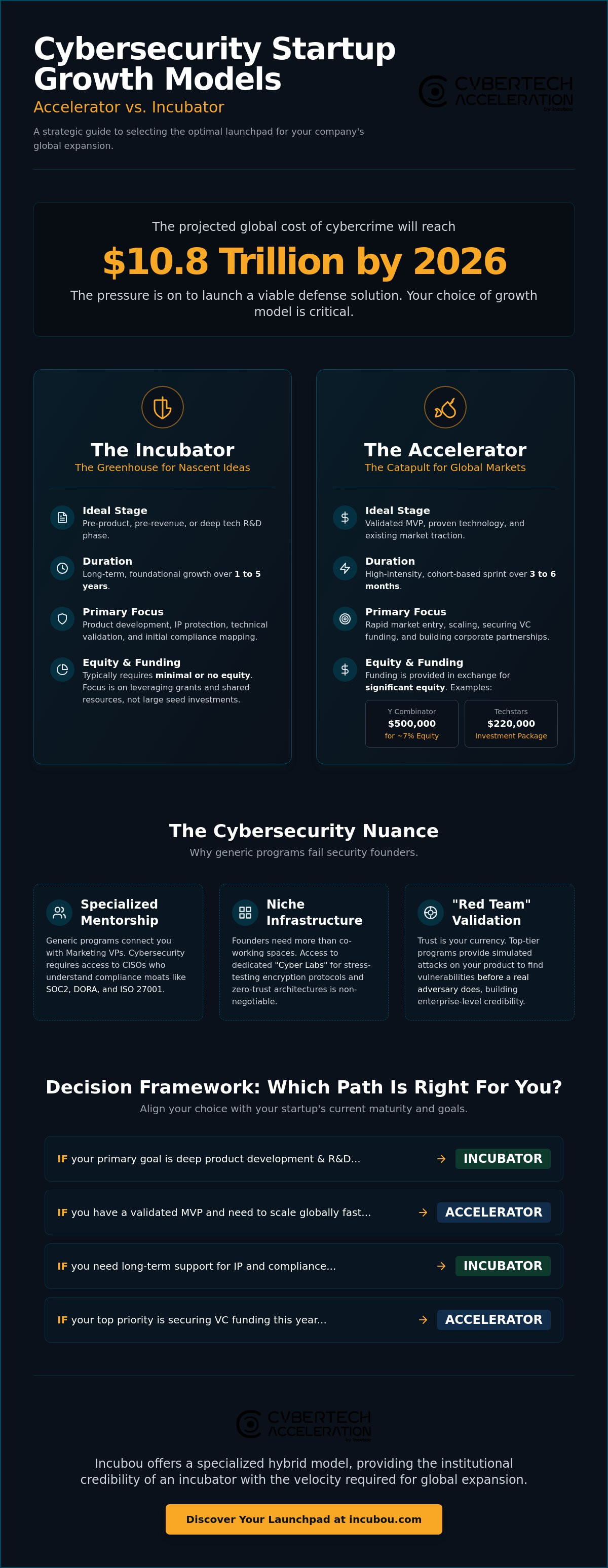
With the projected global cost of cybercrime reaching $10.8 trillion by 2026, the pressure to launch a viable defense solution has shifted from a sprint to a high-stakes strategic offensive. You're likely managing a mounting burn rate during R&D while searching for specialized mentors who truly understand the nuances of SOC2 or the newly effective DORA regulations. It's frustrating to hold world-class technology but lack the structural bridge to reach a global market. Deciding between a cybersecurity accelerator vs incubator is the most consequential choice you'll make this year for your startup's trajectory.
We understand that your goal isn't just to survive; it's to dominate the international security landscape with speed and precision. This article promises to help you master the critical differences between these two models so you can select the optimal launchpad for your expansion. We'll examine specific selection criteria, paths to faster Product-Market Fit, and the networking infrastructure required for rapid market entry. This guide provides the strategic clarity you need to transition from a localized startup to a sophisticated global player.
Key Takeaways
- Differentiate between long-term product development and high-intensity market sprints to align your choice with your startup's current maturity.
- Identify why specialized security mentors and testing labs are essential for navigating complex regulatory frameworks like SOC2 and DORA.
- Evaluate the critical trade-offs of the cybersecurity accelerator vs incubator models to determine if your startup is ready for rapid equity-based scaling.
- Learn how to leverage geographic corridors and regional R&D grants to bridge the gap between European innovation and US market entry.
- Discover the advantages of a hybrid growth model that provides both institutional credibility and the velocity required for global expansion.
Defining the Core: Cybersecurity Accelerator vs. Incubator
Choosing between a cybersecurity accelerator vs incubator isn't merely a matter of duration; it's a strategic decision about your company's biological clock. An incubator serves as a greenhouse for nascent ideas, providing the shelter needed to mature complex code into a viable product. Conversely, Startup accelerators act as a catapult, designed to propel companies with existing traction into global markets through intense, cohort-based pressure. Understanding which path to take depends on whether you're still perfecting your defense-grade technology or if you're ready to execute a global offensive market strategy.
The distinction often comes down to three primary metrics: equity, funding, and the duration of the partnership. While general incubators might span one to five years with minimal equity requirements, accelerators typically compress growth into a high-intensity three to six-month window. In 2026, standard accelerator deals have converged. Y Combinator offers $500,000 for roughly 7% equity, while Techstars provides a $220,000 investment package. These programs demand rapid results, making them unsuitable for founders still in the deep-tech R&D phase.
Cybersecurity requires a unique approach to growth. Unlike a standard SaaS application, security products demand rigorous deep-tech validation and "secure-by-design" auditing. This often necessitates longer incubation periods. You can't rush the stress-testing of a new encryption protocol or a zero-trust architecture. Founders in this niche must weigh the need for speed against the absolute requirement for technical integrity and regulatory resilience.
The Incubator Model: Building the Foundation
The incubator model prioritizes the long game. It's designed for pre-product or pre-revenue teams that need to refine their cybersecurity business scaling roadmap without the ticking clock of a three-month cohort. You gain access to shared resources like dedicated "Cyber Labs," specialized testing environments, and legal support for IP protection. This environment allows you to focus on building a robust technical foundation while navigating early-stage hurdles like patent filings and initial compliance mapping.
The Accelerator Model: Igniting Global Growth
If your technology is proven and your MVP is validated, an accelerator provides the velocity needed to scale. These programs focus on reaching specific cybersecurity investment readiness milestones. You'll work closely with CISO-level advisors and industry veterans who understand the high-stakes nature of international security sales. The goal is clear: build a direct pipeline to venture capital and secure corporate partnerships that facilitate rapid global expansion.
The Cybersecurity Nuance: Why Generic Programs Fail Security Founders
Generic programs often treat cybersecurity like any other B2B SaaS. They focus on user acquisition and viral loops. For a security founder, these metrics are secondary to technical integrity and trust. When choosing between an incubator or accelerator, you must look for specialized infrastructure. A generalist mentor can't help you stress-test a kernel-level driver or validate a post-quantum encryption algorithm. Effectively evaluating the cybersecurity accelerator vs incubator landscape requires a focus on niche expertise that generalist programs simply don't possess.
Access to the right decision-makers is the second failure point. Generalist programs might have connections to Marketing VPs, but they rarely have the ear of a Fortune 500 CISO. A CISO doesn't just look for features; they look for a "Compliance Moat." Trust is your currency. If your mentors don't understand the intricacies of SOC2, HIPAA, or ISO 27001, they can't help you clear the highest bar in enterprise sales. The choice between a cybersecurity accelerator vs incubator shouldn't be based on brand name alone; it requires a deep dive into the program's technical DNA.
High-tier cybersecurity programs incorporate "Red Team" validation. This isn't just a peer review; it's a simulated attack on your product to find vulnerabilities before a real adversary does. This level of technical scrutiny is absent in non-specialized environments. Generalist accelerators often struggle to open doors at the CISO level because they lack the institutional credibility that security leaders demand.
Technical Validation and PoC Support
Specialized programs facilitate Proof of Concept (PoC) trials with enterprise partners who are ready to test unproven tech in controlled environments. They provide access to proprietary threat data or isolated sandboxes. This helps you refine "Security by Design" principles, ensuring your product is resilient from the first line of code. If you're looking for a partner that understands these technical rigors, exploring cybersecurity acceleration tailored to deep tech is essential.
Regulatory and Compliance Guidance
Building for the global expansion for cybersecurity firms requires early and aggressive compliance alignment. Regulatory requirements are shifting. With the Digital Operational Resilience Act (DORA) taking full effect in January 2026, the cost of non-compliance is higher than ever. Specialized incubators help you manage the friction between European data privacy laws and US federal requirements. This institutional certification builds the trust necessary to engage with government contractors and global financial institutions.
Decision Framework: Which Path Matches Your Current Stage?
Selecting the right path between a cybersecurity accelerator vs incubator requires a cold, objective assessment of your startup's technical and commercial maturity. Think of these programs as different gears in a high-performance transmission. Shifting too early into an accelerator can stall your engine if the technology isn't ready for enterprise-grade scrutiny. Conversely, staying in an incubator for too long can lead to missed market windows and excessive burn rates. Founders often struggle with cybersecurity-focused incubator and accelerator models because this industry demands a rare balance of deep-tech R&D and rapid sales execution.
The equity equation is often the most debated factor. Most accelerators in 2026 demand between 5% and 10% equity. While dilution is a valid concern, you must weigh it against the potential for a 10x increase in speed to market. In the cybersecurity sector, being "first to secure" a new niche can be the difference between a billion-dollar exit and obsolescence. If your team consists primarily of engineers who need to learn the language of CISOs and venture capitalists, that equity is a strategic investment in your leadership's evolution.
Funding needs also dictate the choice. Incubators often help you secure non-dilutive R&D grants, which are vital for protecting your runway during the "Valley of Death" in product development. Accelerators, however, are designed to prepare you for a Seed or Series A round within months. They focus on building the metrics and the advisory board necessary to satisfy the rigorous due diligence of specialized security investors.
When to Choose an Incubator
You should lean toward an incubator if you are still in the "Stealth" phase. Protecting your intellectual property is paramount during this stage. If your product requires another year of heavy R&D before it can be demoed without crashing in a live environment, the incubator provides the necessary breathing room. It's also the right choice if you need a stable local hub, such as Vila Nova de Gaia, to build a core engineering team without the distractions of a high-pressure cohort schedule.
When to Choose an Accelerator
An accelerator is the correct choice if you have already achieved early traction and need to refine your cybersecurity saas pricing models for enterprise scale. If your primary goal is to enter the US or other international markets within the next 12 months, you need the catapult effect. This path is for teams ready to build a high-level advisory board and close the enterprise deals that prove your technology is a "must-have" rather than a "nice-to-have."
The Global Expansion Factor: Scaling Beyond Borders
Geographic location is no longer just about where your engineering team sits; it's about which markets your program can unlock. While the debate over a cybersecurity accelerator vs incubator often centers on equity and duration, the most vital differentiator for 2026 is the "Global Bridge." Many founders believe they must choose between staying in Europe or moving to Silicon Valley. However, a strategic corridor between Portugal and the US allows you to maintain high-quality R&D at a lower cost while executing a global offensive. This dual-presence model is the hallmark of a sophisticated growth strategy.
International networking acts as the lifeblood for securing cross-border venture capital. Specialized programs provide "Soft Landing" services, acting as a steady hand when you enter complex markets like Brazil or the US. These services remove the bureaucratic friction of international business expansion, providing immediate credibility with local stakeholders. By leveraging local R&D grants in Portugal, you can effectively fund the international sales teams required to drive global revenue. This approach preserves your equity while maximizing your reach.
Securing cross-border funding requires more than just a pitch deck; it requires a validated presence in multiple jurisdictions. If you're ready to bridge the gap between innovation and international sales, it's time to look at global expansion for cybersecurity as your primary growth lever.
Navigating the US Market Entry
Refining your value proposition for the US security landscape is a brutal exercise in clarity. The American market is hyper-competitive and demands "secure-by-design" proof from the first interaction. You'll need to navigate specific federal procurement hurdles, such as the "Buy American" Act and shifting cybersecurity mandates. Having US-based mentors in your cohort isn't a luxury. It's a requirement for understanding the buyer's psychology and the nuances of US-based enterprise sales cycles.
The Vila Nova de Gaia Advantage
By June 2026, Portugal has solidified its position as a top-tier hub for cybersecurity innovation. Vila Nova de Gaia specifically offers access to an IAPMEI-certified ecosystem, providing institutional support that generalist programs can't match. Lower operational costs in Portugal allow for a significantly longer R&D runway. This fiscal efficiency gives you the breathing room to perfect your technology before committing to the high-cost environment of a US-based scale-up. You get the stability of an institutional partner with the velocity of a global startup.
Incubou: The Specialized Hybrid for Cybersecurity Leaders
Success in the digital defense sector requires more than a simple choice between a cybersecurity accelerator vs incubator. It demands a hybrid approach that synthesizes the technical depth of an incubator with the commercial velocity of an accelerator. Incubou provides this exact synthesis. We act as a sophisticated mentor for founders who've moved past the initial ideation but aren't yet ready to sacrifice their technical integrity for the sake of a generic growth sprint. Our model ensures your "Security by Design" principles remain intact while we build the bridge to international markets.
Credibility is the ultimate currency in cybersecurity. As an IAPMEI-certified institution, Incubou offers a level of institutional validation that generic venture studios simply cannot match. This certification provides your startup with immediate market recognition through the 'Cybertech Acceleration' label. It signals to global partners and investors that your technology has undergone rigorous vetting. We invite you to join our 2026 cohort in Vila Nova de Gaia, where we provide the steady hand needed to manage the bureaucratic and technical hurdles of global scaling.
Tailored Support for Global Ambitions
Global expansion is the core of our mission. We offer specific programs designed for successful US and Brazil market penetration, moving beyond generic business advice to provide high-level strategic consulting. You'll gain direct access to our exclusive network of global CISOs and specialized security investors. These connections don't just provide funding; they provide the technical validation and enterprise feedback loops necessary to achieve true product-market fit on a global scale. We remove the traditional barriers to entry, allowing you to focus on innovation while we handle the complexities of international compliance and procurement.
Join the Elite Cybersecurity Ecosystem
Being part of a specialized, security-only cohort provides a collaborative atmosphere that generalist programs lack. You'll work alongside fellow innovators who understand the specific challenges of the compliance moat and the high-stakes nature of enterprise security sales. This collective intelligence accelerates your learning curve and strengthens your market position. Preparing your application requires a focus on technical validation and clear global vision. We look for founders who are ready to transition from local success to international dominance. Apply to Incubou and accelerate your path to global growth today to secure your place in the 2026 cohort.
Lead the Next Wave of Cybersecurity Innovation
Mastering the distinction between a cybersecurity accelerator vs incubator is the first step toward building a resilient, global enterprise. You now understand that your strategic choice hinges on balancing deep-tech R&D with the velocity required for international market entry. Whether you're refining your core technology in a nurturing environment or preparing for a high-stakes US launch, your path must prioritize specialized security expertise over generic business advice. Aligning your startup stage with the right support structure ensures you don't just enter the market, but dominate it.
Incubou stands ready to act as your strategic partner in this journey. We offer the institutional credibility of an IAPMEI-certified incubator status combined with a proven corridor to the US and Brazil markets. Our specialized cybersecurity-only mentor network provides the steady hand you need to navigate complex regulations and close enterprise deals with confidence. Apply for Incubou's Cybersecurity Acceleration Program and transform your technical vision into a global market reality. The future of security is global, and your time to scale starts today.
Frequently Asked Questions
What is the main difference between a cybersecurity accelerator and an incubator?
The primary distinction between a cybersecurity accelerator vs incubator lies in velocity and maturity. Accelerators are cohort-based, high-intensity sprints designed to scale startups with a validated MVP within three to six months. Incubators provide a long-term, nurturing environment for early-stage R&D, often spanning several years. You choose an incubator to build your technical foundation and an accelerator to execute a global offensive market strategy.
How much equity do cybersecurity accelerators typically take in 2026?
In 2026, top-tier accelerators typically require between 5% and 10% equity. For example, Y Combinator takes 7% equity for its standard $125,000 investment plus an additional $375,000 on an uncapped SAFE. Techstars offers a $220,000 package for roughly 5% to 10% equity. While dilution is a factor, founders often view this as a strategic investment in rapid global expansion and immediate access to elite venture capital.
Is it possible for a startup to go through both an incubator and an accelerator?
It's common for successful founders to leverage both models sequentially. You might begin in an incubator to focus on deep-tech R&D and securing IP without the pressure of a rapid cohort. Once your product is validated and ready for enterprise stress-testing, you transition to an accelerator to scale revenue. This progression ensures you have a robust technical foundation before attempting the high-velocity growth required by global investors.
Do I need to be based in Portugal to join the Incubou accelerator?
You don't need to be originally based in Portugal to join the Incubou program, though our primary operations are in Vila Nova de Gaia. We act as a global bridge-builder for international founders. The program provides a strategic base to access European R&D grants while preparing for market entry into the US and Brazil. We welcome ambitious teams from across the globe who seek a sophisticated, IAPMEI-certified partner.
What kind of technical support should I expect from a cybersecurity-focused program?
A specialized cybersecurity program offers infrastructure that generalist programs lack. Expect access to dedicated "Cyber Labs" for sandboxing and "Red Team" validation to stress-test your product's resilience. Mentorship comes from CISO-level advisors who provide granular feedback on "Security by Design" principles. These programs also offer deep-dive support for navigating complex compliance moats like SOC2, ISO 27001, and the recently implemented DORA regulations.
How does IAPMEI certification benefit my cybersecurity startup?
IAPMEI certification provides your startup with immediate institutional credibility and trust. In the security sector, trust is your primary currency. This certification signals to enterprise buyers and government contractors that your business meets rigorous professional standards. It also unlocks access to a wider ecosystem of European funding, R&D grants, and strategic partnerships that are exclusive to certified institutions within the Portuguese innovation landscape.
Can an accelerator help my startup with US market entry and compliance?
Specialized accelerators are designed specifically to handle the friction of US market entry. They provide US-based mentors who understand the psychology of American enterprise buyers and federal procurement hurdles like the "Buy American" Act. These programs help you align your product with US-specific compliance requirements early. This proactive approach ensures a "Soft Landing," allowing you to focus on closing deals rather than navigating bureaucratic barriers.
What are the common selection criteria for elite cybersecurity accelerators?
Elite programs look for deep-tech innovation and a validated MVP that addresses a critical security gap. They prioritize team maturity, specifically looking for founders who balance technical brilliance with a clear vision for global scalability. The acceptance rate for top-tier programs remains highly competitive, often falling below 3%. Demonstrating a clear "Compliance Moat" and investment readiness is essential for a successful application within the cybersecurity accelerator vs incubator landscape.