

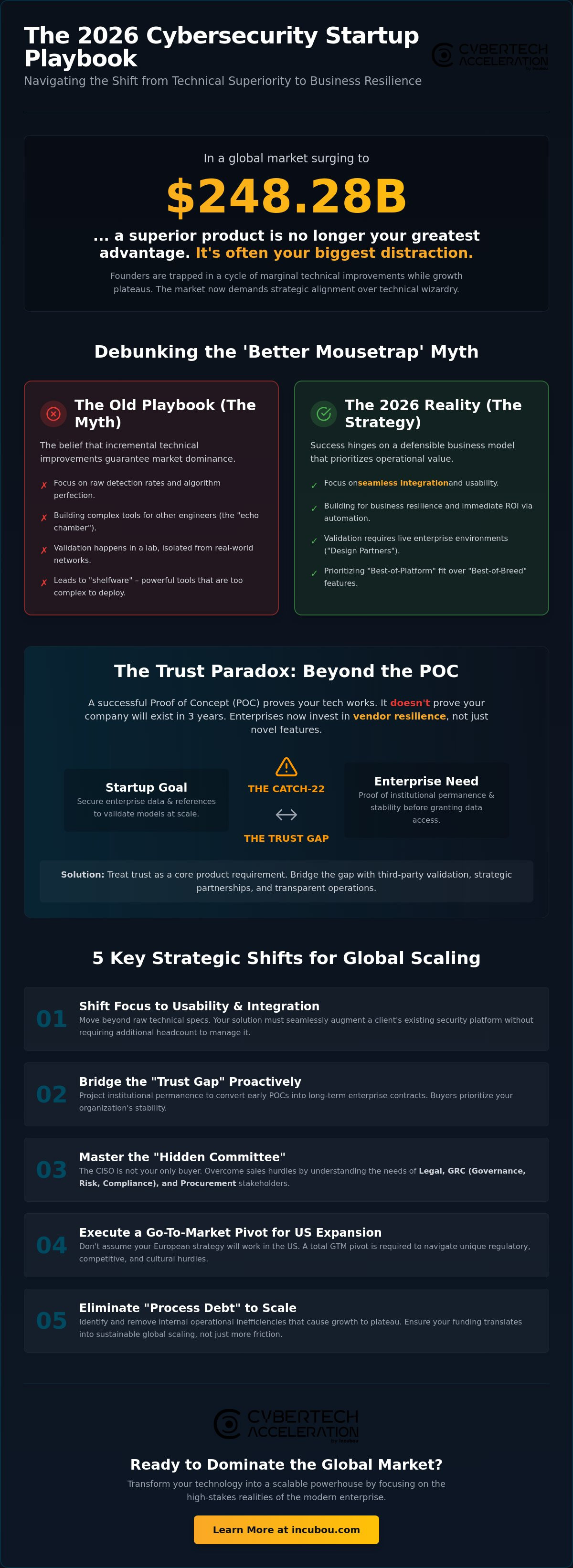
In 2026, a superior product is no longer your greatest competitive advantage; it's often your biggest distraction. While the global cybersecurity market has surged to $248.28 billion, many founders find themselves trapped in a cycle of marginal technical improvements while their growth plateaus. You've likely felt the exhaustion of a 12 month enterprise sales cycle or the Catch-22 of needing major references just to secure your first big contract. These cybersecurity startup challenges aren't technical failures. They're strategic misalignments in a market that now demands business resilience over technical wizardry.
You deserve a path that leads directly to global market dominance without the typical bureaucratic friction. We'll show you how to dismantle the growth myths holding you back and master the complex journey from European validation to a successful US market entry. This article provides a roadmap to shorten your sales cycles, master the new NIST CSF 2.0 governance requirements, and build a strategic network of CISOs and investors. Discover how to transform your technology into a scalable global powerhouse by focusing on the high stakes realities of the modern enterprise.
Key Takeaways
- Shift your focus from raw technical specifications to seamless integration and usability to meet the 2026 market demand.
- Bridge the "Trust Gap" by learning how to project the institutional permanence required to convert early POCs into long-term enterprise contracts.
- Master the "Hidden Committee" of legal, GRC, and procurement stakeholders to overcome the most persistent cybersecurity startup challenges in the sales cycle.
- Execute a total go-to-market pivot when expanding from Europe to the US to navigate unique regulatory and competitive hurdles.
- Identify and eliminate the "Process Debt" that causes growth plateaus, ensuring your funding translates into sustainable global scaling.
Debunking the 'Better Mousetrap' Myth in Cybersecurity
Many founders believe a 5% improvement in detection rates is their ticket to a unicorn valuation. They spend months perfecting algorithms in a vacuum, assuming that technical superiority guarantees market dominance. In reality, the 2026 market is saturated with high-performance tools that no one has the time to manage. One of the most significant cybersecurity startup challenges is realizing that your "better mousetrap" often creates more noise for an already overwhelmed security team. While founders must maintain a foundational understanding of cyber threats to build relevant tools, they frequently neglect the operational friction of the enterprise environment.
The industry is currently trapped in the "Great Cybersecurity Echo Chamber," where technical specs are shouted over the actual needs of the business. This disconnect leads to the "shelfware" phenomenon. Enterprises buy promising tools during a hype cycle but never fully deploy them because the integration process is too complex. To win in 2026, you must move beyond a feature-set and establish a "Right to Win." This means building a defensible business model that prioritizes integration, reduces the total cost of ownership, and demonstrates immediate ROI through automation rather than just raw detection power.
The Ideation Trap: Building for Other Engineers
Technical founders often solve problems that excite their peers but fail to attract a CISO's budget. These founders focus on the "how" while the buyer is focused on the "so what." In the context of 2026's consolidated security stacks, product-market fit is the point where your solution seamlessly augments a platform without requiring additional headcount to manage it. The market has shifted decisively from "Best-of-Breed" to "Best-of-Platform." If your tool doesn't play well with the existing ecosystem, it won't survive the procurement process.
Validation Beyond the Lab
The phrase "it works on my machine" is a death knell for seed funding. Investors in 2026 demand proof that your technology can withstand the messy, fragmented reality of a global enterprise network. Achieving early cybersecurity product market fit requires testing in live environments with diverse data sets. You must also distinguish between "Design Partners" and "Early Adopters." Design partners help you shape the product's architecture to fit industry workflows, while early adopters simply test the final result. Securing the former early on ensures you aren't building a solution in search of a problem.
The Trust Paradox: Why Founders Struggle with Early Validation
Winning a Proof of Concept (POC) often feels like the finish line for technical founders. In the 2026 market, it's barely the starting block. One of the most persistent cybersecurity startup challenges is the "Trust Gap," the space between proving your tech works and proving your company will exist in three years. Enterprises are no longer just buying features; they are investing in vendor resilience. They've seen too many promising startups evaporate, leaving behind unmaintained code and security holes. Consequently, a successful POC proves your efficacy, but it doesn't prove your permanence.
This creates a brutal catch-22. You need enterprise-grade data to validate your detection models, yet enterprises won't grant access to that data until you've proven yourself at scale. To break this cycle, you must treat trust as a core product requirement rather than a sales byproduct. Buyers now prioritize the stability of your organization over the novelty of your algorithms. If your internal operations look fragile, your software will be perceived as a liability, regardless of its performance in a lab environment. Navigating these challenges for cybersecurity startups in 2026 requires a shift from technical validation to institutional validation.
Navigating the Catch-22 of Enterprise References
Landing your first Tier 1 logo requires more than a pitch deck. It requires a proxy for institutional trust. You can bridge this gap by leveraging third-party validation, such as lab testing from established security institutes or strategic partnerships with known entities. Engaging a cybersecurity startup advisory provides the high-level network and credibility needed to bypass standard skepticism. These mentors act as a global bridge, helping you validate your roadmap before a CISO even sees it. If you're looking to accelerate this process, exploring specialized cybersecurity acceleration can provide the institutional weight you currently lack.
Internal Security as an External Sales Tool
A common myth suggests that startups are too small for hackers to notice. In 2026, your internal security posture is actually your primary sales collateral. Large enterprises will scrutinize your own defenses as a reflection of your product's integrity. Certifications like SOC 2 Type II and ISO 27001 are no longer "Year 3" milestones; they are "Day 1" requirements for any serious conversation. By prioritizing these standards early, you remove bureaucratic friction and signal that your startup is built for the long haul. Your commitment to governance reflects your understanding of the high-stakes environment your customers inhabit every day. Don't let your own security become the reason a deal stalls in procurement.
Navigating the Enterprise Sales Gauntlet: Beyond the CISO
Securing a "yes" from the CISO is a significant milestone, but it's rarely the final hurdle. Many founders celebrate prematurely, only to watch their momentum evaporate within the legal department or procurement office. This "Hidden Committee" includes GRC, Legal, and Finance teams who view your startup through the lens of risk mitigation rather than technical innovation. They don't care about your detection rates; they care about your liability and your company's long-term viability. These stakeholders often kill more deals than your actual competitors do, making them the silent gatekeepers of the 2026 market. Overcoming these cybersecurity challenges for startups requires a shift in focus from the technical champion to the economic buyer.
Another dangerous trap is "Death by Pilot." Startups often get trapped in infinite, unpaid testing cycles that drain engineering resources without a clear path to a purchase order. To avoid this, you must be "Procurement-Ready" from the first interaction. This means having your financial records, insurance policies, and compliance documentation organized and ready for scrutiny. In 2026, the speed of your procurement process is a competitive advantage. If a competitor can clear a security questionnaire in three days while you take three weeks, you've already lost the deal. Efficiency in the back office is just as vital as efficiency in your code.
Winning the GRC and Legal Battle
The dreaded security questionnaire is often used as a strategic barrier to entry. Rather than treating it as a chore, use it as an opportunity to demonstrate institutional maturity. Building a "Trust Center" that hosts your SOC 2 reports, data processing agreements, and pentest summaries can preempt 80% of procurement questions. Developing a sophisticated cybersecurity B2B sales strategy ensures you account for these multi-stakeholder requirements early. By addressing GRC concerns during the initial pitch, you signal to the enterprise that you understand their regulatory burdens.
From Pilot to Production
Preventing pilot purgatory requires setting strict "Success Criteria" before a single line of code is deployed. Define exactly what a successful test looks like and get a written commitment that meeting those metrics leads to a contract. You must also identify the "Economic Buyer," the person with the budget, who is often distinct from your "Technical Champion." In 2026, pricing models are shifting toward "Value Realization." Enterprises want to pay for the outcomes your tool provides, such as reduced incident response time or automated compliance reporting, rather than just a seat-based license. Aligning your cost to their value ensures a smoother transition from testing to a long-term partnership.
Global Expansion Hurdles: Crossing the Chasm to the US Market
Crossing the Atlantic is the ultimate stress test for any cybersecurity founder. Many assume that because their detection engine thrived in the European market, it will naturally dominate the US. This is a dangerous misconception. The US market presents a unique set of cybersecurity startup challenges, ranging from an incredibly aggressive competitive landscape to a complex web of state-level privacy laws. Success in Paris or Lisbon does not translate to success in San Francisco without a fundamental shift in your go-to-market strategy. You aren't just selling a product anymore; you're competing for attention in the most crowded security ecosystem on the planet.
If you're targeting sectors adjacent to the federal government, the hurdles grow even higher. Navigating FedRAMP certification or ITAR compliance requires more than just technical adjustments; it demands a dedicated operational commitment. You can't simply "wing it" with a remote sales representative and a virtual office. Building a true local presence means establishing a US entity and providing local support that matches the time zones and expectations of American buyers. In 2026, US enterprises expect their vendors to be within reach, both legally and operationally. Without this "boots on the ground" approach, your startup will always be viewed as a foreign outsider with a higher risk profile.
The US Market Entry Checklist
Transitioning from GDPR to the patchwork of US privacy laws, such as the CCPA, requires a total audit of your data handling processes. This is why global expansion for cybersecurity firms in 2026 demands a "US-First" messaging strategy. Your value proposition must speak directly to the American CISO's obsession with ROI and rapid incident response. Establishing a US headquarters early isn't just about taxes; it's about signaling to the market that you are a permanent fixture in their ecosystem. If you're ready to scale beyond your local borders, our global expansion for cybersecurity services can help you navigate these complex international waters.
Scaling from Vila Nova de Gaia to Silicon Valley
Founders in hubs like Vila Nova de Gaia have a distinct advantage: access to world-class engineering talent at a sustainable cost. The goal is to leverage this Portuguese innovation while building aggressive commercial operations in Silicon Valley or Austin. Programs that are IAPMEI-certified provide a critical bridge, offering the institutional support necessary for internationalization. By maintaining your R&D core in Europe while scaling your sales engine in the US, you create a balanced, capital-efficient growth model. This hybrid approach allows you to out-engineer competitors while remaining agile enough to pivot your messaging for the American buyer.
Strategic Acceleration: Overcoming Growth Plateaus in 2026
Securing a fresh round of funding often feels like the ultimate solution to a stagnant growth curve, yet capital alone cannot fix a broken scaling model. In the competitive landscape of 2026, growth plateaus are rarely caused by a lack of cash. Instead, they're usually the result of "Process Debt" and "Network Isolation." Process debt occurs when the manual workarounds that powered your first ten deals become the very bottlenecks that prevent you from closing a hundred. Network isolation happens when founders lack direct, high-level access to the global CISO community, forcing them to rely on cold outreach that rarely converts. These specific cybersecurity startup challenges require strategic intervention rather than just a larger bank balance.
The transition from founder-led sales to a repeatable revenue engine is a critical pivot point. While a founder's passion can close early adopters, it doesn't scale. You must build a system where sales professionals can replicate your success without your constant involvement. This involves codifying your "Right to Win" and ensuring your value proposition is clear enough for a third party to pitch effectively. Moving beyond the founder's shadow is essential for creating a company that is seen as a permanent institution rather than a temporary project. A scalable engine turns your technical innovation into a predictable business outcome.
The Power of the Specialized Network
Generalist accelerators often fail cybersecurity founders because they don't understand the "Cyber Mindset" or the unique regulatory gauntlets of the industry. You need mentorship from individuals who have actually sat in the CISO's chair or navigated a complex US market entry. This is where specialized support becomes "Smart Capital." For example, scaling a cybersecurity startup in Portugal offers a distinct strategic advantage. You can leverage world-class engineering talent and a supportive innovation ecosystem while maintaining the capital efficiency required to compete on a global stage. This regional hub provides the perfect launchpad for internationalization without the immediate overhead of a Silicon Valley headquarters.
Investment Readiness for 2026
The venture capital landscape has shifted decisively in this "Post-AI" era. Investors are no longer rewarding "Growth at All Costs." Instead, they're looking for sustainable unit economics and a clear path to profitability. They want to see that your platform can automate complex security tasks, reducing the burden on the customer's headcount. Demonstrating that you can overcome common cybersecurity startup challenges through operational excellence is now just as important as your technical roadmap. Investors prioritize founders who treat governance and process as core features. Ready to break through the noise? Apply to Incubou's Cybersecurity Acceleration Program and let's build your global bridge together.
Mastering the Global Security Frontier
The landscape of 2026 demands a fundamental shift from technical obsession to operational maturity. You've seen how integration and ease of use now outweigh raw detection power, and how the "Trust Paradox" requires you to project institutional permanence from your very first interaction. Successfully navigating the enterprise sales gauntlet means winning over the hidden committee of legal and GRC stakeholders while preparing for the significant cultural and regulatory pivot of the US market. These cybersecurity startup challenges are formidable, but they also serve as the filters that separate eventual market leaders from the background noise.
You don't have to navigate this complex path alone. Scale your cybersecurity startup with Incubou's specialized acceleration programs to gain the strategic advantage your technology deserves. As an IAPMEI-certified accelerator, we provide targeted US market entry support and connect you with a deep network of C-suite security mentors. We're ready to help you transform your technical vision into a dominant global force. The future of secure innovation is yours to build.
Frequently Asked Questions
What is the biggest challenge for cybersecurity startups in 2026?
One of the most defining cybersecurity startup challenges in 2026 is overcoming the Trust Gap to prove institutional permanence. Most enterprises are hesitant to integrate new tools from companies that might not exist in three years. Founders must demonstrate that their business model is as resilient as their code. Shifting focus from technical specifications to a defensible, scalable operation is critical for surviving the current market consolidation.
Why do cybersecurity sales cycles take so long?
Cybersecurity sales cycles are extended by the complex requirements of the "Hidden Committee," which includes legal, GRC, and procurement teams. While a CISO might approve the technology quickly, these departments must vet the startup for liability and compliance. This multi-stakeholder gauntlet often stretches deals to 12 months or more. Startups can accelerate this by being procurement-ready with pre-prepared trust centers and comprehensive documentation.
How can a cybersecurity startup get its first enterprise customer?
Securing a first enterprise customer requires leveraging design partnerships rather than standard sales pitches. You should collaborate with a forward-thinking organization to shape your product's architecture around their specific workflows. This collaborative approach builds the necessary trust for a full deployment. Additionally, using third-party lab results or specialized acceleration programs provides the institutional weight needed to bypass initial skepticism from larger buyers.
Is it necessary for a European cybersecurity startup to move to the US?
You don't necessarily need to move your entire team, but establishing a local US presence is vital for global scaling. American enterprises expect local legal entities and support structures that operate within their time zones. This hybrid model allows you to leverage high-quality engineering talent in European hubs while maintaining an aggressive commercial engine in the US. It's about building a bridge between local innovation and global market expectations.
What certifications do cybersecurity startups need to sell to enterprises?
SOC 2 Type II and ISO 27001 are currently considered "Day 1" requirements for selling to enterprises. These certifications serve as a baseline for security governance and professional reliability. Without them, most procurement teams will automatically disqualify a startup during the initial vetting process. Specialized sectors may also require FedRAMP or ITAR compliance if you intend to work with government-adjacent organizations in the US market.
How much funding does a cybersecurity startup need to reach Series A?
In 2026, reaching Series A depends more on demonstrating sustainable unit economics than hitting a specific funding dollar target. Investors now prioritize startups that show a clear path to profitability and a repeatable revenue engine. While previous years focused on growth at all costs, current VCs look for efficient capital usage and strong customer retention rates. Proving you can scale without massive headcount increases is essential for attracting major investment.
What is the role of an IAPMEI-certified accelerator?
An IAPMEI-certified accelerator acts as a strategic bridge that provides startups with institutional credibility and essential resources for internationalization. These programs offer a structured environment to refine your business model and prepare for US market entry. By being part of a certified network, you gain access to specialized mentorship and support that helps navigate the bureaucratic hurdles of global expansion. It signals to investors that your startup is professionally validated.
How can a startup prove its cybersecurity tool actually works?
Proving your tool works requires demonstrating Value Realization through live environment testing with diverse data sets. Enterprises are tired of hypothetical lab results; they want to see how your solution reduces incident response times or automates compliance tasks. One of the most persistent cybersecurity startup challenges is moving beyond a feature-list to show concrete ROI. Success is measured by how effectively your tool integrates into existing security stacks.