

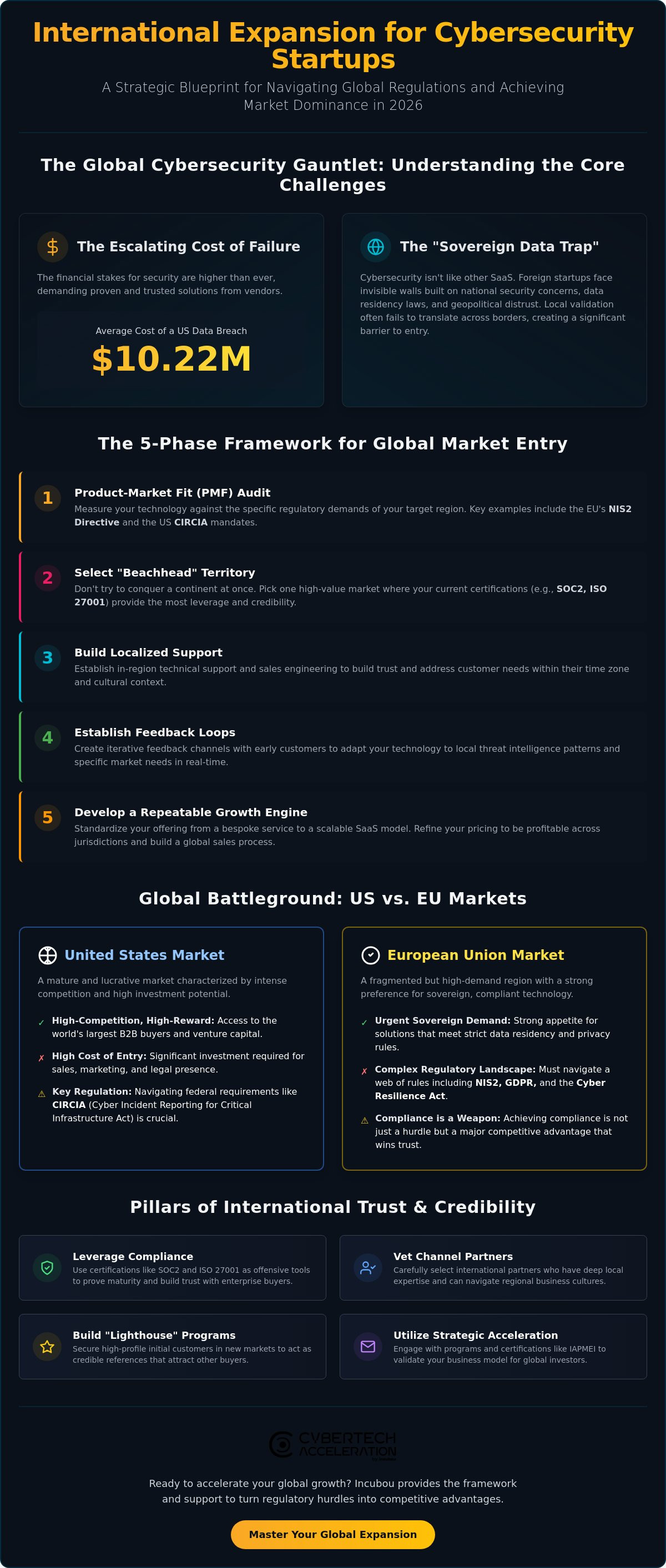
With the average cost of a US data breach reaching a staggering $10.22 million, your global prospects aren't just looking for a vendor; they're seeking a partner who can guarantee their survival. Successful international expansion for cybersecurity startups in 2026 has evolved beyond simple sales targets. It's now a sophisticated game of trust validation where compliance is the primary currency. You likely feel the pressure of the high costs associated with US market entry and the daunting task of navigating the fragmented implementation of the EU’s NIS2 Directive. It’s a complex landscape that can stall even the most innovative technology.
This blueprint provides the strategic framework you need to master these challenges and achieve global market dominance. You'll learn how to turn regulatory hurdles like CIRCIA and the Cyber Resilience Act into competitive advantages that win over skeptical B2B buyers and global investors. We will break down the exact path to penetrating the US market, securing international validation, and building a repeatable growth engine that scales as fast as the threats you defend against.
Key Takeaways
- Identify the "Sovereign Data Trap" and learn how to bypass the unique regulatory walls that frequently stall security startups at the border.
- Master a proven two-phase framework for international expansion for cybersecurity startups that aligns your local validation with global compliance standards.
- Compare the high-competition rewards of the US market against the urgent demand for sovereign technology within Europe's complex regulatory landscape.
- Discover how to vet international channel partners and build "Lighthouse Customer" programs that anchor your brand's credibility in new territories.
- Leverage strategic acceleration and IAPMEI certification to validate your business model for global investors and bridge the gap to international markets.
Navigating the Complexities of International Scaling for Tech Startups
Scaling a cybersecurity startup across borders involves far more than localized marketing or adding server capacity in a new region. In the high-stakes world of security technology, international scaling represents a fundamental shift in jurisdictional authority and risk management. Unlike generic SaaS products that solve productivity or design challenges, security tools sit at the heart of a client's most sensitive infrastructure. This means your international expansion for cybersecurity startups must account for national security interests and the specific "Sovereign Data Trap" that many founders overlook.
The Sovereign Data Trap occurs when local regulations or nationalistic security preferences create invisible walls for foreign software. While a project management tool can scale globally with minimal friction, a threat detection platform faces intense scrutiny regarding data residency, encryption standards, and even the geopolitical alignment of its home country. Generic SaaS scaling focuses on user acquisition; security scaling focuses on sovereign trust. You'll find that your hard-won local validation often fails to impress international enterprise buyers who view foreign startups as potential supply chain risks rather than innovative partners.
The Trust Deficit in Global Security
The Trust Deficit is the primary barrier to cybersecurity market entry. Most "born-local" startups struggle because they haven't aligned their operations with the "buy-global" mentality of Fortune 500 companies. These enterprises demand rigorous third-party validation before they'll even consider a pilot program. When evaluating various international market entry modes, you must prioritize credibility over speed. Without recognized certifications and high-profile endorsements, your technical superiority remains irrelevant to a CISO who fears the career-ending fallout of a foreign-sourced breach.
Regulatory Compliance as a Competitive Edge
Smart founders don't view compliance as a bureaucratic hurdle. They use it as a weapon. By mapping your product to GDPR, SOC2, and ISO 27001 early on, you create a frictionless path for international expansion for cybersecurity startups. Compliance costs are actually market penetration investments that prove your maturity to skeptical buyers. In 2026, the implementation of the EU's NIS2 Directive and the Cyber Resilience Act means your geographic roadmap is dictated by your ability to meet sovereign security requirements. Aligning with these high standards early allows you to enter restricted markets while your competitors are still struggling with basic audits.
A Strategic Framework for Global Cybersecurity Market Entry
Success in a new territory isn't a matter of luck; it's the result of a rigorous execution framework. Founders must move past the "spray and pray" approach to sales and adopt a structured methodology that prioritizes validation at every turn. Executing a successful international expansion for cybersecurity startups requires a shift from reactive growth to a five-phase execution model. This begins with a Product-Market Fit (PMF) audit that measures your technology against the specific regulatory demands of your target region, such as the EU's NIS2 requirements or the US CIRCIA mandates.
Once you've audited your fit, you must select a "Beachhead" territory. Don't try to conquer a whole continent at once. Pick one high-value market where your current certifications provide the most leverage. From there, you'll build localized support and establish iterative feedback loops. This ensures your technology adapts to local threat intelligence patterns in real time. This methodical approach transforms international expansion for cybersecurity startups from a high-risk gamble into a calculated strategic move.
Refining Your Cybersecurity Business Model
Transitioning from a bespoke local consultancy to a scalable global SaaS model is non-negotiable for rapid growth. Bespoke services don't scale; they drain your engineering resources. You must standardize your offering to ensure it remains profitable across different jurisdictions. This transition is a core part of the cybersecurity business scaling roadmap for 2026. Your pricing strategy also needs a global overhaul. It must account for international tax complexities and the varying purchasing power of regional enterprise clients. Integrating cybersecurity in internationalization strategies ensures that your business model is resilient enough to handle cross-border operational risks.
Technical Validation and Pilot Programs
Global buyers are fatigued by "Proof of Concept" (PoC) presentations that show features without results. To win in 2026, you need a "Proof of Value" (PoV). A PoV demonstrates exactly how your solution mitigates specific financial or operational risks within the client's unique environment. Securing international beta testers is the fastest way to build this credibility. These early adopters act as your regional advocates, providing the peer-level validation that enterprise CISOs demand. Leveraging established acceleration networks can provide the necessary introductions to these high-value testers, significantly shortening your validation cycle and clearing the path for a full-scale market entry.
Comparative Analysis: Evaluating the US Market vs. European Expansion
Choosing where to plant your first international flag is the most consequential decision in your growth journey. The roadmap for international expansion for cybersecurity startups often leads to a binary choice: the sheer scale of North America or the sovereign-focused markets of Europe. While the US offers the world’s highest security spending, Europe provides a unique opening for founders who can navigate its fragmented regulatory landscape. Success isn't just about picking the biggest market; it's about picking the one where your specific technical validation carries the most weight.
The US Market Entry Challenge
Entering the North American market requires more than a remote sales team. US enterprises are hyper-sensitive to supply chain risks, often demanding a "US-based" entity and local boots-on-the-ground before they'll even consider a contract. You'll face the "CISO hurdle," where technical excellence is secondary to your ability to prove long-term stability and immediate local support. To navigate these high-stakes negotiations, founders should consult the global expansion for cybersecurity firms guide to understand the specific buying cycles and procurement requirements of US-based corporations.
Leveraging the EU Sovereign Tech Demand
Europe presents a fundamentally different opportunity. Driven by the NIS2 directive and a growing desire for data autonomy, many European enterprises are actively seeking non-US security alternatives. This demand for "Sovereign Tech" gives EU-certified firms a distinct strategic advantage. By positioning yourself as a provider that understands local privacy nuances and compliance hurdles, you can achieve deep cybersecurity market penetration without the massive overhead required for a US launch. This regional focus allows for a more targeted international expansion for cybersecurity startups, prioritizing high-trust relationships and regulatory alignment over raw market volume.
Case Study Blueprint: Executing a High-Trust Go-to-Market Strategy
Executing a successful market entry in the security sector requires more than a localized website and a few cold calls. You're selling a promise of protection, which means your Go-to-Market (GTM) strategy must prioritize credibility over raw volume. A successful international expansion for cybersecurity startups relies on a "Lighthouse Customer" program. This involves securing one high-profile, recognizable client in your target territory to act as a regional anchor. This single win provides the peer-level social proof that local CISOs require before they'll even consider a technical evaluation. Speed is a trap. If you rush the trust-building phase, you'll find your sales cycle stretching into years rather than months.
Measuring success during this phase goes beyond quarterly revenue targets. You must track "Trust Milestones." These include passing regional security audits, getting listed on preferred vendor rosters, and securing endorsements from local industry influencers. By utilizing specific cybersecurity market penetration tactics, you can systematically dismantle the barriers to entry that stall your competitors. This high-trust approach ensures that once you land your first few clients, the rest of the market follows with significantly less friction.
The Power of Channel Partnerships
Managed Security Service Providers (MSSPs) are the ultimate scaling lever for any international expansion for cybersecurity startups. These partners already hold the keys to the kingdom; they have established relationships and existing trust with your target buyers. When negotiating international distribution agreements, focus on maintaining IP control while offering a competitive incentive. Typical revenue shares for international security resellers often sit between 20% and 35% of the contract value, depending on the level of technical support and implementation they provide. By prioritizing these deep-rooted connections, you bypass the years of brand-building usually required to penetrate a foreign market.
GTM Execution Template for New Territories
Your 2026 GTM plan must be a living document that adapts to regional technical nuances. Start by implementing the go-to-market strategy for cybersecurity execution template, which emphasizes localized content marketing. This doesn't mean just translating your brochures. It means speaking the specific technical language and addressing the unique threat vectors prevalent in that region. Establish a tight feedback loop between your international sales teams and core engineering. If a German client requires a specific encryption standard, your product team needs to know immediately. This responsiveness is what separates global leaders from local players. If you're ready to accelerate this process, explore our cybersecurity acceleration programs to bridge the gap between your technology and global markets.
Accelerating Global Growth: The Incubou Advantage
Scaling a startup from a local success story to a global powerhouse requires more than just capital; it requires a sophisticated ecosystem that understands the specific friction points of the security industry. Incubou serves as that vital bridge. We provide the strategic infrastructure necessary for international expansion for cybersecurity startups, taking founders from our hub in Vila Nova de Gaia to the world's most competitive markets. This journey is anchored by the IAPMEI certification, a prestigious validation that signals your startup's credibility to global investors and partners. It's a seal of quality that simplifies the due diligence process and opens doors that remain closed to unverified competitors.
Access to our curated network of international cybersecurity experts and mentors further accelerates this growth. These aren't just advisors; they're seasoned professionals who've navigated the same bureaucratic hurdles and technical challenges you face. We've seen this model succeed repeatedly. Startups that began their journey in Portugal have successfully penetrated the US market by leveraging our strategic guidance and technical validation frameworks. They didn't just expand; they dominated by following a structured path to global relevance.
Vila Nova de Gaia: A Strategic Launchpad
Portugal has rapidly emerged as a premier destination for scaling a cybersecurity startup. The combination of cost-effective innovation and high-tier EU regulatory alignment makes it an ideal launchpad for international growth. Within the Incubou ecosystem, you gain the ability to conduct rapid international prototyping without the prohibitive overhead found in other tech hubs. This allows you to refine your product against global standards like NIS2 or SOC2 while maintaining the agility needed to pivot as market demands shift.
Your Path to Global Market Penetration
Transitioning from a localized acceleration phase to sustainable international operations is a high-stakes evolution. We specialize in smoothing this transition, particularly when it comes to the complexities of US market entry. Whether you're dealing with the intricacies of CIRCIA reporting or building a "Lighthouse Customer" program in North America, our team provides the hands-on support needed to clear these hurdles. We don't just provide a workspace; we provide a clear roadmap to global market dominance. Ready to take your tech global? Apply for Incubou Cybersecurity Acceleration today and start your journey toward international expansion for cybersecurity startups.
Securing Your Place on the Global Stage
Global market dominance isn't reserved for the largest incumbents; it's claimed by the most strategically aligned innovators. Mastering international expansion for cybersecurity startups requires you to view regulatory compliance as a market entry tool rather than a hurdle. By prioritizing high-trust partnerships and choosing the right beachhead territory, you transform technical validation into long-term commercial credibility. Success depends on your ability to bridge the gap between local innovation and the rigorous demands of global enterprise buyers.
As an IAPMEI-certified incubator, Incubou acts as your steady hand in this complex journey. We provide a strategic bridge to both US and EU markets, backed by a deep network of industry-specific mentors who understand the nuances of security scaling. Fast-track your global expansion with Incubou’s specialized cybersecurity acceleration and move from local validation to international leadership. The global security landscape is shifting rapidly. Your technology belongs at the forefront of that change, and we're here to help you lead the way.
Frequently Asked Questions
What is the biggest challenge for cybersecurity startups scaling internationally?
Establishing sovereign trust remains the most significant hurdle for international expansion for cybersecurity startups. Buyers often view foreign technology as a potential supply chain risk, especially in critical infrastructure sectors. You must overcome this by aligning with local regulations and securing third-party validation that proves your technical integrity matches the host nation's specific security standards.
How much funding do I need for US market entry in 2026?
US market entry in 2026 requires substantial capital to cover high customer acquisition costs and stringent compliance audits. While specific budgets vary by niche, you'll need enough runway to sustain a 12 to 18 month sales cycle. US enterprises expect local support and insurance coverage that matches their high-risk environment, where a single breach can cost upwards of $10 million.
Does my cybersecurity startup need a local office in every country we enter?
You don't need a physical presence in every country, but regional "beachhead" offices are vital for high-trust B2B security sales. Most international expansion for cybersecurity startups succeeds by using a hub-and-spoke model. A single office in a strategic location like Portugal can serve the entire EU market while maintaining lean operations and high-tier regulatory alignment.
Which international security certifications are most important for scaling?
SOC2 Type II and ISO 27001 are the foundational requirements for global credibility. In 2026, you must also prioritize region-specific standards like the EU Cyber Resilience Act (CRA) and the US CIRCIA mandates. These certifications act as a universal language that bypasses the need for repetitive technical audits with every new enterprise client you pursue.
How does an accelerator help with international scaling for tech startups?
Accelerators provide a strategic bridge by offering technical validation and introductions to high-value mentor networks. For example, an IAPMEI-certified incubator helps startups navigate complex bureaucratic hurdles and provides the credibility needed to attract global investors. This support significantly shortens the time it takes to move from local prototyping to full-scale international market entry.
Is the US or Europe a better market for new cybersecurity technologies?
The US offers the highest spending rewards, while Europe provides a growing market for sovereign-focused alternatives. If your technology prioritizes data autonomy and strict privacy, the European market's NIS2 requirements might offer a faster path to dominance. Conversely, the US is ideal for high-growth firms ready to compete directly with global security giants for massive contracts.
How do I protect my intellectual property during international expansion?
Protecting your intellectual property requires a combination of robust legal agreements and strategic control over your distribution channels. You should utilize localized contracts that respect international IP laws while ensuring your core source code remains centralized. Partnering with reputable resellers helps maintain oversight of how your technology is deployed and managed in foreign jurisdictions.
What role do channel partners play in global cybersecurity growth?
Channel partners, particularly Managed Security Service Providers (MSSPs), act as essential force multipliers for your global growth. They provide the existing trust and local relationships that a new entrant naturally lacks. By leveraging their established sales infrastructure, you can scale your technology across multiple territories without the overhead of building a massive internal sales team.


