

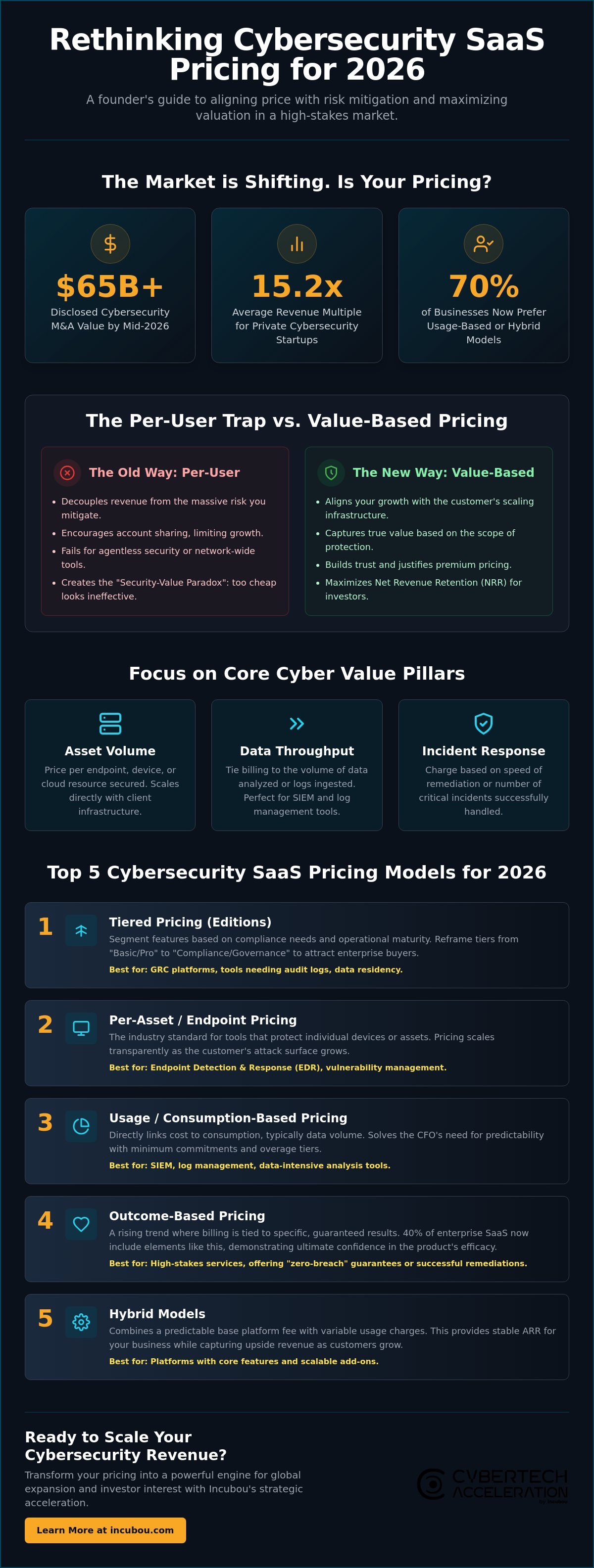
By mid-2026, disclosed cybersecurity M&A value has already surpassed $65 billion, yet many founders still leave money on the table because their billing structures don't reflect the actual risk they mitigate. Selecting the right cybersecurity saas pricing models is no longer just a sales task; it's a core strategic move that dictates your valuation in a market where private startups now command an average of 15.2x revenue. You've likely felt the frustration of providing massive security value while your revenue remains tethered to a stagnant seat count. It's often a struggle to explain these technical costs to procurement teams who prioritize the bottom line over breach prevention.
This guide helps you bridge that gap. Discover how to align your pricing with real-world security outcomes to drive sustainable global growth and capture the attention of elite investors. We'll break down the transition to usage-based and hybrid frameworks that are currently preferred by 70% of businesses. You'll learn how to build a structure that boosts your net revenue retention and positions your company as a high-value asset for upcoming funding rounds. By the end of this guide, you'll have a roadmap to transform your pricing into a powerful engine for international expansion.
Key Takeaways
- Define your pricing by the magnitude of risk mitigated rather than seat counts to build trust and reflect true product value.
- Compare the top five cybersecurity saas pricing models for 2026, including tiered compliance-ready editions and per-asset structures that scale with enterprise growth.
- Identify and eliminate the per-user trap to prevent account sharing and keep your sales velocity high as you scale.
- Adapt your billing for international markets by balancing US expectations for enterprise licenses with regional purchasing power adjustments.
- Prepare your startup for venture capital interest by shifting from intuitive guessing to data-driven pricing strategies that maximize net revenue retention.
Beyond Per-User: Why Cybersecurity SaaS Pricing Requires a Unique Value Metric
Traditional cybersecurity saas pricing models often borrow too heavily from general productivity tools, yet the two worlds share very little in common. In a standard Software as a service delivery, charging per user makes sense because each seat represents a human gaining utility. In the security sector, value isn't found in the number of logins. It's found in the scope of the shield. If your software secures an entire cloud infrastructure but only has three admin users, a per-seat model leaves your revenue decoupled from the massive risk you're neutralizing. You're effectively giving away your most valuable protection for the price of three email accounts.
There's also a psychological barrier unique to this sector known as the "Security-Value Paradox." Buyers view security as a mission-critical safeguard, almost like high-stakes insurance. If your price point is significantly lower than the perceived risk or the cost of a potential breach, you don't look like a bargain; you look like a liability. In this market, price is a proxy for efficacy. A price that's "too cheap" suggests your R&D or threat intelligence might be substandard, which can quickly destroy trust before a demo even begins.
The Shift from Access to Protection
Charging per user is fundamentally counter-intuitive for agentless security or network-wide monitoring. When your product operates in the background, the "user" is often a ghost. Instead, successful founders focus on the three core cyber value pillars: Asset Volume, Data Throughput, and Incident Response Speed. By shifting the focus here, you align your growth with the customer's scaling infrastructure. A Cybersecurity Value Metric is the unit of consumption that most closely correlates with the risk mitigated.
Predictability vs. Value Realization
While usage-based cybersecurity saas pricing models capture the most value, they often clash with a CFO’s desire for budget certainty. You can solve this by implementing minimum commitments. These floors stabilize your ARR while allowing for overage revenue when the customer's environment expands. This approach prevents "bill shock," a common fear where a sudden spike in data or assets leads to an unapproved invoice. By pegging your pricing to internal risk assessment frameworks, you speak the language of the board, ensuring your tool is viewed as a strategic investment rather than a fluctuating utility cost.
The 5 Most Effective Cybersecurity SaaS Pricing Models for 2026
Strategic revenue growth in 2026 requires moving beyond generic billing structures. While many industries rely on common SaaS pricing models, the security sector demands a more nuanced approach that reflects technical complexity and regulatory pressure. Successful cybersecurity saas pricing models today prioritize alignment with the buyer's operational reality rather than simple seat counts. These five frameworks have emerged as the most resilient for scaling startups:
- Tiered Pricing (Editions): Segmenting by compliance standards such as SOC2-ready or HIPAA-ready.
- Per-Asset/Endpoint Pricing: The industry standard for Endpoint Detection and Response (EDR) and vulnerability management.
- Usage/Consumption-Based Pricing: Ideal for SIEM and log management, where value is tied directly to data volume.
- Outcome-Based Pricing: A rising trend where 40% of enterprise SaaS now includes elements like "zero-breach" guarantees or successful remediations.
- Hybrid Models: Combining a predictable platform fee with variable usage to capture upside as customers scale their infrastructure.
Tiered Pricing for Compliance and Governance
Gating features based on the maturity of a client’s Security Operations Center (SOC) is a powerful differentiator. Instead of "Basic" or "Pro" tiers, sophisticated vendors offer "Compliance" or "Governance" editions. These tiers include advanced audit logs, role-based access controls, and data residency options that are non-negotiable for enterprise procurement teams. This modular approach allows you to land smaller deals while maintaining a clear path to high-contract values. Founders looking to refine these frameworks often seek specialized cybersecurity acceleration to ensure their model survives international scrutiny.
Consumption Metrics: Logs, Data, and Identities
The shift toward usage-based pricing is accelerating, with Gartner forecasting that 70% of businesses will prefer this over per-seat models by 2026. In the world of high-velocity log management, "Per-GB" metrics are evolving into "Per-Event" billing to better reflect processing costs. For Identity and Access Management (IAM), the focus has moved from per-identity to per-authentication. Managing the high cost of goods sold (COGS) associated with data storage is critical here; your cybersecurity saas pricing models must account for the infrastructure overhead of long-term log retention and real-time analysis to maintain healthy margins above 80%.
Evaluating the Trade-offs: When Does Your Security Pricing Model Stop Scaling?
A pricing model that works for your first ten customers might become a liability when you're chasing enterprise contracts. Many founders fall into the "Per-User Trap." This model creates a perverse incentive for employees to share accounts to avoid additional fees. For a security product, this is catastrophic. It obscures audit trails, weakens identity posture, and creates the very vulnerabilities your software is meant to close. If your billing structure undermines your product's efficacy, you'll see a rapid decline in trust and long-term brand equity.
Complexity is another silent killer of sales velocity. With 68% of enterprise CIOs planning vendor consolidation in 2026, they are looking for platforms that simplify their stack, not more complicated line items. When you have too many SKUs, your sales team spends more time explaining the bill than demonstrating the value. This complexity ceiling creates friction and confuses procurement teams. To maintain high growth, your structure must align with a clear Cybersecurity Business Scaling Roadmap. This ensures your revenue capture remains streamlined and defensible as you expand.
Gross margin erosion is a critical risk for usage-based cybersecurity saas pricing models. If your billing doesn't account for the fluctuating costs of cloud egress or long-term log storage, your margins will shrink as your customers grow. High-performing security firms maintain gross margins above 80% by carefully pegging their usage tiers to their underlying infrastructure costs. Without this alignment, you might find yourself in the dangerous position of having high revenue but negative unit economics.
The "Friction" Factor in Security Sales
Pricing complexity often stalls the Proof of Concept (PoC) phase. If a prospect can't estimate their future costs during the trial, they won't sign the contract. Procurement teams specifically dislike "unlimited" models that lack granular visibility into what's being protected. They need a clear audit trail to justify the expense to the board. Streamlining your quote-to-cash process involves removing these hurdles and providing transparent, value-aligned tiers that procurement can easily digest.
Pricing for Retention and NRR
Net Revenue Retention (NRR) is the lifeblood of cybersecurity valuations. Public leaders in this space consistently show NRR above 110%, driven by expansion rather than just new logos. Per-seat models often suffer from "shelfware," where unused licenses lead to massive churn at renewal time. You can combat this by using expansion revenue to offset high initial customer acquisition costs. Automated upselling via usage triggers ensures that as your customer's data or asset volume grows, your revenue scales without requiring a manual renegotiation.
Pricing for Global Expansion: Adapting Your Model for the US and International Markets
Launching into new territories requires more than a simple currency converter. It demands a fundamental shift in how you package your value. American enterprises often demand "All-you-can-eat" enterprise licenses to eliminate budget unpredictability. While usage-based billing is gaining ground globally, US procurement teams frequently prefer a flat, predictable fee for an entire department or organization. This preference helps them manage the Total Cost of Ownership (TCO) without the fear of fluctuating monthly invoices that can occur with high-growth data environments.
Scaling beyond North America requires a focus on Purchasing Power Parity (PPP). Simply converting a US dollar price into Euros or Yen can price you out of high-growth markets where local budgets are tighter. Localizing your cybersecurity saas pricing models based on regional economic conditions ensures you remain competitive without devaluing the core product. Strategic founders use market-specific insights from resources like Global Expansion for Cybersecurity Firms to calibrate these adjustments effectively and maintain a prestigious brand image regardless of the region.
The US Enterprise Buyer Persona
US buyers prioritize speed and compliance. Bundling initial support and implementation into the subscription price can significantly shorten your sales cycle. In the US, compliance isn't just a checkbox; it's a primary revenue driver. Adding premium "bolt-ons" for FedRAMP or HIPAA compliance allows you to capture additional value from high-stakes industries like healthcare or government contracting. This approach justifies a higher price point while directly addressing the regulatory pressures that make security a non-discretionary expense.
Building for the Channel
Global scale is rarely achieved through direct sales alone. You need a pricing structure that empowers Managed Security Service Providers (MSSPs) to thrive. This means building "Margin for the Middleman" directly into your tiers. Implementing deal registration and rebate programs incentivizes partners to lead with your solution. Ensure your direct pricing doesn't undercut your partners, as channel conflict is the fastest way to derail an international expansion. If you are ready to scale, consider how global expansion for cybersecurity can accelerate your entry into these complex markets.
Scaling Your Cybersecurity Revenue with Incubou’s Strategic Acceleration
Transitioning from a technical founder to a global CEO requires a fundamental shift in how you quantify your product's impact. Incubou eliminates the guesswork inherent in traditional cybersecurity saas pricing models by grounding your commercial strategy in real-world market validation. We act as a sophisticated mentor and strategic partner, connecting your team with a prestigious global network of CISOs. This access allows you to test your pricing assumptions against the actual budgetary hurdles of your target buyers before you commit to a full-scale launch. Validating your unit economics early is the most effective way to refine your business model for maximum Cybersecurity Investment Readiness.
Our role as an IAPMEI-certified accelerator provides your startup with the credibility needed to navigate complex international bureaucratic hurdles. We focus on building a bridge between your technical innovation and the strategic demands of the venture capital ecosystem. By moving from intuition to a data-driven approach, you ensure your revenue growth is both predictable and defensible. This structured journey is designed to remove traditional barriers to entry, allowing you to focus on scaling your security impact while we handle the nuances of market alignment.
Strategic Advisory for Pricing Transitions
Navigating the shift from legacy perpetual licenses to modern cybersecurity saas pricing models is a high-stakes operation. Our mentors guide you through this transition to prevent revenue collapse, helping you package specific features for a high-value "Enterprise Ready" tier. We recently supported a Portuguese startup in moving to a consumption-based model specifically for their US market entry. This strategic pivot allowed them to capture significant expansion revenue as their customers' cloud environments grew, proving that the right unit of value can accelerate sales velocity in competitive regions.
Next Steps for Your Scaling Journey
The first step toward global dominance is a thorough audit of your current pricing architecture against 2026 market standards. You must ensure your financial models are robust enough to withstand the intense scrutiny of Series A due diligence. This involves analyzing your net revenue retention and customer acquisition costs through a strategic lens. When you are ready to fast-track your revenue growth and secure your place in the global ecosystem, Apply for Incubou’s Cybersecurity Acceleration Services to begin your transformation into a market leader.
Secure Your Seat in the Global Market
Mastering your commercial strategy is the final step in transforming a technical breakthrough into a global powerhouse. You've explored how shifting to risk-aligned metrics and localized frameworks can unlock untapped ARR while building deep trust with procurement teams. By moving away from stagnant per-user billing, you create a revenue structure that scales naturally alongside your customers' digital footprints. Refined cybersecurity saas pricing models don't just capture value; they signal your product's mission-critical status to elite venture capital firms and international buyers alike.
Your journey toward market dominance demands a strategic partner who understands the high-stakes nature of the security sector. Scale your revenue with Incubou’s Cybersecurity Acceleration Services to leverage our IAPMEI-certified acceleration programs and a deep network of industry-specific mentors. We offer a specialized focus on US market entry for cybersecurity firms, ensuring you navigate complex bureaucratic hurdles with professional confidence. Your vision for global expansion is within reach. It's time to build your legacy with a partner who shares your ambition.
Frequently Asked Questions
What is the most common pricing model for cybersecurity startups in 2026?
Tiered pricing remains the most prevalent structure for startups, with 67% of companies utilizing this model to segment features by compliance standards or operational depth. However, 38% of vendors now incorporate usage-based elements to account for the rising costs of AI and data processing. This hybrid approach ensures predictable base revenue while allowing startups to capture additional upside as their customers' security environments expand.
How do I choose between per-user and per-endpoint pricing?
Select per-endpoint pricing if your product's primary utility is securing hardware, cloud instances, or specific network nodes. This is the standard for EDR and vulnerability management solutions. Per-user pricing is more appropriate for identity-centric tools where human interaction is the main driver of value. If your solution is agentless or automated, move away from user-based metrics to avoid incentivizing account sharing, which creates significant security vulnerabilities.
Is freemium a viable strategy for B2B cybersecurity SaaS?
Freemium is rarely effective for high-stakes B2B security because a "free" price point can undermine the perception of trust and efficacy. Instead, offer a restricted "Community Edition" or a time-limited Proof of Concept (PoC) that allows for technical validation. These methods provide a low-friction entry point without devaluing the mission-critical protection that enterprise procurement teams expect to pay for.
How much should I charge for a cybersecurity platform fee?
Your platform fee should reflect the baseline value of your centralized management, reporting, and integration capabilities. This fee covers your core operational costs and ensures a minimum revenue commitment from every client. While the specific amount depends on your sub-sector, the fee must justify the infrastructure access that enterprise buyers in the US market frequently demand in their "all-you-can-eat" license expectations.
How does my pricing model affect my company’s valuation for investors?
Investors prioritize cybersecurity saas pricing models that drive high Net Revenue Retention (NRR) and predictable ARR growth. Scalable billing structures often command higher multiples because they offer a natural path for expansion without requiring manual renegotiations. In 2026, private startups with data-driven models see average valuations of 15.2x revenue, which is a significant premium over generic B2B SaaS companies.
Can I change my SaaS pricing model without losing existing customers?
Yes, you can transition your model by grandfathering existing customers into their current plans for a set period while introducing new structures for new logos. Communicate the change as a shift toward better value alignment or enhanced platform capabilities. This phased approach protects your current revenue base while you migrate the market toward more sustainable, usage-driven billing over time.
What is a "Value Metric" in cybersecurity software?
A value metric is the specific unit of consumption that most closely correlates with the risk your product mitigates. Common examples include protected endpoints, volume of logs ingested, or the number of identities secured. Identifying the right metric ensures that as your customer's infrastructure becomes more complex, your revenue captures the increased protection you provide without the friction of constant seat-count audits.
How should I price my security product for the US market vs. Europe?
Price for the US market by focusing on comprehensive enterprise licenses and compliance "bolt-ons" for regulations like HIPAA or FedRAMP. In Europe, emphasize data residency, GDPR compliance, and Purchasing Power Parity (PPP) adjustments for different regional economies. US buyers often prioritize total cost of ownership and speed, while European procurement teams focus more on granular regulatory alignment and local economic conditions.